
The Toyota SUV That Gives The BMW X3 A Surprisingly Tough Fight
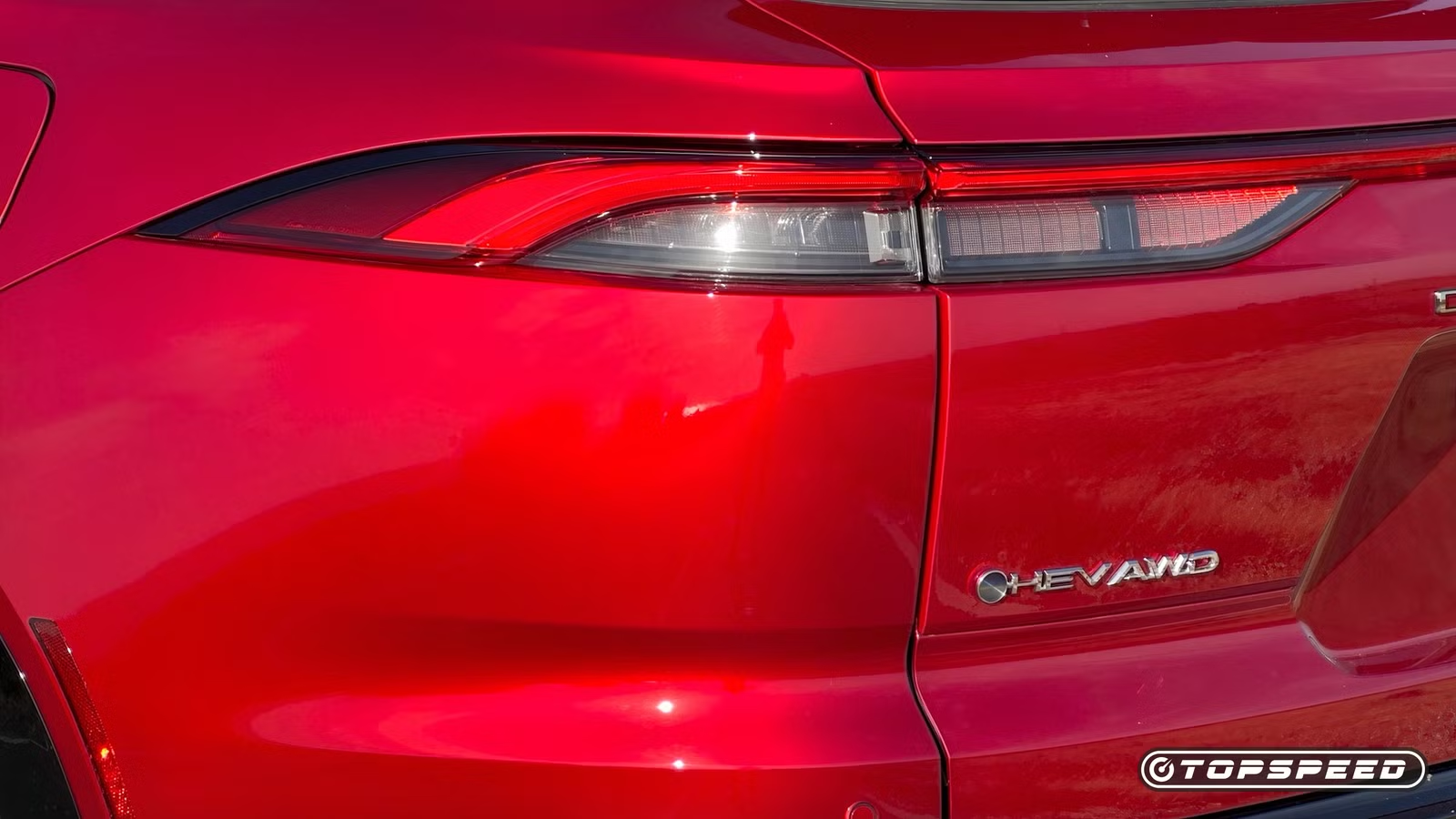
The compact SUV segment is a tough one. There are so many to choose from and now with everything going the premium route, there’s even more to choose from that are luxury or near luxury. Near-luxury, or luxury-lite as some have coined it, has put itself in a very interesting position. You can still get a standard car for standard pricing, but if you want, you can basically get a cheaper luxury car, which bars you from that segment almost altogether.

German automakers like BMW are making it almost too easy to do so too. While they are still considered to be the “ultimate driving machine,” in recent years, they’ve had a few design blunders. For starters, the oversized kidney grilles have turned some, if not most, off to their overall design language. Nobody wants a luxury car that looks like it has two beaver tails for grilles. They got rid of that (for the most part), but now they are faced with new challenges. This has left the door wide open for buyers to cross-shop some unlikely nameplates against the German automaker.
Toyota Efficiency vs. Bimmer Performance
Typically, you wouldn’t be cross-shopping a BMW and a Toyota. They’re just not in the same price or market. BMW offers high-performance adrenaline, while Toyota offers comfort, reliability, and fuel efficiency for half the cost. Toyota has prioritized efficiency so much that half of their products now come with a fully hybrid system.

They were easily able to interject this system into their products as the Prius had been testing it for decades. The Crown Signia is one of those models proving that you can get the best of everything. BMW, on the other hand, has some of the best performance engines on the market. Their straight six performance engines are incomparable. So much so that Toyota even borrowed one for the Toyota GR Supra.
How Toyota’s Hybrid Closes The Horsepower Gap To Within 15 HP Of BMW

The 2026 Toyota Crown Signia comes with a standard naturally aspirated 2.5-liter inline four-cylinder engine that is then paired with two electric motors. It has a combined output of 240 horsepower. This efficiency gives it 38 miles per gallon combined, with 37 MPG on the highway and 39 MPG in the city. The BMW, on the other hand, has 15 more horsepower with 255 horsepower to speak of and 295 pound-feet of torque from the base twin-scroll turbocharged 2.0-liter four-cylinder engine. It’s then tied to an eight-speed automatic transmission and comes standard with all-wheel drive.
One Second Separates These Two On Paper, But What About The Road?

It is quite interesting how close these are in power and straight-line performance, given that they occupy totally different market brackets and feature two completely different powertrains. According to Car and Driver, the Toyota Crown Signia gets to 60 MPH in seven seconds while the BMW gets up there in six flat. Again, those are some impressive performance numbers from the Crown Signia, which is essentially a mid-size crossover cruiser compared to the BMW X3’s sporty compact nature. Not to mention, the ZF-8 from BMW has rapid downshifts and can achieve peak torque at 1,600 RPM.
Why The Toyota’s Interior Looks More Premium Than The BMW’s

Here’s the thing about the Toyota Crown Signia: it actually ends up looking more stately than the new version of the BMW X3 from the interior. The BMW X3’s interior has been lauded as of late for its strange look into the modern era with dramatic lines, complete lack of buttons and cheap feeling/looking door paneling à la plastic door handles and lock buttons. The Toyota has a grander presence and feel thanks to the color choices, the bronze-colored chrome finishes, and ergonomic design overall.
The $1,500 Leather Upcharge BMW Doesn’t Tell You About

While Toyota includes the premium cabin interior materials outright, BMW makes you pay for the higher-end leather that ends up costing an extra $1,500 depending on which one you may choose. Toyota’s Crown Signia features standard leather-trimmed seats with a soft-touch dashboard. Some other acoustic luxuries include the noise-cancelling glass windshield and front-side sound-laminated glass.
Standard BMW materials include the Veganza leather with the Merino leather costing the extra cash. Not to disparage the BMW too much, but it does offer some of the best bolstering seats in its class with exceptional trim for the center console and dashboard.
BMW’s 14.9-Inch Infotainment Vs. Toyota’s Tactile Controls: Who Got It Right?
We are certainly in an era of screens galore, and it seems as though if you are a luxury carmaker, you must employ the use of at least 30 inches of screens or more to be considered luxury. Hyperbole aside, these actually don’t hit 30 inches of screen width, but the BMW X3 does come pretty close!
The Toyota Crown Signia comes with two 12.3-inch digital screens for the infotainment system and the gauge cluster. Thankfully, there are real tactile HVAC controls. The X3 features a 12.3-inch gauge cluster and a 14.9-inch infotainment touchscreen command center that are both included in a single panel that sweeps the dashboard. Included is their state-of-the-art iDrive OS. However, there are not many buttons to be had except on the center console.
Value And Ownership

Here’s where the real cost play comes into effect, as one has significant advantages over the other. That’s not just a one-second difference in 0 to 60 timing. Both technically come in only two trims. The biggest difference is that you have to build the BMW X3 with a multitude of packages to choose from, whereas the Toyota Crown Signia comes loaded with whatever features you need based on the two trims you can choose from.
Plus, the base model XLE comes with enough features as is and costs far less than the base model X3. We will get into the details in the next two paragraphs, but if you’ve read up on luxury cars, BMWs specifically, you know that the value proposition on luxury cars isn’t always as alluring as the cars themselves.
Too Much And Not Enough

Let’s talk about pricing. The Toyota Crown Signia, including destination, has a starting MSRP of $46,285. The top of the line Limited only comes in around $50,685. The BMW X3 starts more expensive with a starting sticker of $52,650 with the M50 xDrive shooting up to $67,850. By the time the standard X3 is all said and done with options and features, you’re looking at closer to the M50 xDrive’s price (give or take a few thousand) compared to the Crown Signia.
The Crown Signia comes standard with heated/ventilated front seats, heated outboard rear seats, a panoramic moonroof, and an 11-speaker JBL premium sound system. Heated rear seats and a panoramic moonroof are added-cost features in the X3.
BMW Loses Up to 54% Of Its Value In Five Years — Toyota Loses 39% At Most

Here’s the realest value proposition for the whole argument: the depreciation of it all. The fact is that luxury SUVs have a much steeper decline in their value within the first five years of being driven off the lot than any standard SUV. According to CarEdge, you’re looking at between 46 and 54 percent of a decline with the X3.
The Toyota Crown Signia is a vastly different story with it only depreciating between 29 and 39 percent within the first five years. That’s an incredible difference. This is why leases are more popular with BMW and German luxury cars in general, as opposed to owning them outright like most Toyota products, because they just end up causing the owner financial strain after the warranty ends.
Practicality And Driving Features

These two exist in different segments, different categories, and different driving classes altogether. The Toyota Crown Signia, for example, is a much softer, low-slung highway jewel. The BMW X3 is built for sharp turns and sports car agility. The BMW has a more rigid suspension and offers better towing capacity at almost double what the Crown Signia can tow. The X3 also has a higher roofline, giving it more vertical cargo space compared to the longer Crown Signia body.
Which One Is More Comfortable?

The Toyota Crown Signia has a comfort-focused suspension system that’s designed to eat the bumps in the road. It has a lower height profile that gives it lower highway drag and a more comfortable feel in general. The BMW X3’s suspension is more rigid and tuned for performance-oriented handling, which unfortunately has next to zero give when you go over a pothole in the road.
The Toyota Offers More Rear Legroom And 6 Extra Cubic Feet Of Cargo Space

Speaking more directly to the cargo capacity and overall space of the two, the Toyota Crown Signia offers 37.1 inches of rear legroom with 68.8 total cubic feet of storage. The BMW X3 offers 36.4 inches of rear legroom with 62.7 cubic feet of storage with the second row folded flat. While we again recognize that this is a strange cross-shop, we hope that you’ll see that these two vehicles are actually not that different from one another. The only major difference is in the corner carving capability as opposed to the straight-line highway comfort. It all comes down to what you need out of a daily driver — comfort and convenience or a track-capable sport utility vehicle.
Sources: Toyota, BMW, CarEdge

Related posts




Latest Post


No Comments