
The Adventure Motorcycle Riders Buy Instead Of Chasing More Power
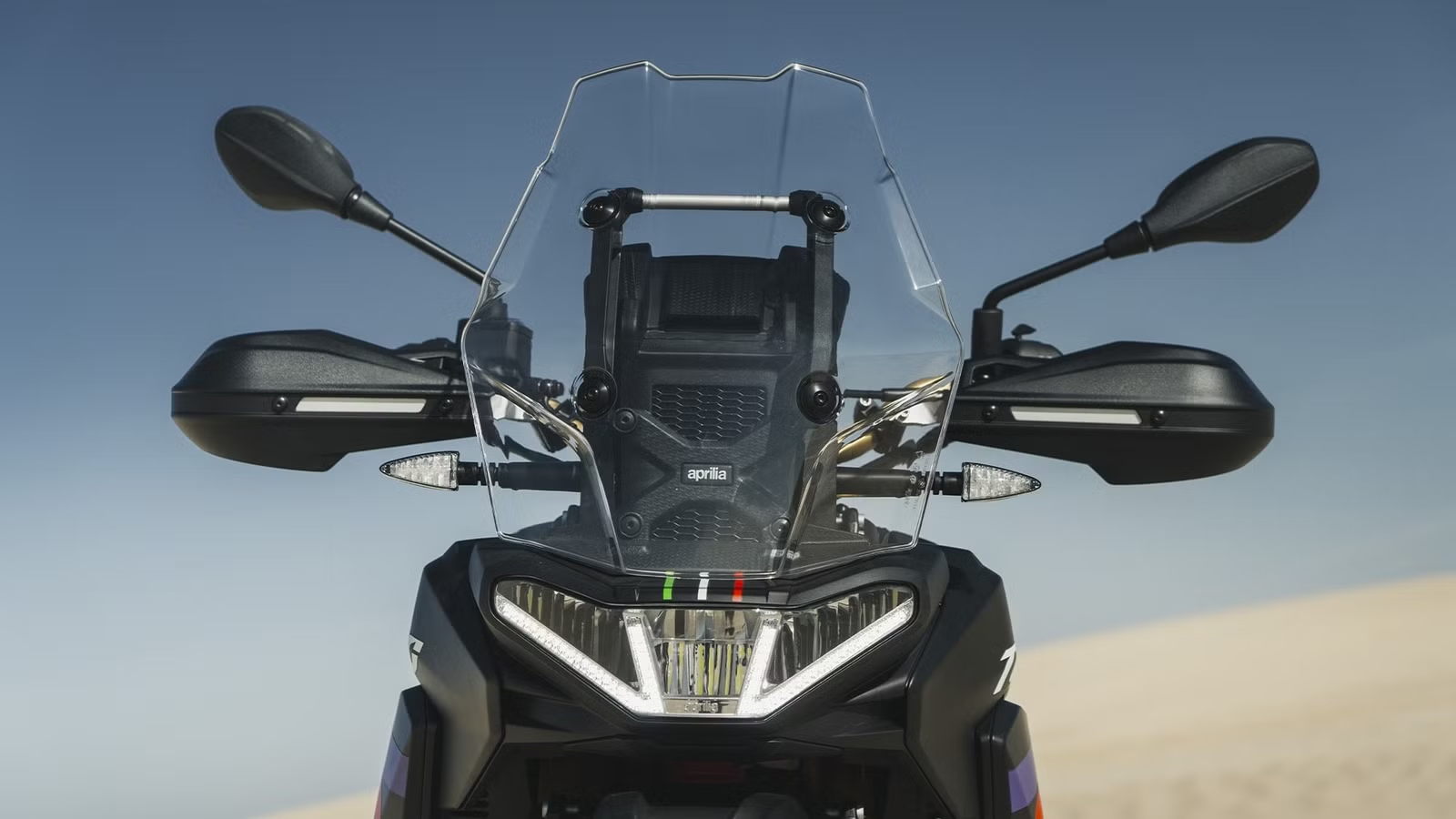
Adventure bikes are getting faster at roughly the same time that riders are becoming more skillful at extracting more from them off-road. That, however, does create an awkward mismatch. A 100-plus horsepower engine is useful for loaded touring and rapid highway work, but once the route turns rocky or sandy, the rider starts caring far more about how much weight is moving underneath them and how well the chassis deals with it.

That makes the smartest middleweight development path less obvious than simply increasing the displacement of a motorcycle. Better control can come from firmer suspension, lower mass, improved ergonomics, and an engine that delivers enough performance without overwhelming the rear tire. Aprilia has leaned heavily into that side of the solution, and the result makes a strong case for spending development effort outside a dyno chart.
Adventure Bikes Have Reached The Point Where Power Isn’t The Limiting Factor
Not all that long ago, an 80-horsepower motorcycle would’ve qualified as seriously quick. Today, it sits toward the lower end of the middleweight adventure category. The BMW F 900 GS and KTM 890 Adventure R both produce 105 horsepower, and they aren’t even remotely the largest adventure motorcycle that their respective manufacturers sell.

Additional displacement brings stronger roll-on acceleration, easier performance with luggage, and fewer downshifts while overtaking. But dirt places a different set of demands on an adventure bike. Controlling the motorcycle through sand, rocks, ruts, and repeated direction changes often depends less on how quickly the engine can add speed, and more on how easily the rider can manage what is already there.

Weight is an aspect that off-road conditions expose ruthlessly, and becomes particularly difficult to disguise. A low center of gravity helps, as do clever electronics, but every extra pound still has to change direction swiftly, cross an obstacle without becoming unstable, and occasionally be picked up off the ground as well. Suspension also has to control that mass without using so much damping or spring rate that the motorcycle skips across rough surfaces or becomes a mushy mess when back on the pavement.
And that, incidentally, creates an interesting opening around the 100-ish horsepower middleweight crowd. Instead of building another increasingly powerful ADV and engineering around the consequences, a manufacturer can start with enough performance and spend its development effort elsewhere. Aprilia has effectively done exactly that with its ADV, carrying lessons learned somewhere considerably harsher than an interstate.
The 2026 Aprilia Tuareg Rally Turns A Proven Middleweight Into A More Serious Dirt Bike

The 2026 Aprilia Tuareg Rally is the harder-edged development of the Tuareg 660 that returned the historic Tuareg name for the 2022 model year. More importantly, its development has genuine competition pedigree behind it. Aprilia and GCorse turned the production platform into a rally-raid racer that won the Africa Eco Race in 2024 and 2025, before feeding some of that experience back into the production Rally version. It isn’t a homologated race motorcycle wearing lights, but it’s Aprilia’s attempt to move the already capable Tuareg closer to that competition spec without wrecking its usefulness as an adventure bike.
Its 659cc Twin Makes Enough Power For The Job

The Tuareg’s 659cc parallel-twin produces 80 horsepower at 9,250 rpm and 51 pound-feet of torque at 6,500 rpm, sending drive to the rear wheel via a six-speed gearbox. For 2025, the Tuareg family received 52mm throttle bodies, revised mapping, intake changes, and a lower-inertia generator, changes that carried into the current Rally trim.
The combination gives the engine a particularly useful role here. It still revs enthusiastically, but adventure-specific tuning separates it from the same basic 660 design used in Aprilia’s sportier road motorcycles. There’s enough performance for fast road use without giving the rear tire an absurd amount of power to manage on loose ground, as with the F 900 GS, for instance. An Aprilia Quick Shift system is optional, while an assist-and-slipper clutch remains standard.

Aprilia Performance Ride Control (APRC) also brings more electronic flexibility with four riding modes that work alongside adjustable traction control, engine braking, engine maps, and switchable ABS, while cruise control is standard. Rear ABS can be disabled for dirt, or ABS can be switched off entirely if the rider so wishes. The result is an 80-horsepower motorcycle that gives the rider considerable control over how those horses tread the ground.
The Rally-Spec Changes What The Standard Tuareg Does With Its Chassis

Both versions use fully adjustable 43mm Kayaba suspension with 9.4 inches of wheel travel at the front and rear, so Aprilia hasn’t chased a longer suspension for the Rally either. But important changes have happened inside the tubes. Linear-rate springs replace the standard motorcycle’s progressive setup, accompanied by off-road-specific calibration that reduces static sag and keeps the bike riding higher in its stroke.

That makes more of the existing suspension travel usable when the terrain gets rough. The Rally, in fact, resists bottoming well over larger hits while improving its behavior over off-road terrain, addressing an area where the standard Tuareg is less composed than some competitors. But there is still a tradeoff. Its 35.9-inch seat is two inches taller than the standard bike’s, partly because of the Rally seat itself and partly because of how the firmer suspension settles less beneath the rider. Taller, straighter handlebars improve the standing position, while a high front fender, reinforced skid plate, tougher chain guide, and aluminum-reinforced handguards make the Tuareg Rally’s intent fairly difficult to misread.
At 439 Pounds, The Tuareg Rally Makes Light Weight Its Performance Upgrade

The most persuasive number on the Tuareg Rally’s specification sheet is its 438.7 pounds wet weight. That’s roughly 10 pounds lighter than the standard Tuareg despite the extra protection and more purposeful off-road equipment. Aprilia gets there through an SC-Project titanium muffler and lighter heavy-duty spoked wheels. Those wheels also become narrower and use inner tubes, trading some road convenience for a setup better suited to aggressive off-road riding and tire choices.
Reducing mass rather than adding engine output pays dividends almost everywhere that the Rally is meant to go. There’s less motorcycle to arrest when the front wheel deflects, less inertia to manage through quick direction changes, and less weight working against the suspension over repeated impacts. And there are no unwanted sacrifices: the 4.8-gallon tank remains, as does the TFT display, passenger capability, and road manners inherited from the regular Tuareg.
The Tuareg Rally Costs Less Than More Powerful Competitors

At $13,999, the 2026 Tuareg Rally costs $1,500 more than the standard Tuareg 660. The premium buys relatively little if most of your riding happens on pavement. The regular bike has the same power output, as well as the same suspension travel, electronics package, and basic chassis, with a lower seat and tubeless wheels, which arguably make greater sense for road-biased usage.
That makes the more interesting comparison with KTM’s two very different solutions to the same problem. The 2027 690 Rally is the harder-core option, with a 692.7cc single producing 78 horsepower, 10.4 inches of front suspension travel, 9.8 inches at the rear, and a 5.3-gallon fuel capacity. At 356 pounds without fuel, it is considerably lighter than the Aprilia as well, and far closer to a rally machine in execution.

In exchange, however, it also gives up the smoother road manners, passenger practicality, and long-distance refinement of a twin. Move the other way and the $16,299 2026 890 Adventure R brings 105 horsepower, the same 5.3-gallon capacity, and 9.4 inches of suspension travel, but weighs 474 pounds fully fueled.

The Tuareg Rally lands neatly between them by being more road-friendly than the 690 Rally, lighter and less powerful than the 890 Adventure R, and focused on making its 80 horsepower easier to exploit. For an adventure rider who spends enough time off-road to notice every one of those pounds, that is a much more useful specification to chase.
Source: Aprilia

Related posts

Latest Post


No Comments