
The Revived Toyota Nameplate That Undercuts A Model Y And Out-Accelerates A GTI
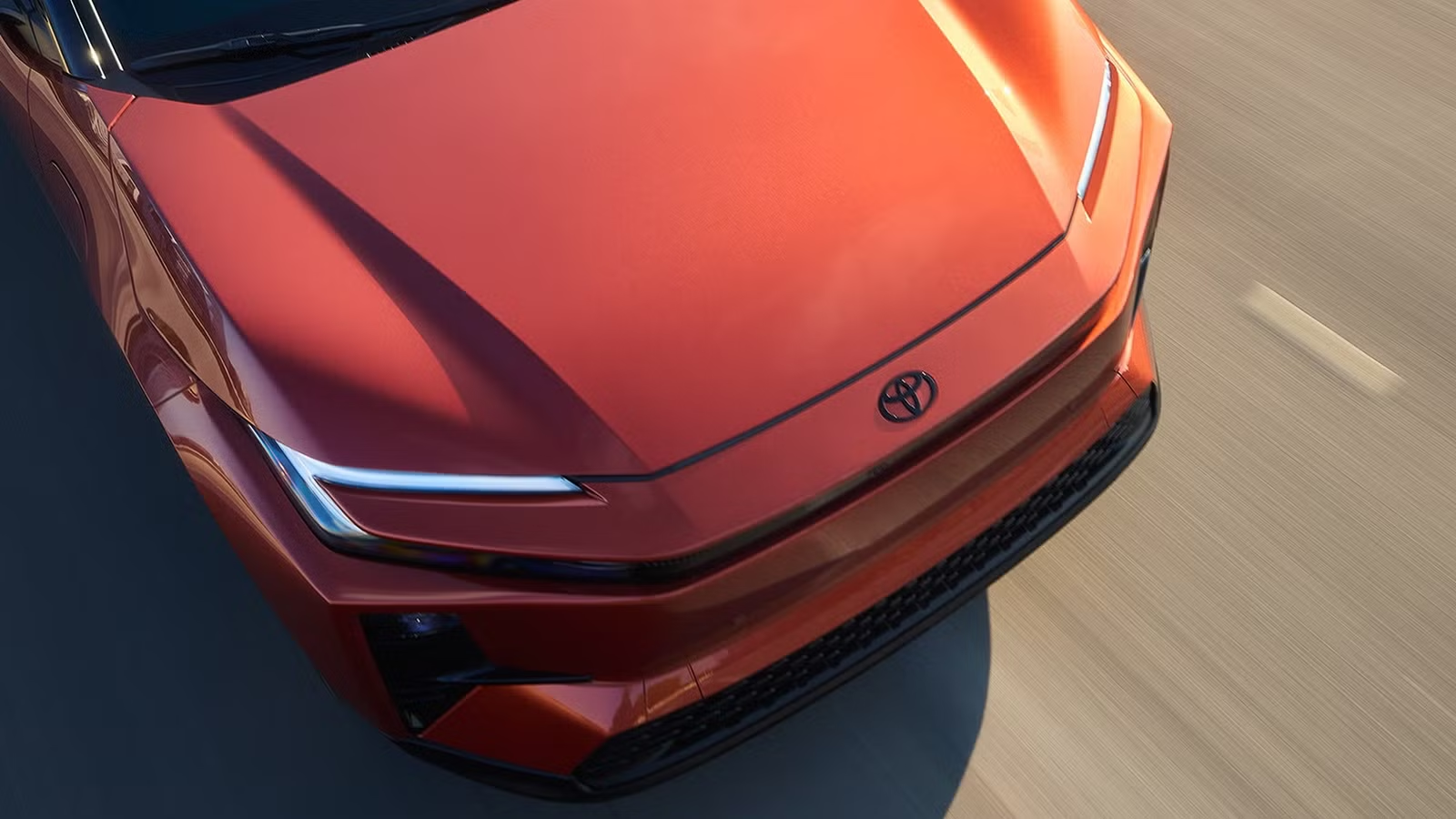
For the last decade, automotive internet culture has been making digital renders and reimagining long-gone, forgotten nameplates into aggressive, fast, eclectic vehicles. The artists turn these classic names into fantasy concepts with modern elements: LED light bars, wider stances, multi-motor powertrains, and a choice of weapon instead of a regular gas guzzler. These renders have dominated social media for a while, yet no mainstream automaker has paid them much attention. Instead, we get soft family haulers built purely for efficiency numbers. But in 2026, Toyota broke that mold and delivered a compact car that was once nothing but a subcompact crossover. Now electrified and turned into a fast, aggressive, sub-5-second, production-ready machine.
The Digital Art Muscle Fantasy

Scroll through Instagram, YouTube, or any social media, and sooner or later you’ll likely encounter the work of digital render artists. These creators take dead and forgotten nameplates like the Pontiac Firebird, Buick GNX, or the Chevelle SS, or any other underpowered gas-powered car, and reimagine them into high-performance electric machines.
The formula is simple yet effective: take a recognizable nameplate, increase the visual drama to match today’s aggressive cars, and add loads of power that would put muscle cars of yesteryear to shame. It works perfectly to spark interest, start a debate, and create a what-if scenario, all while tapping into nostalgia for cars from a bygone era. Yet however viral these digital art concepts become, nothing solid comes of them. Legacy manufacturers looked the other way, and instead of resurrecting badges from the past as performance monsters, they turned those badges into soft-riding electric family crossovers.
Why Mainstream EVs Kept Missing The Mark


The issue with mainstream EVs isn’t a lack of performance or straight-line speed; it is a complete lack of character in how they deliver power. As EVs started to penetrate the mainstream market, their key selling point was instantaneous torque off the line and the feel of endless power, but over time, what made them different from a traditional gas-powered car became the very reason EVs were labeled soulless appliances.
Coupled with sterile exterior and interior styling, soft looks, and a soft ride, these vehicles offer no true mechanical feel to grab a performance enthusiast’s attention. Even when manufacturers use a classic heritage badge, the resulting car doesn’t match the performance, dynamics, or feel. Legacy nameplates are being used as marketing leverage rather than badges of real dynamic intent.
Through digital renders, artists have filled the vacuum created among enthusiasts, and community engagement also shows that car enthusiasts don’t want a boring, sterile commuter; they want a compact, wide-stanced machine that can be aggressive, dynamic, and fast. And finally, Toyota brought back a badge that is not only affordable but also fast, in a hot-hatch package.
2026 Toyota C-HR EV: The First Render That Came To Life

Toyota flipped the script with the release of its 2026 C-HR EV. In a move that felt straight out of social-media renders, Toyota took a badge that was once a slow crossover powered by a modest 144-horsepower gas engine with a CVT transmission, and revived it with aggressive modern styling on a dedicated e-TNGA platform. The 2026 C-HR EV wasn’t just a concept or speculative mock-up; it was a confirmed production vehicle for the United States.
The mechanical transformation from its predecessor was staggering. The 2026 C-HR EV was available in the United States exclusively with a standard dual-motor all-wheel-drive powertrain that delivered a massive 338 combined horsepower. The front motor generated 224 hp and 198 lb-ft of torque, while the rear motor produced 117 hp and 125 lb-ft, pushing the C-HR out of its sluggish commuter past and into aggressive electric hot-hatch territory.

When put to the test, the real-world performance surpasses both its predecessor and Toyota’s own conservative estimates. While Toyota officially quoted a 4.9-second 0–60 mph sprint, instrumented testing by Car and Driver clocked the C-HR EV at a quick 4.4 seconds, and it ran the quarter-mile in 13.0 seconds at 106 mph. It delivers the instant electric punch internet renders have promised for a decade.
Crucially, Toyota achieved this performance reset without breaking the bank for the everyday enthusiast, with a starting MSRP of $37,000 for the SE trim and $39,000 for the upgraded XSE trim — $38,595 and $40,595 including destination and handling. By offering sub-4.5-second, 338-hp performance under $40,000 on a dedicated EV architecture, the C-HR EV effectively undercuts nearly every fantasy EV muscle car floating around the digital space.
Sub-$40k Performance Meets Real-World Practicality

To understand why the C-HR EV succeeds as a real-world enthusiast vehicle, we must look beyond the raw acceleration numbers and see how Toyota tackled the practical realities of daily driving. First, it maintains functional utility with 25.3 cubic feet of cargo space behind the second row. Second is its charging infrastructure. The 2026 C-HR EV comes standard with a North American Charging Standard (NACS) port.
This gives owners native access to the Tesla Supercharger network without clunky adapters. With a 74.7 kWh total lithium-ion battery capacity, around 67 kWh usable, its 150 kW peak DC fast-charging setup lets the battery charge up from 10% to 80% in roughly 30 to 32 minutes under optimal conditions. An 11.0-kW onboard AC charger can handle home charging requirements in about 7.5 hours.
However, transparency is key to winning over the enthusiast crowd. The primary trade-off is, and always has been, an EV’s real-world highway range. While official EPA estimates land at 287 miles for the SE trim and 273 miles for the XSE trim, Car and Driver’s real-world 75-mph highway testing yielded 230 miles on a full charge for the XSE grade. Additionally, while straight-line acceleration is explosive, the chassis tuning ultimately prioritizes everyday ride comfort over razor-sharp cornering. It remains a fair, realistic trade-off for a sub-$40,000, 338-hp AWD compact machine that delivers genuine performance thrills in daily driving.
What Manufacturers Can Learn From Toyota’s EV Pivot

What Toyota accomplished with the 2026 C-HR EV is proof that car lovers and the digital render community have been right all along. Those forgotten badges could be revived with a modern, aggressive electric avatar even on a budget. Toyota took a badge that previously meant nothing to driving enthusiasts and turned it into a car that could be the next big deal for the community. With the 2026 C-HR EV going on sale, it renewed hope that other brands could make a comeback with their iconic nameplates, too. Toyota proved that internet fantasy can exist on a factory floor. Now it’s time for the rest of the industry to react and build them for the street.
Source: Toyota, Car and Driver.

Related posts



Latest Post


No Comments