
Harley-Davidson Road Glide vs. Street Glide: An In-Depth Comparison
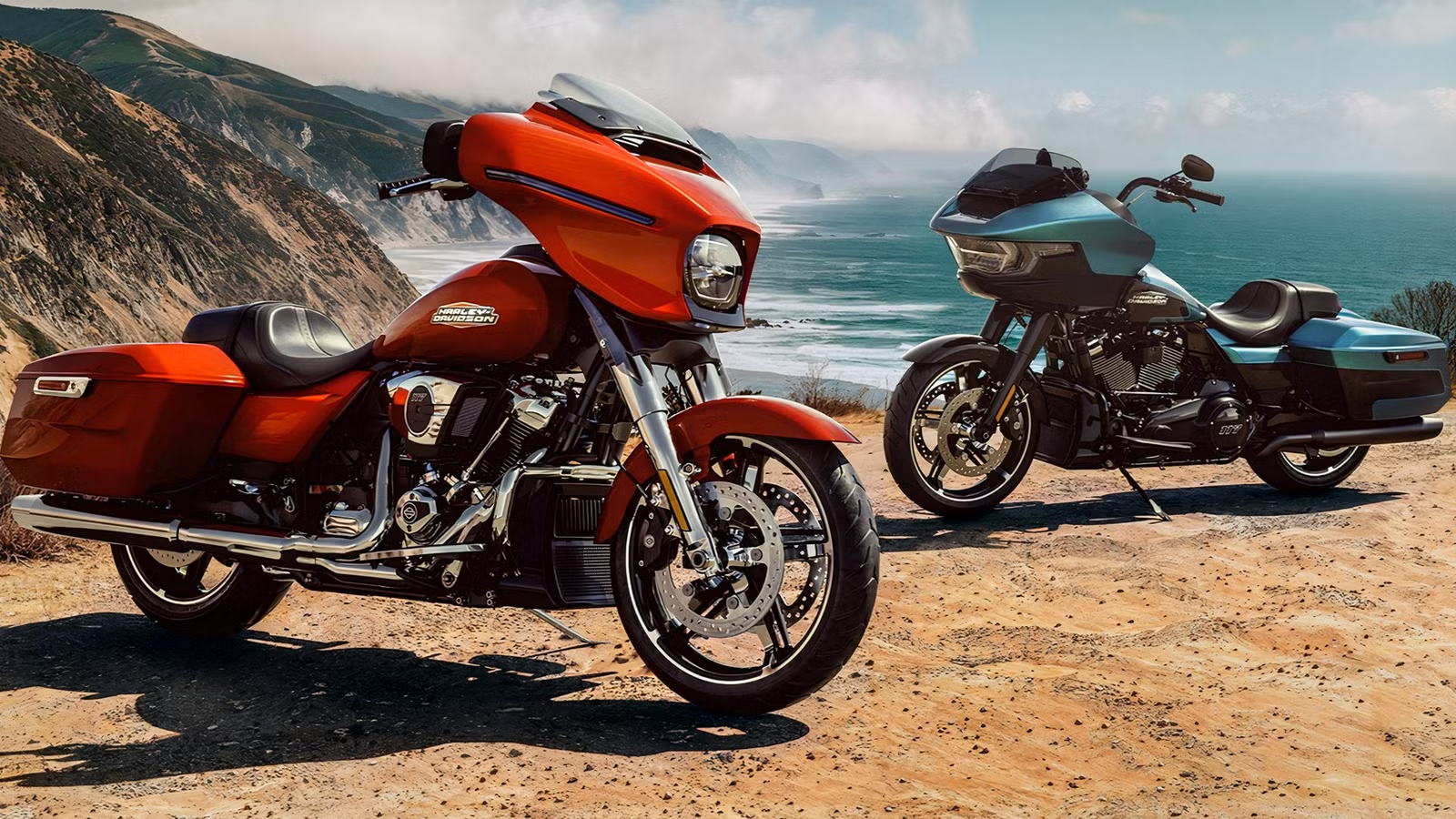
The Road Glide vs. Street Glide debate has followed Harley-Davidson’s baggers for years, and the 2026 models make the choice tougher than ever. The Harley Road Glide and Harley Street Glide are powered by the same engine, ride on closely related chassis hardware, carry the same amount of fuel and luggage, and have very similar base MSRPs. Dig deeper, though, and one fundamental difference changes how these two heavyweight tourers behave from behind the bars.
The Road Glide And Street Glide Share More Than You Think

Harley-Davidson categorizes both bikes as Grand American Touring models, and their shared foundation makes this obvious. Each uses the 1,923cc Milwaukee-Eight 117 V-twin, with liquid-cooled cylinder heads and variable valve timing, producing 105 horsepower at 4,600 rpm and 130 pound-feet of torque at 3,250 rpm. Both send that output through a six-speed transmission and belt final drive, while a six-gallon fuel tank and claimed 44 mpg give them the same theoretical range.
Performance Is Essentially Identical

Neither Glide has an engine advantage, and the similarities continue into the chassis. Both use a 49mm dual-bending-valve fork and dual emulsion rear shocks with adjustable preload. Braking comes from four-piston calipers gripping dual 320mm front rotors, backed by a single 300mm rear rotor. Each rolls on a 19-inch front and 18-inch rear wheel, with a 130/60B19 front tire and 180/55B18 rear, while both have a 64-inch wheelbase and 32 degrees of lean angle on either side.
|
2026 Street Glide |
 54 autotech 2026 Road Glide |
|
|
Engine |
1,923cc Milwaukee-Eight 117 V-twin, liquid-cooled cylinder heads, VVT; 105 horsepower @ 4,600 rpm; 130 pound-feet @ 3,250 rpm |
1,923cc Milwaukee-Eight 117 V-twin, liquid-cooled cylinder heads, VVT; 105 horsepower @ 4,600 rpm; 130 pound-feet @ 3,250 rpm |
|
Transmission |
Six-speed manual; belt final drive |
Six-speed manual; belt final drive |
|
Suspension |
49mm dual-bending-valve fork; dual emulsion rear shocks with adjustable preload |
49mm dual-bending-valve fork; dual emulsion rear shocks with adjustable preload |
|
Wheels and Tires |
19-inch front, 18-inch rear; 130/60B19 front, 180/55B18 rear |
19-inch front, 18-inch rear; 130/60B19 front, 180/55B18 rear |
|
Wet Weight |
811 pounds |
838 pounds |
Their Touring Equipment Is Closely Matched, Too

The electronics don’t create much daylight either. Both have a 12.3-inch TFT running Harley’s Skyline OS, along with Bluetooth connectivity, navigation capability, and multiple selectable ride modes. Cornering ABS, traction control, linked braking, drag-torque slip control, hill-hold control, and tire-pressure monitoring round out the rider aids. Each also offers 2.42 cubic feet of luggage capacity, so neither bike gains a practical advantage when it’s time to pack for a long trip.
With so much hardware shared between them, Street Glide vs. Road Glide isn’t the usual comparison where one motorcycle wins on horsepower while the other counters with equipment or practicality. Even their base MSRPs are identical. Instead, the biggest distinction sits right in front of the rider, and it affects considerably more than what either Harley looks like parked outside a diner.
The Fairings Make These Two Very Different Glides

The Harley Street Glide uses the brand’s signature Batwing fairing, which is mounted to the fork and turns with the handlebars. The Harley Road Glide takes the opposite approach with its Sharknose fairing fixed directly to the frame, leaving the handlebars to move independently behind it. It’s an immediately obvious visual difference, but mounting a large piece of aerodynamic bodywork to two different parts of the motorcycle also changes how external forces make their way into the chassis and steering.
Batwing Vs. Sharknose Is More Than A Styling Choice

Because the Street Glide carries its fairing on the steering assembly, the rider turns that structure along with the bars. The Road Glide’s arrangement removes its larger front fairing from the steering assembly, so wind acting against the Sharknose isn’t transmitted through the bars in quite the same manner. That distinction becomes more relevant as speed rises, particularly during long highway stints where aerodynamic forces, crosswinds and turbulence have more opportunity to influence a large touring motorcycle.
Weight, Handling, And Comfort Reveal The Trade-Off

The Street Glide fights back with less mass. It weighs 811 pounds in running order against the Road Glide’s 838 pounds, a 27-pound advantage that matters when you’re maneuvering either bike around a parking lot, making tight low-speed turns or pushing it around the garage. The Street Glide also has a 26.4-inch seat height and 5.5 inches of ground clearance, while the Road Glide measures 26.6 inches and 5.7 inches, respectively.
Once speeds rise, the Road Glide’s extra weight becomes less important, and its frame-mounted design starts making more sense. Its Sharknose places the windscreen and bodywork farther forward while keeping the fairing stationary through steering inputs, creating a different relationship between the rider, wind, and front end. The Street Glide’s Batwing sits closer and moves with the rider’s steering. Neither layout is universally better, but the Road Glide’s architecture is particularly compelling for riders spending hours at highway speeds.
Price And Features Won’t Make The Decision Any Easier

You might expect Harley-Davidson to settle the argument by positioning one clearly above the other, but it doesn’t. The 2026 Street Glide starts at $24,999, and the Road Glide starts just $1,000 more at $25,999 before optional paint and accessories. That makes this an unusually clean comparison because choosing the Sharknose doesn’t require stepping up to a substantially more expensive model, while choosing the Batwing doesn’t mean accepting a cheaper or less comprehensively equipped touring motorcycle.
There are, of course, ways to spend considerably more money on either formula. Harley’s lineup extends into higher-spec touring models, including its premium CVO offerings, which bring larger-displacement engines, upgraded components, more elaborate finishes, and additional equipment. Those bikes occupy a different tier in both performance and price, though. Between the standard Road Glide and Street Glide we’re comparing here, neither serves as the premium alternative to the other.
Neither Bike Has A Clear Equipment Advantage

The very close base MSRPs reinforce what the specifications have already shown. You’re getting the same engine output, core suspension hardware, brakes, infotainment platform, electronic rider aids, fuel capacity, and luggage volume whichever direction you go. Harley’s enormous accessory catalog can transform either motorcycle afterward, but in standard form, there’s no equipment package that automatically makes one the smarter purchase. You’re choosing between two executions of the same touring platform.

That leaves us with something unusual in a motorcycle comparison. We’ve removed power, technology, luggage capacity, fuel economy and base price as meaningful deciding factors. What remains isn’t a tiny specification buried halfway down a data sheet. It’s the most obvious visual difference between the two bikes, and understanding what it does makes choosing between them much easier.
|
2026 Street Glide |
2026 Road Glide |
|
|
Frame |
Steel touring frame; fork-mounted Batwing fairing |
Steel touring frame; frame-mounted Sharknose fairing |
|
Electronic Features |
12.3-inch full-color TFT, Skyline OS, selectable ride modes, Apple CarPlay, Bluetooth, ABS, cornering ABS, linked braking, cornering linked braking, traction control, cornering traction control, drag-torque slip control, cornering drag-torque slip control, hill-hold control, tire-pressure monitoring, LED lighting |
12.3-inch full-color TFT, Skyline OS, selectable ride modes, Apple CarPlay, Bluetooth, ABS, cornering ABS, linked braking, cornering linked braking, traction control, cornering traction control, drag-torque slip control, cornering drag-torque slip control, hill-hold control, tire-pressure monitoring, LED lighting |
|
Colors |
Vivid Black; Dark Billiard Gray; Blood Orange; Purple Abyss; Aurora Blue Denim; Olive Steel/Vivid Black; Teal Thunder/Vivid Black; Midnight Ember on Liberty Edition |
Vivid Black; Dark Billiard Gray; Blood Orange; Purple Abyss; Aurora Blue Denim; Olive Steel/Vivid Black; Teal Thunder/Vivid Black; Midnight Ember on Liberty Edition |
|
Base MSRP |
$24,999 |
$25,999 |
Road Glide Vs. Street Glide: Which One Should You Buy?
The Road Glide vs. Street Glide decision ultimately depends on where and how you expect to use an 800-plus-pound Harley. The Street Glide makes the stronger case for riders who want Harley’s classic Batwing experience and appreciate having 27 fewer pounds to manage. Its lower running weight is most valuable at walking speeds, while the fork-mounted fairing delivers the cockpit layout that’s defined generations of Harley baggers.
Choose The Road Glide If Highway Miles Come First

The Road Glide becomes especially persuasive when long-distance highway riding dominates the agenda. Its frame-mounted Sharknose keeps the fairing separate from the steering assembly and provides the distinct cockpit and aerodynamic layout that has made the model a favorite among high-mileage bagger riders. You pay for that arrangement with an additional 27 pounds, but not with additional MSRP, less luggage space, reduced engine performance or a weaker equipment package.
Choose The Street Glide If You Want The Lighter, Traditional Formula

The Street Glide remains the more traditional interpretation and the lighter of the two. Ultimately, that’s why there isn’t an objective winner in the Street Glide vs. Road Glide comparison. Harley has effectively built two versions of the same Grand American Touring motorcycle around different fairing philosophies. If low-speed manageability and the Batwing layout matter more, take the Street Glide. If a frame-mounted fairing and highway-focused setup carry more weight in your decision, the Road Glide is the logical choice.
Source: Harley-Davidson

Related posts



Latest Post


No Comments