
The Discontinued Toyota Hybrids With The Cheapest Battery Replacements In 2026
Used hybrid cars represent a smart financial investment due to their proven long-term mechanical durability and immediate fuel savings. Proven hybrid powertrains routinely surpass 150,000 to 200,000 miles, allowing drivers to offset high pump prices while enjoying lower overall maintenance costs compared to purely gas-powered vehicles.

However, prospective owners must account for eventual high-voltage battery degradation. Franchised dealership replacements often range from $3,000 to $8,000, creating severe sticker shock on older models. Factoring battery health into pre-purchase inspections remains critical.
Toyota Pioneered Mass-Market Hybrid Technology Across Three Decades
Toyota has shaped the modern automotive landscape by introducing mass-production hybrid powertrains to the mass market. The original Prius launched in Japan in 1997 and reached global showrooms by 2000. This introduction established the foundation for the brand’s Hybrid Synergy Drive. Over thirty years, Toyota has refined its planetary gear transmissions and combustion engines to integrate with electric motors.

Drivers across the U.S. rely on Toyota’s hybrid technology for daily commutes to decrease total fuel consumption. Early iterations of the brand’s hybrids have proven reliable, thanks to a long track record that has developed consumer confidence and transformed hybrid powertrains from a niche tech experiment into a default choice for budget-conscious drivers.
Toyota’s Hybrid Outlook Beyond 2026

Toyota retains its dedication to hybrid technologies in 2026, with its systems being available across most of its catalog. The brand has optimized high-volume manufacturing for Nickel-Metal Hydride battery technology, which has proven dependable, often outlasting initial warranties by two to three times. Toyota engineers optimize thermal management, state-of-charge algorithms, and physical cell layouts to minimize degradation under severe daily driving conditions.
The brand’s decision to standardize module sizes and electrical layouts across multiple vehicle platforms creates a massive economy of scale. That footprint lays the groundwork for today’s thriving third-party support ecosystem. Today, Toyota builds millions of hybrid units, establishing a standardized hardware foundation that continues to support budget-minded drivers long after factory warranties expire.
The Discontinued Prius C And Prius V Represent Sleeper Used-Car Bargains

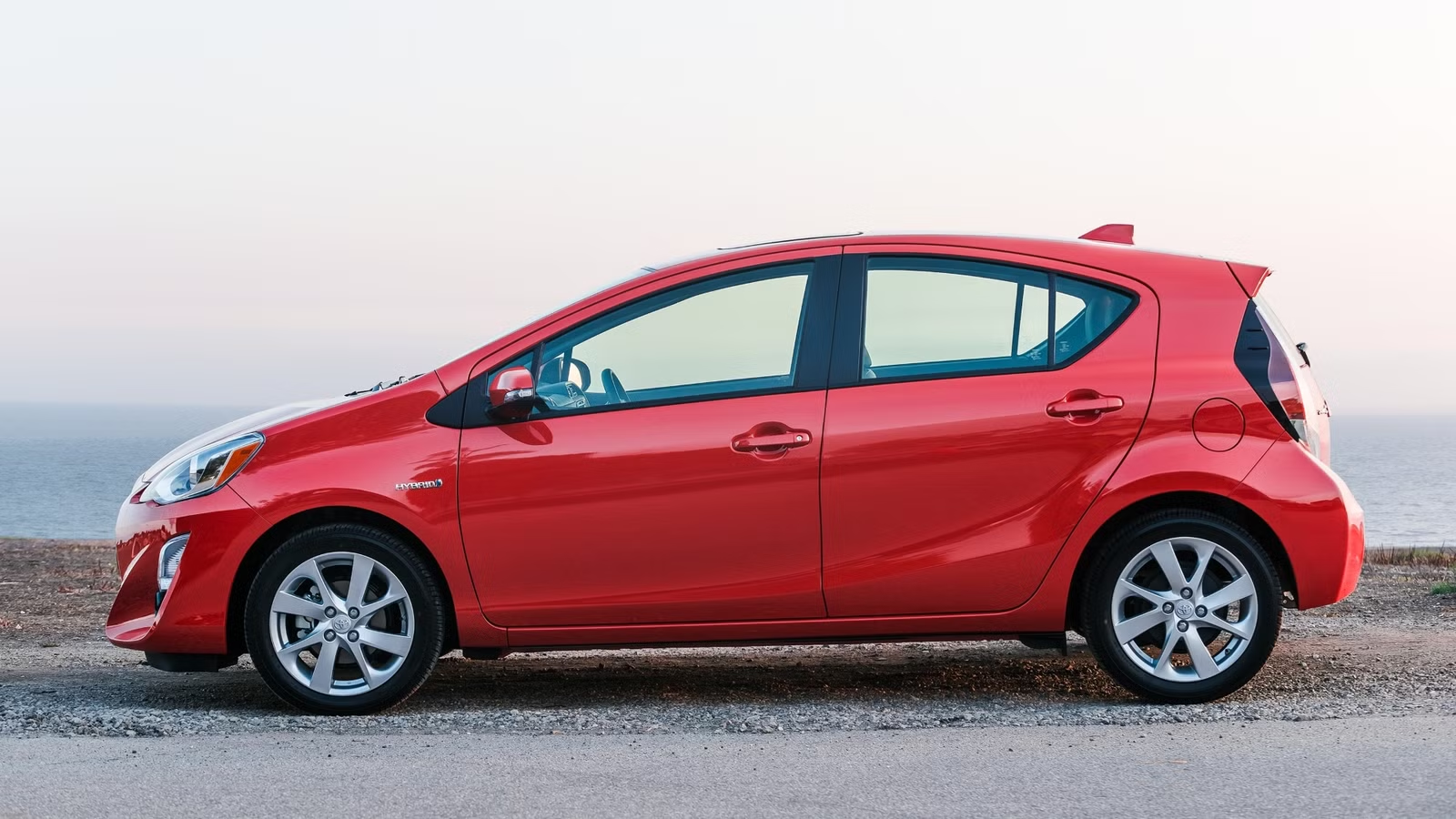
The Prius C subcompact and the larger Prius V wagon filled unique niches in the hybrid market before Toyota ceased their production. Toyota built the Prius C for tight urban spaces, squeezing good city fuel economy into a maneuverable footprint. Meanwhile, the Prius V wagon offered crossover-rivaling cargo capacity without forcing drivers to give up 40-plus MPG efficiency. Despite their utility, Toyota phased out both models to make room for modern crossover options like the 2026 Toyota RAV4 and Corolla Hybrid. That exit leaves used-car shoppers with a prime opportunity. Both models share bulletproof mechanical underpinnings while trading at a distinct discount compared to the standard Prius hatchback.

Those shopping in the used car market often come across high-mileage Prius C and Prius V models selling for low prices. This occurs because they typically approach or exceed 150,000 miles. Less informed buyers pass on these cars out of fear that an impending hybrid battery replacement will instantly double the money they’ve spent.
Smart enthusiasts know that these specific discontinued models harbor a secret advantage over newer, more complex hybrids. Their basic electrical design makes them easy to repair. Finding a clean body and a healthy engine on a bargain-priced Prius C or V provides the ideal foundation for an affordable, long-distance commuter that benefits from a low fueling cost.
Massive Price Discrepancies Separate Dealership Quotes From Specialist Options

If you own an older Prius C or V model, you can still take it to a traditional dealership service center for a hybrid battery pack service or replacement. Franchise service advisors routinely quote replacement costs between $4,000 and $7,000, according to data from specialized repair facilities like Ryan’s Automotive. Dealerships maintain steep labor rates and insist on installing new OEM assemblies, which increases the cost to a point that’s higher than the vehicle’s market value. This expensive repair cost leads many owners to believe their car is not financially worth fixing, prompting them to trade in for a clean vehicle at a heavily reduced price.
Independent hybrid specialists disrupt this dealership pricing model by offering targeted replacement solutions that bypass traditional OEM markups. Specialty shops supply fully remanufactured battery packs or brand-new aftermarket cell assemblies for a tiny fraction of the dealer price. According to industry pricing compiled by Green Tec Auto and Prius Kings, full battery installations for these models regularly land between $999 and $2,495. Independent mechanics replace only the necessary hardware while leveraging mobile installation networks, effectively eliminating the artificially inflated service bills that dealerships use to push customers into buying new cars.
Standardized Pack Architectures Keep Aftermarket Supply Chains Extremely Cheap

The secret behind the low repair costs for these discontinued models lies in platform stability and simple design. Toyota manufactured the Prius V using the exact same Nickel-Metal Hydride battery pack architecture across its entire 2012 through 2017 U.S. production run. Because Toyota refrained from altering the physical dimensions, bus bars, or module counts during that six-year window, aftermarket suppliers built stable manufacturing lines around one standardized platform. A replacement unit for a first-year Prius V fits a final-year model without requiring custom wiring harnesses or costly retrofits, keeping manufacturing overhead low and inventory plentiful across the country.
The subcompact Prius C benefits from an equally advantageous supply chain due to its lightweight, low-module configuration. Because the smaller Prius C uses fewer overall internal battery modules to power its compact electric motor, full-pack rebuilds require less raw material and minimal labor hours. Specialist data indicates that independent shops install Prius C replacement packs for anywhere between $1,250 and $2,250, depending on whether the customer selects remanufactured cells or upgraded high-capacity units. This tight standardization ensures that third-party builders easily refurbish or produce packs at scale. This helps keep owner costs in the low $2,000 range.
Extended Warranties Debunk Third-Party Quality Myths and Provide Long-Term Peace

Skeptical car buyers often assume that aftermarket hybrid batteries represent a risky gamble compared to OEM units from a franchised dealer. However, modern independent refurbishers and aftermarket manufacturers eliminate this fear by offering trusted warranty coverage for their products. Budget-friendly remanufactured options usually include standard 12-month or 24-month guarantees, while premium new-cell assemblies regularly feature 48-month or transferable lifetime coverage. These comprehensive guarantees demonstrate that third-party vendors hold complete confidence in their reconditioned Nickel-Metal Hydride modules and upgraded cylindrical cell tech.
The secondary hybrid ecosystem draws strength from a long-standing recycling infrastructure that Toyota accidentally helped create decades ago. Back in 2016, the Japanese brand established a generous core credit system that paid owners and shops around $1,350 for returning depleted hybrid batteries. That financial incentive prevented old packs from rotting in scrapyards and directed millions of original core units directly into specialized recycling channels. Today, independent refurbishers use that vast reservoir of original battery cases, bus bars, and wiring looms to build affordable high-quality units. This recycling flywheel keeps raw material costs down, allowing aftermarket suppliers to pass noteworthy savings down to pre-owned vehicle owners.
Real-World Service Life Proves These Batteries Easily Outlast Misleading Myths

Real-world fleet data and service records from thousands of working taxicabs, rideshare vehicles, and commuter cars prove Toyota’s hybrids last on a single battery, well beyond the warranty coverage. A well-maintained Toyota Nickel-Metal Hydride pack routinely delivers reliable daily operation up to 150,000 to 200,000 miles before showing significant capacity loss. Many original packs push far past 250,000 miles on their factory cells when driven in moderate climates.
When a battery pack eventually degrades, heat serves as the primary culprit rather than simple age or mileage. High ambient temperatures accelerate internal chemical breakdown within individual battery cells, leading to uneven resistance across the pack. The utility-focused Prius V wagon suffers from this issue more frequently because cargo, pet hair, or luggage often blocks the rear cooling fan intake vent located near the back seats. Simple preventative maintenance, such as regularly cleaning the battery cooling fan and keeping the air intake free of obstruction, prevents heat buildup and adds years of operational life to both original and replacement hybrid packs.
The Strategic Advantage Of Buying Discontinued Older Tech Over Modern Hybrid Platforms

Choosing an older, discontinued hybrid model over a modern, high-tech equivalent offers a clear financial advantage for budget-focused drivers. Newer hybrids often rely on complex lithium-ion battery setups or integrated multi-module electronics that lack an established, low-cost independent supply chain. When a modern lithium-based pack falls out of warranty, owners face limited replacement options and steep dealer-only prices. In contrast, the discontinued Prius C and Prius V’s Nickel-Metal Hydride packs benefit from proven reliability. Most qualified independent hybrid specialists can also efficiently service the component at an affordable rate.
Bypassing the dealership and taking advantage of a comprehensive aftermarket supply chain means that used-car buyers benefit from the Prius C and Prius V’s low-cost. Purchasing a clean, high-mileage chassis with a worn battery allows buyers to negotiate a low purchase price. Installing a refreshed $1,200 to $2,000 specialist pack restores full fuel efficiency and yields a reliable commuter car for a tiny fraction of the price of a new vehicle. The discontinued status of these spacious wagons and nimble hatchbacks creates an ideal opportunity for drivers who prefer outsmarting dealership markups over paying endless monthly car loans.
Sources: Toyota, Green Tec Auto, Green Car Reports, The Hybrid Geek, and Hybrid Battery Service.

Related posts






Latest Post


No Comments