
The Engineer Who Raced A Mopar Muscle Car 4,000 Miles Through The Canadian Woods
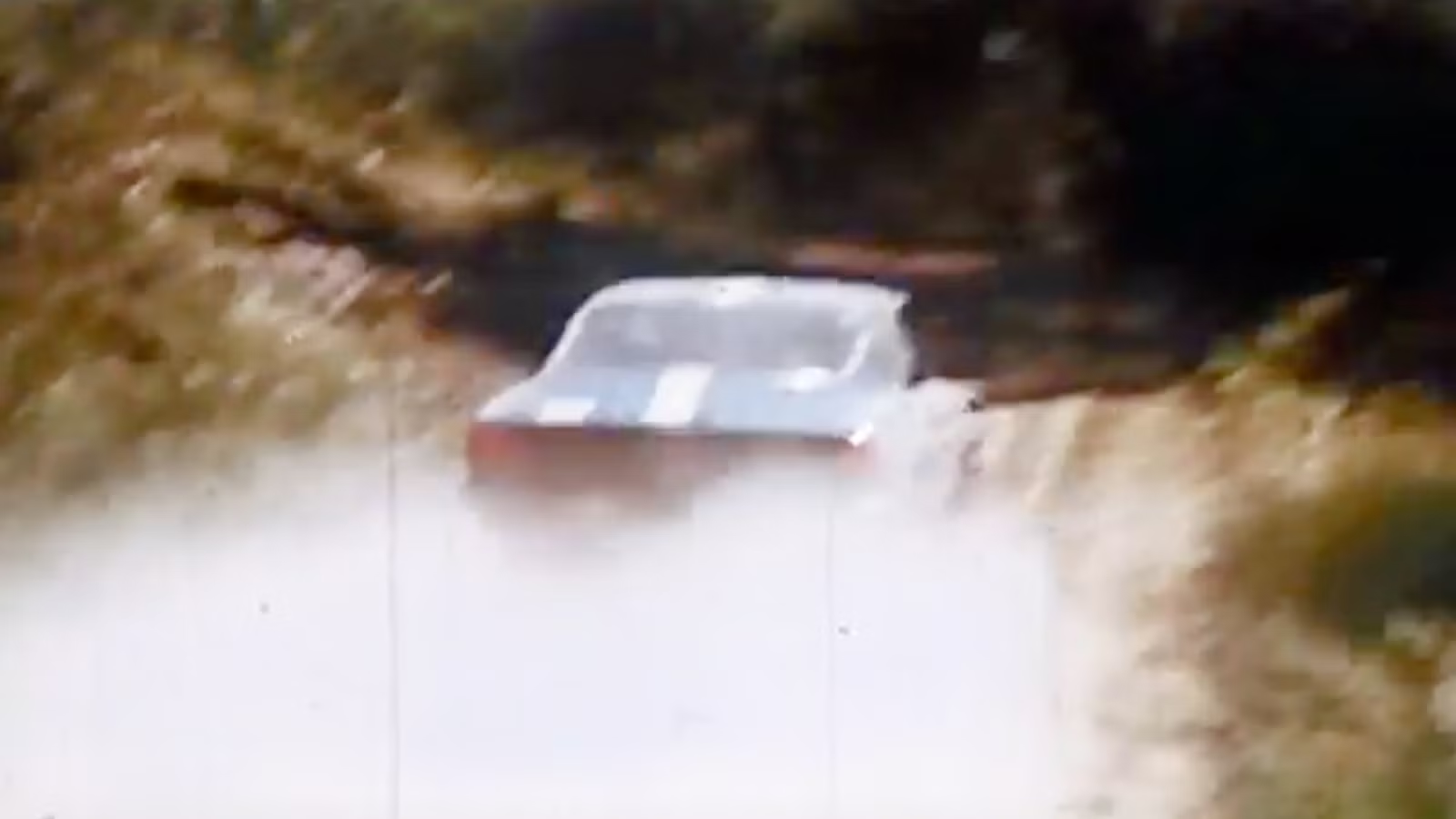
There’s nothing cooler than a V8 muscle car getting sideways on a dirt road. Exhibit A: The entire Dukes of Hazzard and Mad Max franchises. One engineer built a career as a race car driver and Mopar engineer doing exactly that. His greatest triumph was racing a ’60s Plymouth muscle car 4,000 miles through the Canadian wilderness to win one of North America’s pioneering rally races. Prepped by his Mopar racing team, the car was finished to a spec that’ll make even muscle-machine diehards shake their heads.
Rally Racing Transforms Ordinary Roads Into Some Of The Toughest Racetracks On Earth

Today, stage rally is one of the most grueling forms of motorsports on the planet. Stage rally competitions close down regular stretches of road and release competitors onto each “stage” at intervals to race the clock. The sport exploded in popularity with the legendary manufacturer-backed Group B teams of the 1980s. But it wasn’t always a well-known sport.
Rewind to the 1960s, and rally racing was still largely a European obsession. North American rallies leaned more heavily on the less organized “time-speed-distance” format. Over several days, teams followed prescribed routes on open public roads with speed limits, testing backroads navigation skills as much as driving skill.
These punishing multi-day endurance races were a long way from NASCAR-obsessed Detroit’s mainstream racing culture. Chrysler engineer Scott Harvey knew rally promised a very public–and brutal—-test of his company’s cars. So he volunteered to drive.

The Humble Plymouth A-Body Had A Surprisingly Serious Racing Career

Chrysler Corporation introduced its compact A-body architecture for the 1960 model year with the Plymouth Valiant. The Dodge Dart joined the A-body family later. Cutting-edge unibody construction reduced weight, and Chrysler’s “Torsion-Aire” front suspension was designed to take advantage of that structure’s rigidity. Instead of tall coil springs pushing into the upper fender structure, long steel bars ran rearward from the lower control arms into a crossmember built into the unibody; every wheel movement had to twist the bar itself. Valiants with the “Hyper-Pak” tune of the base “Slant-Six” engine swept the first seven spots of NASCAR’s inaugural Daytona Speedweeks Compact Car Race.
Engineer and rally enthusiast Scott Harvey headed a 19-person Chrysler team developing racing-grade improvements to the Valiant’s steering, handling, and off-road durability. Innovations included fast-ratio steering, bolt-through idler arms, and staggered-leaf springs. Harvey arrived at the 1964 Monte Carlo winter rally with a three-Valiant team. He and co-driver Gene Henderson were the first all-American team to complete Europe’s famed winter rally in an American car.

For 1964, Plymouth spun its humble Valiant into a sporty new fastback sub-series called the Barracuda. Beginning in 1965, the new Formula S package paired the 273 Commando V8 with heavy-duty suspension and a front sway bar; buyers could also add performance equipment such as disc brakes and a Sure-Grip differential. There was no better showcase for the nimble car’s capabilities than racing. By the 1965 model year, Scott Harvey and his family were posing with his “Corporate Blue” Barracuda race car for Mopar ads. He’d field a pair of first-gen Barracudas on road-course racetracks across the country in SCCA’s inaugural 1966 Trans Am series. His “Team Starfish” finished second in the championship.
Still, Harvey and Chrysler stood to benefit from an off-road A-body win at home in North America. So when the second-generation Plymouth Barracuda debuted in 1967, Harvey knew exactly where to race it to prove its mettle.
This 235-HP Barracuda Was Built To Survive 4,000 Off-Road Miles At Racing Speed–Twice!

Harvey’s Mopar racing team prepped the Barracuda opposite many factory-team muscle cars of the 1960s: all suspension work, with engine modifications so light they were nearly an afterthought. The Barracuda kept its 273 cubic-inch V8 at stock bore and stroke. Journalist Eric Dahlquist reported that by 1969, Harvey had installed cylinder heads from a 340 cubic-inch V8. The 340 heads improved airflow through 2.02-inch intake and 1.60-inch exhaust valves. But they didn’t change the displacement: With larger combustion chambers, that improved airflow may have come at the expense of compression. The engine also got an Edelbrock medium high-rise manifold, Carter AVS four-barrel carburetor, and unsilenced paper air cleaner.
Harvey’s Barracuda retained the factory A-833 “four-on-the-floor” manual transmission, stock Inland shift lever, and stock gear ratios. His car also used a Sure-Grip limited-slip differential.p

Though Harvey kept the powertrain nearly stock, he went to great lengths to protect it. A 1/8-inch steel plate wrapped around the rear differential housing, another steel shield covered the fuel tank, and the oil pan received a full skid plate. A V-shaped bracket tied up the muffler and tailpipe, so the system would stay attached after repeated impacts.
Next, Harvey dove into Mopar’s parts bin for suspension upgrades. He found the heavier leaf springs he wanted on a 1964 Valiant station wagon, part number 2495087. He nabbed rear shocks engineered for a larger B-body, a police-spec Belvedere to be precise. The racer chose to keep the Formula S Barracuda’s stock front torsion bars. But he did add a one-inch-OD front sway bar. Harvey’s goal was to keep unsprung weight low while tuning spring rates and tire pressure for a relatively soft ride with predictable grip on dirt roads. The alignment he settled on was about 1/2-degree negative front camber and 1/8-inch toe-in.

The Barracuda was finished with purpose-built rally equipment. The kit included four auxiliary Cibie quartz-iodine lights. The dashboard got a Halda Speed Pilot and separate timing equipment, with the Halda’s mechanical odometer drive taken from the left-front wheel. You can’t exactly trust your rear-drive odometer when you’re drifting sideways down a dirt road.
Rally-racing buckets came out of a Saab. In place of the rear seat, the car carried four boxes of goodies. They were packed with spare wheel bearings, brake pieces, ignition components, bulbs, radiator hoses, a fan belt, throttle cable, spare odometer cables, a spare driving light, wheel and tire, tow rope, jack, winch, tools, oil, fire extinguisher, and the mandated first-aid kit.
Flat Tires, Broken Engine Mounts, And A Cow Stampede Couldn’t Stop The Plymouth

Before its first Shell 4000, Harvey had already put the new Barracuda through the 1,000-mile Canadian Winter Rally. But his grueling 4,500-mile 1967 Shell 4000 proved to be much more than a second shakedown run. He outlasted many competitors over eight days. The Plymouth did more than finish: thanks to Harvey’s driving and co-driver Mike Kerry’s navigation, the team came in second overall and won Class 5.
As the 1968 Shell 4000 drew closer, Harvey had a decision to make. Plymouth had discontinued the 273, making the 340 cubic-inch V8 the standard small-block Formula S engine for 1968. Building a new race car would bump him out of the 5,000-cc class. So while the other Mopar team, Gene Henderson and Ken Pogue, entered a Barracuda 340S, Harvey chose to run his 1967 car in Class 5 again without a complete rebuild.
With Ralph Beckman in the co-driver seat, Harvey set out from Calgary on June 1. Unlike pure time-and-distance rally, the 1968 race had multiple special stages on closed roads where the teams could drive flat out. Despite sticking with the 273, Harvey still faced the larger-engine handicap. He needed to complete each closed stage 10 percent faster than cars such as the leading Mini Cooper to meet his target times. Missing those times meant penalty points.

The Barracuda absolutely flew through these closed sections, hitting 135 mph in one. Then, during the Cypress Hills section, a herd of cows wandered onto the course. Harvey had to slam on the brakes and come to a complete stop to avoid hitting the animals. He accumulated seven penalty points in a single stage.
During another section, the Barracuda’s rear engine mount collapsed. The service crew did not have nearly enough time to lift the block and install another one, but they got enough bolts into the mounting to send Harvey back out. During the final leg, Harvey suffered two flat tires. Out on the stage, Harvey and Beckman were on their own and had to change both flats themselves. They got the car rolling again and stayed on schedule. They crossed the finish line after 96 hours of competition in just six days. They’d only accrued eight penalty points. The team won Class 5 for the second time and earned first place overall.
The aforementioned Mini Cooper was disqualified after its crew bolted a second radiator to the front bumper. The Barracuda 340S came in 11th overall and won its class.
The Barracuda Survived, And So Did Scott Harvey’s Version Of Rally Racing
Harvey returned to the U.S. to take on a third role: chairman/rallymaster of Michigan’s Press On Regardless. In 1968, he introduced the SCCA’s first-ever closed-course rally stage. He would go on to win that same rally for three consecutive years: 1969, ’70, and ’71. Behind the scenes, he was organizing multiple races across Michigan, Ohio, and New York into the MONY series, which helped evolve into SCCA Pro Rally in 1973.
Scott Harvey raced Sunbeams as well as Mopars. He raced a Plymouth Cricket in 1971 and won Michigan’s 1975 Sno*Drift winter rally in a Dodge Ramcharger. He proved to be a relentless competitor for decades, finishing second in the Production GT class at the 2007 Gorman Ridge Rally at 77 years old.

By 2021, Harvey’s 1967 Barracuda had retired to California. Wesley Motorsports in Lansing, Michigan, bought the Barracuda and Harvey’s rally Ramcharger. The shop is now restoring both race cars to their former glory. Harvey’s Barracuda finally came home to Michigan, where the kind of rally racing he helped pioneer is still sending cars sideways through the woods.
Sources: SCCA, Chrysler, Michigan Motor Sports Hall of Fame, Rally Racing News,

Related posts

Latest Post


No Comments