The Subaru That Makes More Sense For Long-Term Owners Than You Might Think
9 minutes reading
Monday, 5 Oct 2026 20:00 0 7 autotech
Subaru ownership inspires two sharply different reactions. Loyal owners describe cars that survive brutal winters and remain in the family for hundreds of thousands of miles. Skeptics counter with warnings about head gaskets, oil consumption, wheel bearings, and continuously variable transmissions expensive enough to erase years of careful budgeting. Neither side is entirely wrong, which makes choosing a Subaru for long-term ownership more complicated than simply trusting or dismissing the badge. Yet one current model combines strong resale value, manageable projected expenses, standard AWD, and an established gasoline engine in a package starting below $30,000. It is not a risk-free path to 200,000 miles, but the financial case is considerably stronger than the familiar horror stories suggest.
A five-figure repair bill naturally receives more attention than depreciation because one arrives suddenly while the other happens quietly. Nevertheless, the loss of value is usually one of the largest costs associated with a new vehicle. Avoiding a hypothetical repair does not necessarily make another SUV cheaper to own if that alternative sheds thousands more in resale value.
That difference gives a long-term owner some financial protection. Strong resale value matters even if you intend to keep a vehicle for a decade because plans change, accidents happen, and an eventual trade-in remains part of the ownership equation.
Standard AWD Does Not Create Luxury-SUV Expenses
2026 Subaru Crosstrek WheelSubaru
AWD frequently requires either upgrading to a more expensive trim or accepting additional mechanical complexity and fuel consumption. Despite that, Subaru continues to offer the benefits of its standard Symmetrical AWD system across all models except the BRZ sports coupe. The SUV that makes sense for long-term owners does not penalize you like other AWD SUVs. It returns approximately 29 mpg combined with its most efficient gasoline configuration.
According to iSeeCars, the featured model is projected to lose 28.8 percent of its value after five years, leaving it with 71.2 percent of its original value. The average subcompact SUV depreciates by 38.4 percent over the same period, while SUVs collectively lose approximately 44.9 percent.
Kelley Blue Book places the model within the top 10 percent of subcompact SUVs for five-year cost to own. Its current projection includes approximately $2,686 in scheduled maintenance and $1,807 in repairs during the first five years.
The 2026 Subaru Crosstrek Is The Unexpected Long-Term Pick
Subaru Finally Made The 2.5-Liter Engine Standard
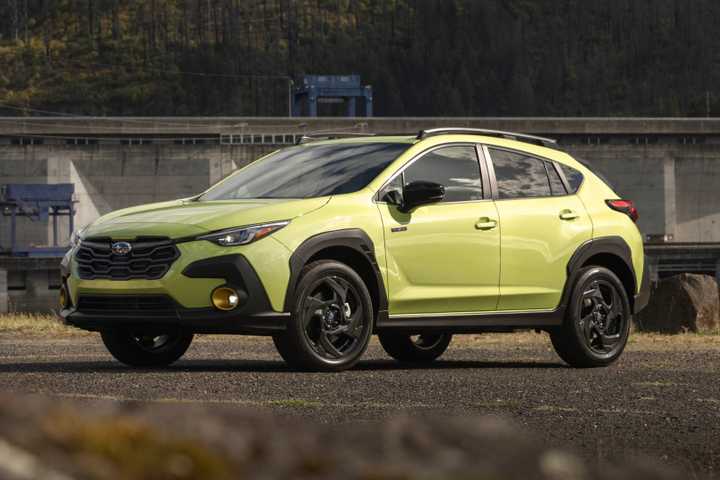
Yellow 2026 Subaru Crosstrek Front 3/4 ViewSubaru
The 2026 Subaru Crosstrek strengthens its value proposition by eliminating its former 2.0-liter base engine. Every gasoline model now uses a naturally aspirated 2.5-liter boxer four-cylinder producing 180 horsepower and 178 lb-ft of torque.
Those figures will not transform the Crosstrek into a performance SUV, but they correct one of the model’s most obvious weaknesses. The previous base engine produced only 152 horsepower, forcing buyers seeking more convincing acceleration to opt for a higher trim.
More importantly for long-term ownership, the 2.5-liter is not an aggressively boosted engine chasing headline power. Subaru has offered a version of this engine in the Crosstrek since the 2021 model year. That gives the gasoline powertrain a more established history than the newly introduced hybrid system.
The Less Expensive Trims Make The Strongest Case
Front 3/4 action shot of 2026 Subaru Crosstrek in blue driving off-roadSubaru
A 2026 Crosstrek starts at approximately $28,000 before destination and options, with the Premium trim sitting only modestly above it. Both utilize the 2.5-liter engine, a CVT, Symmetrical AWD, 8.7 inches of ground clearance, and Subaru’s EyeSight driver-assistance technology.
Moving up to the Limited trim adds comfort and technology, while the Wilderness model offers 9.3 inches of ground clearance, all-terrain tires, altered gearing, and additional trail equipment. Those features can be worthwhile, but they weaken the financial argument if you rarely leave pavement.
The gasoline Base and Premium trims are the sweet spots for ownership. They preserve the mechanical capability that makes the Crosstrek appealing without adding thousands of dollars in equipment, larger wheels, specialized tires, or features that may become more expensive to replace as the vehicle ages.
The Reliability Evidence Is Encouraging But Incomplete
Previous Crosstreks Have Demonstrated Real Longevity
Yellow 2026 Subaru Crosstrek Driving ShotSubaru
The Crosstrek’s durability case reaches beyond owner loyalty and brand reputation. iSeeCars gives it a 7.6 out of 10 reliability score and ranks it first among 21 subcompact SUVs. The study estimates an average lifespan of 170,743 miles, or approximately 13.9 years, with a 26.9-percent chance of reaching at least 200,000 miles.
Those numbers do not mean one out of every four new Crosstreks is guaranteed to reach 200,000 miles without a major repair. Still, the results provide a stronger foundation than anecdotal claims from either devoted owners or frustrated forum posters. The Crosstrek has enough surviving high-mileage examples to demonstrate that long service is realistic rather than exceptional.
The Current Generation Has Not Yet Proven Itself
Yellow 2026 Subaru Crosstrek Rear 3/4 ViewSubaru
The strongest argument against declaring the 2026 model a reliability champion is time. The current Crosstrek generation arrived for 2024, leaving too little history to establish its durability over ten or fifteen years.
Although iSeeCars gives the broader Crosstrek line a favorable rating, it lists generation-specific reliability for the 2024–2026 model as unavailable because of insufficient data. The preceding 2018–2023 generation performs well, but that does not mean there is a direct relationship to prove the same for the latest generation.
The 2026 Crosstrek therefore represents a calculated choice, not a proven 200,000-mile certainty. Its case rests on an established engine family, encouraging model-line history, strong value retention, and restrained running costs. Subaru’s three-year/36,000-mile basic warranty and five-year/60,000-mile powertrain coverage provide limited protection, but a true long-term owner will drive the vehicle well beyond the warranty period.
The CVT And Boxer Engine Require An Honest Conversation
The Lineartronic CVT Is The Biggest Long-Term Question
A 2026 Subaru Crosstrek parked by a lakeSubaru
Every gasoline Crosstrek uses a continuously variable transmission. The Lineartronic CVT contributes to respectable fuel economy and works with Subaru’s standard AWD system, but it is also the component most likely to concern someone planning to keep the SUV beyond 100,000 miles.
A failed transmission can wipe out several years’ worth of otherwise reasonable maintenance expenses. Conversely, treating every Subaru CVT as a guaranteed failure ignores the large number that continue operating at high mileage.
The safest approach sits between panic and neglect. Follow the model-specific maintenance booklet, have the fluid inspected at Subaru’s prescribed intervals, and discuss earlier service with a qualified technician if you regularly use the vehicle for towing, climbing mountain roads, or driving in extreme temperatures.
Old Head-Gasket Failures Do Not Define This Engine
Beauty shot of a 2026 Subaru Crosstrek in Wilderness TrimSubaru
Subaru’s head gasket reputation was largely earned by EJ25-powered models from the late 1990s to the 2000s. Phase I 2.5-liter DOHC engines became associated with internal failures, while some Phase II SOHC engines developed external coolant or oil leaks.
The 2026 Crosstrek does not use that old EJ25. Its modern FB-series 2.5-liter engine has different architecture, cooling passages, and gasket designs. Applying every failure associated with a 20-year-old Subaru to a new Crosstrek would be no more accurate than judging a current Toyota by every engine problem Toyota encountered two decades ago.
That distinction is not a promise of immunity. A boxer engine can make certain repairs more labor-intensive, and owners should monitor oil level, coolant condition, fluid leaks, and temperature changes. The correct conclusion is not that Subaru solved every possible engine problem. It is that the Crosstrek should be judged by its actual powertrain rather than inherited folklore.
Recall history also deserves attention. Some early 2024 Crosstreks were recalled because an instrument-panel wiring harness could contact a steering-beam bracket. Approximately 29,500 Crosstreks were included in the recall. Buyers should check the specific VIN through Subaru or NHTSA instead of assuming that a model-year search tells the whole story.
The Crosstrek Rewards Owners Who Keep Their Cars
Its Modest Specifications Create A Complete Package
2026 Subaru Crosstrek Hybrid front 3/4 shotSubaru
The Crosstrek is not the quickest, most spacious, or most luxurious small SUV. Its advantage comes from combining enough of nearly everything into one relatively affordable vehicle.
Regular trims provide 8.7 inches of ground clearance, and the most efficient gasoline versions return around 29 mpg combined. Standard AWD supplies a capability that costs extra on many rivals. The hatchback body also offers everyday cargo flexibility without the size, weight, fuel consumption, or price of a larger SUV.
Safety supports the long-term case as well. The IIHS reports good results in several crashworthiness evaluations, and Subaru revised the rear-seat belts for 2026 to improve protection in the updated moderate-overlap front test. Safety technology will continue to evolve, but strong underlying crash protection can help an older vehicle remain useful rather than feel prematurely obsolete.
The Gas Model Makes More Sense Than The Hybrid—For Now
The 2026 Crosstrek Hybrid produces 194 horsepower and delivers 36 mpg combined, making it attractive to drivers who rack up a lot of miles each year. However, it also begins roughly $6,500 above the least expensive gasoline Crosstrek and lacks meaningful long-term reliability or depreciation history.
Kelley Blue Book currently estimates approximately $42,180 in total five-year ownership costs for the gasoline Crosstrek. That includes about $11,380 in depreciation, $2,686 in maintenance, and $1,807 in repairs. A directly comparable estimate for the new hybrid is not yet available, making claims about superior long-term value premature.
The hybrid may eventually offset its premium for a high-mileage owner, especially if fuel prices rise. The hybrid model is estimated to incur $1,700 per year in fuel costs, while the gasoline version costs around $2,100, resulting in a $400 difference. For now, the gasoline Base or Premium offers the cleaner long-term case: a lower purchase price, a proven engine family, a strong projected resale value, and fewer unanswered questions.
A Crosstrek will not make Subaru’s mechanical history disappear, nor will careful maintenance eliminate every risk. What it can do is give you standard AWD, useful efficiency, encouraging longevity data, and unusually strong value retention without demanding luxury-SUV money. For an owner thinking in ten-year increments instead of three-year leases, that balance makes far more sense than the badge’s loudest critics might admit.
Base Trim Engine
2.5L H-4 ICE
Base Trim Transmission
8-speed Lineartronic CVT
Base Trim Drivetrain
All-Wheel Drive
Base Trim Horsepower
180 HP @5800 RPM
Base Trim Torque
178 lb.-ft. @ 3700 RPM
Base Trim Fuel Economy (city/highway/combined)
27/33/29 MPG
Base Trim Battery Type
Lead acid battery
Make
Subaru
Model
Crosstrek
Sources: Subaru, Kelley Blue Book, iSeeCars, IIHS, NHTSA, Edmunds








No Comments