
The Yamaha That Quietly Nails The Everyday-Riding Formula
The entry-level motorcycles don’t often get much attention beyond one’s first purchase. It’s a class of motorcycles that caters to beginners before they graduate into the middleweight category and beyond. But with the whole downsizing trend catching up, given the state of global economics, the sub-$6,000 naked-bike class in particular, has become surprisingly ambitious. Kawasaki now offers a 451cc twin with 51 horsepower, while KTM gives its 390 Duke a TFT, ride modes, and adjustable suspension. And that’s great news if performance per dollar is the question.

Daily riding, however, asks a less glamorous set of questions. Can the bike squeeze through traffic without feeling heavy? Is the clutch light enough for a miserable commute? Will it hold highway speed without feeling wrung out, while also returning decent fuel economy? A motorcycle that gets those details right can be easier to live with than something faster and flashier. Yamaha’s smallest naked bike has spent years working on getting these things right.
Everyday Riding Rewards Restraint More Than Excess
Urban motorcycles spend a lot of time doing unheroic work. They creep through traffic, make tight U-turns, get pushed around parking lots, and hop over broken pavement. Low weight, predictable throttle response, a manageable seat height, and a relaxed upper-body position matter a lot here. The same motorcycle still has to survive the faster part of the week. A commuter that feels pleasant at 35 mph but strained at 70 mph quickly becomes limiting, particularly in the U.S., where even a short errand can involve freeway miles.


Usable everyday bikes therefore need enough engine to cruise comfortably, gearing that does not keep the motor frantic, and a chassis that remains stable once traffic clears. Running costs also belong in the equation. Small-capacity motorcycles are supposed to be inexpensive to use, yet buyers increasingly expect features like standard ABS, LED lighting, smartphone integration, and charging provision. That creates a difficult price target because every extra feature risks pushing a small motorcycle close to larger, more powerful machinery.

The smartest solution is not to chase the class leader in every respect. It is actually to make the controls easy, the dimensions friendly, the engine flexible enough, and the equipment useful without letting the price escape into unreasonable territory. Yamaha has had that recipe in front of us for a while within its small streetfighter, quietly evolving in the shadows of its more popular MT siblings to get the everyday riding requirements down to near perfect levels.
The Yamaha MT-03 Keeps Its Priorities In Order

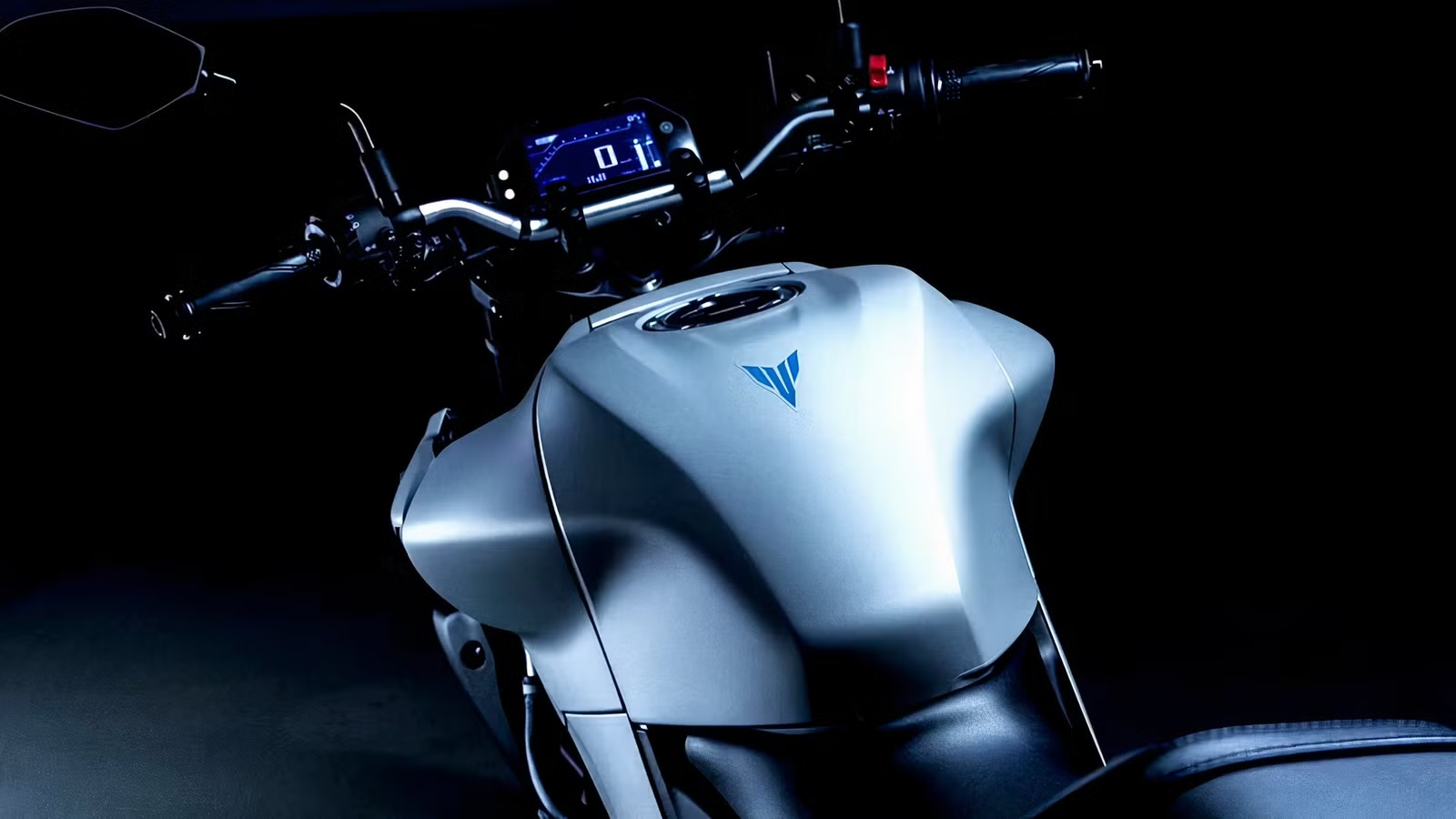
The Yamaha MT-03 has been the naked counterpart to the YZF-R3 in the U.S. since 2020. They share the same 321cc parallel-twin foundation while trading the sport bike’s fairing and lower bars for a more upright street-focused layout. Yamaha gave the MT-03 a useful round of revisions for 2025, including improved ergonomics, an assist and slipper clutch, smartphone connectivity, a new LCD, and a USB-A charging port. Those changes carry into the current 2026 model without disturbing the basic package at $4,999.
The 321cc Twin Makes Modest Power Easy To Use

The 321cc liquid-cooled parallel-twin is an old acquaintance now, and familiarity works in its favor. With a 180-degree crank, counterbalancer, forged pistons, and Yamaha’s offset-cylinder layout, the engine is designed to reduce vibration and internal friction. Yamaha estimates 62 mpg, and the 3.7-gallon tank gives the bike practical commuting range. Its output is 41.4 horsepower at 10,750 rpm and 21.8 pound-feet at 9,000 rpm, so this is still an engine that likes revs.

Throttle response is smooth, the six-speed gearbox lets the rider keep the twin in its useful range, and it will maintain freeway speeds without the strained feel common to weaker entry-level machines. The tall upper gears help calm the engine once the bike settles into a highway cruise. There is not much punch low in the rev range, so quick passes require a downshift and some commitment. Although, the reward is an engine that lets you use large throttle openings without instantly doing illegal speeds.
Its Size Does Most Of The Hard Work In Town

At 373 pounds wet, the MT-03 is light enough to move around a garage or parking space. The 30.7-inch seat is equally manageable, and Yamaha slimmed the seat and side covers for 2025, improving the rider’s reach to the ground. The chassis carries over the practical bias. A 37mm KYB inverted fork offers 5.1 inches of travel, while the rear shock provides 4.9 inches and seven-step spring-preload adjustment. Its 22.6-inch asymmetrical swingarm is relatively long within the compact chassis, a layout Yamaha uses to add stability during braking, cornering, and acceleration.

This seemingly basic setup is still compliant over rough urban pavement while still giving the bike quick, predictable steering on faster roads. The single 298mm front disc and 220mm rear disc use standard ABS. Braking performance is adequate more than sharp, and the front-lever feel is progressive, fitting for a motorcycle built around easy control. The upright handlebar and compact 54.3-inch wheelbase complete the chassis.
Yamaha Fixed The Small Daily Annoyances

The most useful part of the current package after the 2025 refresh, were the little details that Yamaha improved upon. The assist and slipper clutch reduces lever effort while managing aggressive downshifts, while the redesigned passenger seat is wider with thicker cushioning. In addition to the slimmer rider seat and bodywork that make the already low bike easier to straddle.

The Yamaha Motorcycle Connect feature can display incoming call, email, and message notifications, while the app records ride data such as distance and fuel consumption. A USB-A socket beside the LCD gives phones or heated gear a power source. Yamaha also offers a quickshifter as an option. More importantly, the MT-03 adds everyday conveniences without adding bulk or an overload of unnecessary features, or changing the very attractive price point.
The MT-03 Wins On The Sheer Balance Of Price-To-Performance

Honda’s 2026 CB300R starts lower at $4,499 and is dramatically lighter at 316 pounds wet. It is an excellent city-first alternative, highlighted by the 286cc single-cylinder engine, and a 2.6-gallon fuel tank capacity. In comparison, the Yamaha costs $500 more, yet brings the smoother character and broader highway usefulness of a parallel-twin, more power, a lower seat height, and considerably more fuel capacity.

The 2026 Kawasaki Z500 ABS matches the MT-03 more closely. For $5,699, it brings a 451cc twin producing 51 horsepower, while weighing about the same as the Yamaha and carrying the same 3.7 gallons of fuel. The MT-03, however, still has a lower purchase price compared to the Z500, proven city manners, and enough performance for the occasional freeway run. It does not dominate any single specification outright, but it simply removes a lot of friction from using a motorcycle every day, which is why Yamaha’s smallest MT still gets the daily riding formula right.
Source: Yamaha

Related posts




Latest Post



No Comments