The Luxury EV That Lost Half Its Value In Just 3 Years
8 minutes reading
Sunday, 4 Oct 2026 16:00 0 6 autotech
Lucid is a California-based electric vehicle brand that actually had some pretty humble beginnings as a battery company starting in 2007. They were originally known as Atieva, founded by Bernard Tse and Sam Wang. It wasn’t until 2016 that they rebranded as Lucid Motors when they simultaneously revealed the Edna and the Air prototypes. By 2021, they went public thanks to a merger and opened their first production facility in Casa Grande, Arizona. That is where the Air was first manufactured and continues to be produced today.
The Lucid Air is a full-size luxury electric vehicle that goes toe to toe with the likes of Tesla, Mercedes-Benz, and even BMW. They are stunningly designed, yet subtle, with interior touches that Tesla wouldn’t even dream of matching. They also focus on sustainability and use a synthetic leather called PurLuxe, but you can opt for real, full-grain leather. It also features Alcántara, a 5K infotainment display — basically all the trappings you’d come to expect from a modern luxury car. The only problem is that they’re losing value rapidly and in large amounts — but why?
Why Nobody Wanted A $100,000 EV From A Brand Nobody Had Heard Of
Lucid Air Touring front 3/4 shotLucid
Breaking out into the American automotive market is a massive gamble. Investments in starting a new brand cost well into one billion dollars, if not more. An even bigger gamble is to bet your entire stake on an ultra-luxurious electric sedan in an age where brands like Lexus are putting the brakes on their legendary LS, and SUV sales couldn’t be higher.
Not to mention, the Lucid Air when it came out in 2022 had a starting MSRP of $87,400 for the Pure, while every single other trim was well over the $100,000 mark. It’s also difficult to resell first-edition vehicles, especially if they’re from a brand-new automaker. You’d be hard-pressed to find a dealer that would take that VIN on.
When Last Year’s Software Makes Your EV Obsolete
Lucid Air Grand Touring Front Three-Quarter DrivingLucid
Cars are more like computers these days. The minute you buy it, it’s obsolete and has to constantly be upgraded with new software. While automakers leave a fair amount of headroom in the centralized domain controllers, the processors can’t end up handling the UI’s newer software. There was also an efficiency problem, according to Car and Driver, that rendered the Lucid Air’s older models much less efficient than the updated current models. That’s a hard sell for someone that needs to go far in their electric car.
Luxury EVs Sit Unsold For Up To 90 Days — And Their Prices Change Weekly
Lucid Air Touring rear 3/4 shotLucid
This plight doesn’t necessarily fall solely on the Lucid Air either. Other early adopters include the Porsche Taycan and the Audi e-tron GT as well. These have also been offloaded for similar reasons, and at the same time, so there has been a massive influx of EVs that virtually nobody wants.
According to iSeeCars, there’s auction data that shows luxury electric cars spend between 60 and 90 days on the market as opposed to their entry-level counterparts like Chevy Equinox EVs. The prices of these EVs are volatile too and change from week to week if they’re not certified pre-owned, according to Cox Automotive Trends, but the early-adoption problem is only part of the story. What happened specifically to the Lucid Air — and how much did it actually lose?
The Lucid Air Took A Massive Blow
It’s unfortunate, because the Lucid Air is a genuinely impressive vehicle and a strong contender against the outdated, bland, and often overhyped Tesla Model S. It offers a true sense of pedigree luxury with the pride of being built in the US. It also offers an insane amount of range for a luxury EV with a max of 516 miles (for the Grand Touring models when they were new). They also came during a time of economic uncertainty when the banks were raising the interest rates, making consumers less likely to buy a $100,000 plus luxury sedan. There’s also not a high demand for a new brand that people knew virtually nothing about.
With all of that talk of people not wanting to buy early on, or spend the cost of a small house in rural Arizona, Lucid listened and ended up slashing prices. The 2024 model Air Pure was released with a slightly lower MSRP of $73,150. They did have to cut some features, like the full-length glass panel roof, to make way for a lighter aluminum one, as well as remove the front-wheel-drive motor, reducing the range and power output. Yet this was still a smart move by Lucid to incentivize new buyers while keeping the vehicles relatively luxurious.
Out-Of-Pocket Maintenance Woes
2025 Lucid Air Touring side shot chargingWilliam Clavey | TopSpeed
Maintaining a luxury car is expensive. Maintaining a luxury car that’s new and electric only is even more expensive. Like their direct competitor, Tesla, Lucid offers a direct-to-consumer model, which unfortunately limits the number of dealers as well as service centers. That also limits the number of aftermarket parts that you can source for your Lucid Air.
These cars feature extremely complex 900V Wunderbox charging systems that your average mechanic wouldn’t be able to deal with. Thankfully, they do have a decent basic warranty that covers four years and 50,000 miles (whichever comes first), but by year three could already have some Airs well over 50,000 miles.
Luxury EV Depreciation Vs. ICE Flagships
2025 Lucid Air Touring Side ProfileWilliam Clavey | TopSpeed
KBB is a great resource for all things depreciation and values of vehicles. Luckily for Lucid, the plight of steep value decline doesn’t apply to them alone. Any flagship product, as it relates to automobiles, generally loses well over 50 percent of its original value over the first three to five years. Compounding this is the fact that it’s a luxury electric vehicle and a sedan, no less. Buyers do and should have concerns over battery degradation, especially if it’s already three years old. Traditional ICE luxury cars, while still losing a lot of value, don’t lose nearly as much as a luxury EV, flagship or not.
Luxury Leases Against Battery Anxiety
Side shot of a Lucid Air Grand Touring Doors OpenLucid
We’ve written plenty of times about how most consumers who buy luxury sedans or SUVs typically dump their leases after the first three years. They don’t want to deal with the inevitability of extreme out-of-warranty maintenance issues. While this might not always be the case for luxury EVs like those from Tesla or Mercedes-Benz, this is definitely the case for flagship owners of 2023 Lucid Airs.
ICE consumers typically worry about their air suspension or fluid leaks — things that can be fixed, that might be pricey, but that still won’t break the bank. EV drivers, on the other hand, are worried about catastrophic battery malfunctioning that could cost them the entire value of the vehicle.
The S-Class Effect
2025 Lucid Air Touring Rear SeatsWilliam Clavey | TopSpeed
The steep depreciation of a flagship luxury vehicle is a tale as old as time, originally told by the Mercedes-Benz S-Class. A 2015 Mercedes S63 AMG that cost $160,000 originally now costs $35,000 or less as of 2021, according to Cars.com. There is a lot more that goes into owning a luxury flagship sedan than just oil leaks and air suspension woes, however. There’s also innumerable sensors, motors, and electronics that control all of it that could all break at the drop of a hat. Massage seat functions are often controlled by air bladders that could fail or lose their connection. At the end of the day, there are a million different reasons why people don’t hold onto them.
What Does This Kind Of Depreciation Mean?
Lucid Air Grand Touring Front Three-QuarterLucid
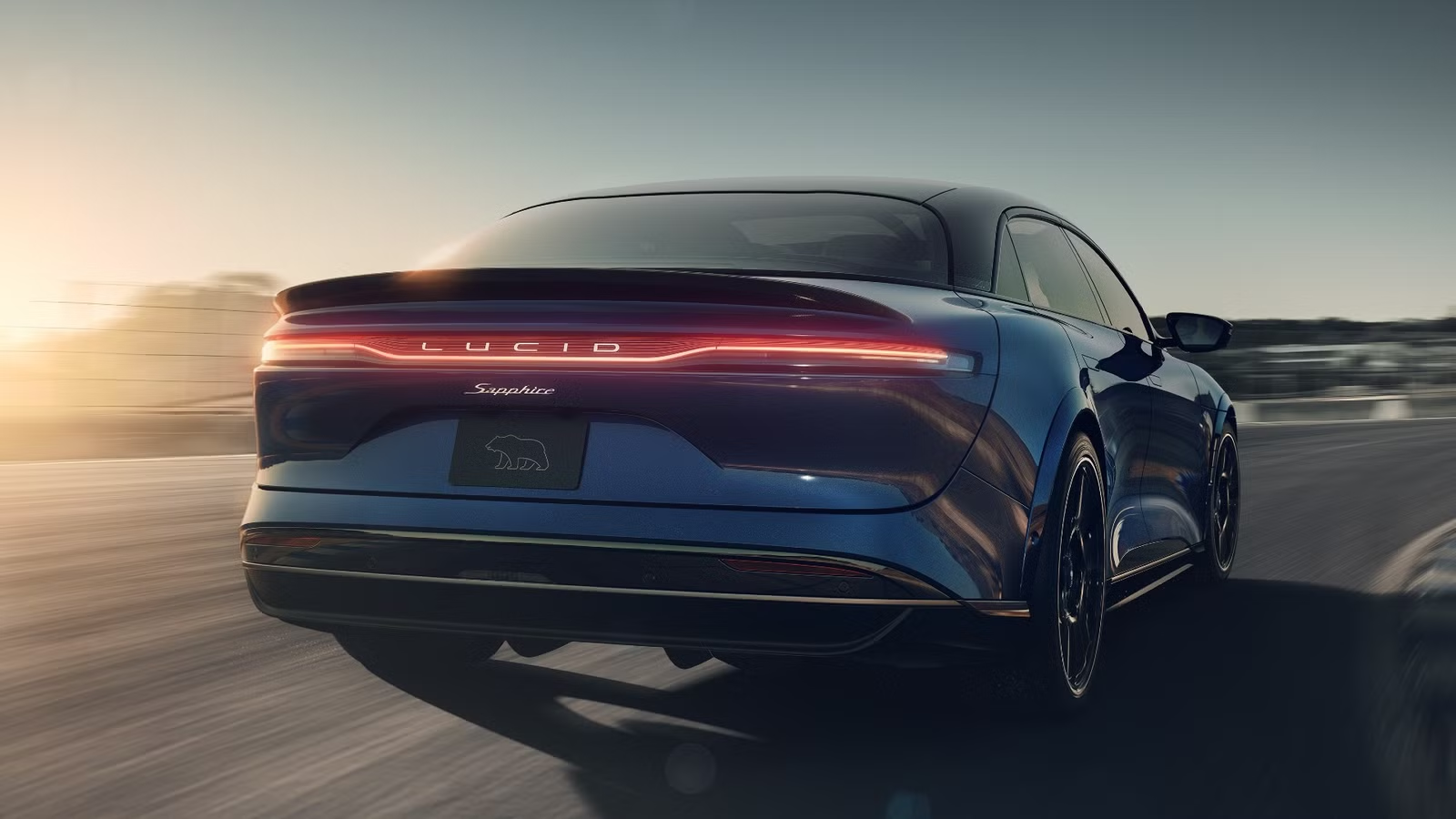
Nothing! We’re only kidding, but if you think about it, the people that are buying these new things don’t care about these kinds of issues. They typically have the money to solve these problems. The rest of us, on the other hand, who are buying them used can buy them for the same price as a brand-new mid-spec Honda Accord — one that’s faster, more luxurious, and downright great-looking. The Lucid Air also makes a compelling argument for performance-per-dollar, with the Sapphire achieving zero to 60 mph in breakneck timing at 1.89 seconds.
Supercar Performance For Next To Nothing
Profile shot of 2026 Lucid Air SapphireLucid
It’s not as though the 2023 Lucid Air Grand Touring is a slow vehicle either. The Grand Touring outputs an astounding 819 horsepower and an equally remarkable 885 pound-feet of instantaneous torque, all for an almost unbelievable current market value of approximately $45,000, according to Kelley Blue Book. The aforementioned S-Class can only output 791 horsepower at maximum, and that’s still impressive.
Keeping Up With The Maintenance
We’ve already touched on the basic maintenance, but thankfully the factory battery warranty is even better. You do benefit from an eight-year, 100,000 mile factory warranty, which is great news for those buying their $45,000 supercar EV. If you somehow find a Lucid Air that’s out of warranty already, there are third-party extended warranties available that do end up excluding high-voltage drive components and infotainment modules, among other features. As the old saying goes: one man’s trash is another man’s treasure (not that these are trash — you get the point).
Base Trim Engine
Electric
Base Trim Transmission
Single Speed Automatic
Base Trim Drivetrain
Rear-Wheel Drive
Base Trim Horsepower
480 hp
Make
Lucid Motors
Model
Air
Segment
Full-Size Luxury Sedan
Sources: Lucid, Car and Driver, iSeeCars, Cars.com, KBB









No Comments