
The Toyota That Became A Cult Classic Without Trying
Toyota maintains a massive operational presence in the U.S. Since its introduction to the region, it has driven economic integration through extensive local investments. The automaker operates multiple manufacturing plants, engineering centers, and research facilities across the country, employing thousands of American workers.

Its strong reputation among consumers stems from a focus on vehicle longevity, safety, low maintenance costs, and exceptional resale value. The Japanese brand also pioneered fuel-efficient hybrid technology that further solidified market dominance. Toyota earns consistent consumer satisfaction ratings by continuously adapting to consumer preferences and offering reliable trucks, SUVs, and sedans.
Toyota’s Revolutionary SUV Design Strategy
Over the past 40 years, Toyota’s approach to designing sport utility vehicles for the U.S. market has prioritized practical utility, structural longevity, and evolving consumer lifestyle demands. During the 1980s and 1990s, early designs focused on rugged, truck-based, body-on-frame architectures that emphasized durability, high ground clearance, and off-road capability. As driver preferences shifted toward urban commuting and family transport, design teams integrated unibody platform configurations that delivered smoother rides, improved handling, and expanded cabin volume.

Toyota’s local design studios tailored vehicle proportions, interior ergonomics, and cargo capacity specifically to match North American space expectations and highway driving habits. Modern engineering efforts incorporated driving technologies that could conquer different terrains. Optimized aerodynamic profiles and advanced hybrid powertrains also ensured enhanced fuel economy without sacrificing towing strength or structural integrity. Throughout every generation, continuous refinement guides the evolutionary process. The brand also maintains alignment with market demands, sustaining a competitive presence across the American automotive landscape. It does so by balancing mechanical reliability with progressive safety features and versatile interior layouts.
The First RAV4 Is Now A Cult Classic

The first-generation Toyota RAV4 debuted in the U.S. for the 1996 model year. Its introduction transformed the automotive landscape by pioneering the compact crossover SUV segment. The Japanese brand built the first RAV4 on a modified passenger car platform rather than opting for a traditional body-on-frame chassis. This direction achieved a high seating position and all-weather capability of an SUV with the fuel efficiency, comfort, and nimble handling of a compact car. Opting for a unibody construction eliminated the harsh ride quality typically associated with traditional off-roaders, creating an entirely new vehicle class that appealed to urban commuters and active lifestyle buyers alike.
Market reception in the region proved immediate and overwhelming. U.S. sales rapidly surged as the model established a dominant foothold, moving over 50,000 units during its first full year on sale. By the end of its production cycle in 2000, annual sales volume exceeded 70,000 units, consistently outpacing initial supply and outperforming traditional competitors. The immense commercial success of the vehicle forced rival manufacturers to develop competing unibody crossovers. American consumer preference fundamentally shifted away from truck-based utility vehicles toward modern crossover architectures.
The first RAV4’s rise to cult status is a commendable one, considering it held a reputation of being conservative and mundane when new. This analog and simple approach is an aesthetic that retro car collectors appreciate, as new models introduce more tech and electronics that can make the experience of owning a car more complicated and overstimulating.
A Simple But Effective Drivetrain Solution

The first-generation Toyota RAV4 features a 2.0-liter 3S-FE naturally aspirated inline-four engine paired with either a five-speed manual or a four-speed automatic transmission. At its 1996 U.S. launch, this engine produced 120 horsepower at 5,400 RPM and 125 pound-feet of torque at 4,600 RPM. A mid-cycle update for the 1998 model year increased output slightly to 127 hp and 132 lb-ft of torque.
Power transfers through either front-wheel drive or a full-time all-wheel-drive system. Acceleration from 0 to 60 MPH requires 9.8 seconds with the manual transmission, while the automatic takes roughly 10.5 to 11 seconds depending on configuration. The vehicle achieves a claimed top speed of 102 MPH. Despite its lightweight crossover architecture, the compact SUV maintains a maximum towing capacity of 1,500 pounds when properly equipped.
The Brilliance Of The First RAV4’s Unibody Platform

The first-generation Toyota RAV4 features an independent four-wheel suspension setup, utilizing MacPherson struts at the front and a trailing-arm double-wishbone design at the rear. Toyota’s car-based unibody structure with fully independent suspension means that the RAV4 eliminated the harsh ride, truck-like body roll, and unpredictable bumps common to traditional body-on-frame competitors. The front MacPherson struts deliver precise steering control, while the rear double-wishbone architecture optimizes tire contact with the road, improving cornering stability and passenger comfort.
This geometry allowed engineers to lower the floorpan, expanding interior cabin space and lowering the center of gravity while maintaining adequate ground clearance for light off-road terrain. Coil springs at all four corners absorb road imperfections far more effectively than leaf springs, offering refined ride characteristics similar to a passenger sedan. By introducing smooth handling and better ride quality than a high-riding utility vehicle, this suspension design redefined driver expectations and established the structural framework for all future compact crossover SUVs.
Values Are Slowly Rising To Collector Levels

In its final 2000 model year, the first-generation Toyota RAV4 carried a base MSRP of $17,368 for two-wheel-drive variants, while fully optioned all-wheel-drive configurations reached up to $21,177. On the current pre-owned market, functional daily-driver examples typically sell between $3,500 and $6,500, whereas pristine, low-mileage models command prices ranging from $7,000 to over $10,000. Toyota introduced a mid-cycle facelift for the 1998 model year that updated several key design features over the 1996 through 1997 pre-facelift versions.
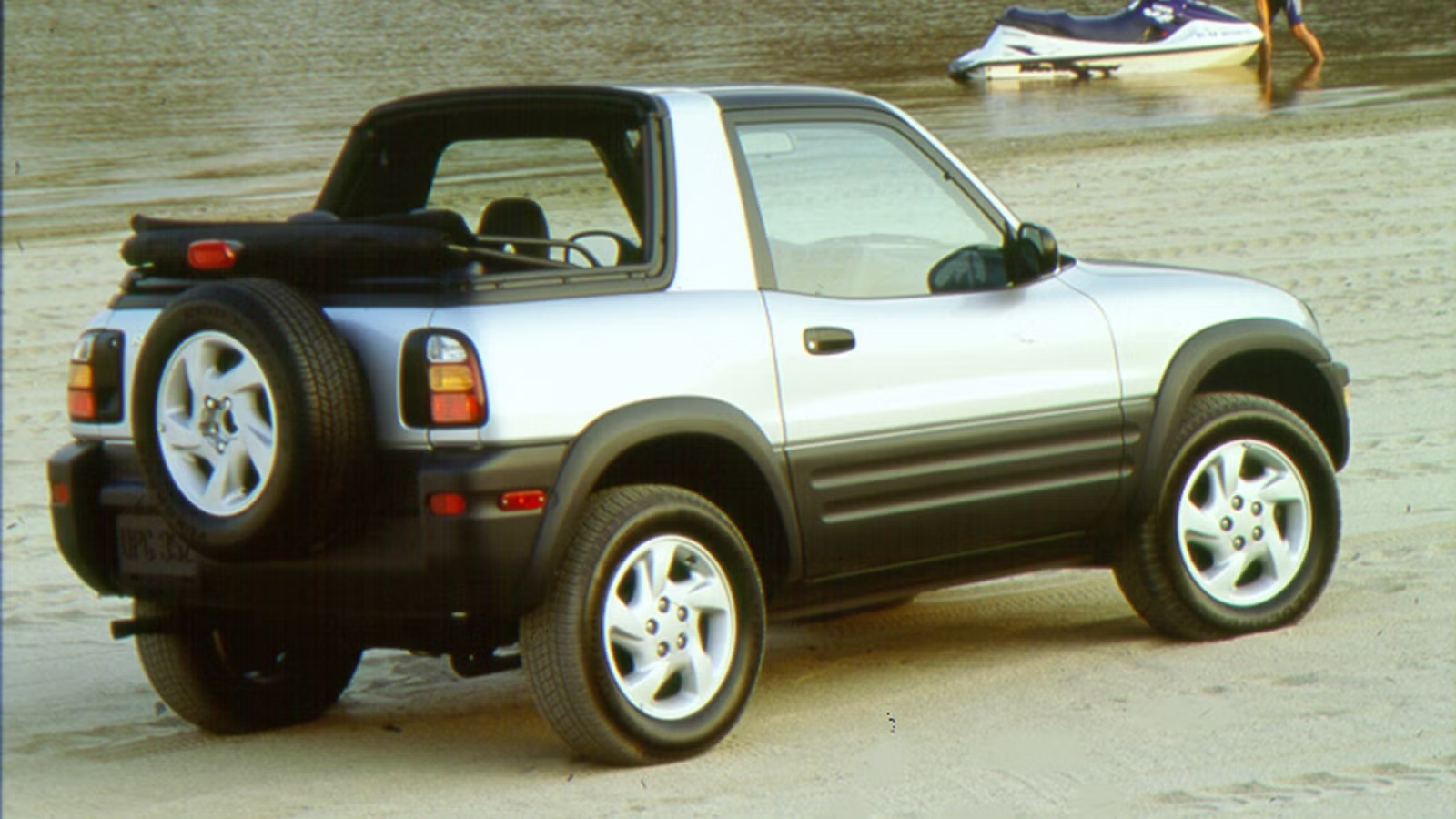
Visually, early models featured basic horizontal-bar grilles, heavily fluted glass headlight lenses, and traditional amber-and-red taillights. The 1998 through 2000 facelift models replaced these elements with a revised mesh grille, modern multi-reflector clear headlights, a reshaped front bumper, and updated taillight assemblies with clear indicator lenses. Cabin updates included revised instrument gauges, new upholstery options, redesigned door panels, and added cupholders. The facelift also introduced a soft-top convertible variant alongside the standard hardtop body styles before production ended.
The Best First-Generation RAV4 Model Year

The 1999 model year represents the optimal choice when purchasing a first-generation Toyota RAV4. Buying a late-generation model ensures access to all mid-cycle technical and aesthetic enhancements, including the revised 2.0-liter 3S-FE engine with its increased power output. The 1999 model features modern multi-reflector headlights, an updated interior with improved storage, and structural sound insulation refinements introduced during the facelift phase.
Crucially, the 1999 model year avoids potential first-year production flaws while offering better parts availability than earlier examples. Choosing this model year also provides the flexibility of selecting between the versatile five-door hardtop, three-door hardtop, or soft-top convertible variants before production shifts to the second generation, making it the most refined and complete version of the original crossover platform.
Long-Term Servicing Costs Are Minimal

The 3S-FE inline-four engine is a dual-overhead-camshaft four-cylinder design built with a cast-iron block and an aluminum cylinder head. This engine is known for its non-interference valvetrain architecture, ranking it among Toyota’s most dependable engines. It’s an engine that routinely surpasses 250,000 miles without requiring major overhauls due to its simple mechanical structure and robust internal tolerances.
Standard routine maintenance calls for engine oil and filter changes every 5,000 miles or six months, alongside spark plug replacements every 30,000 miles. Because the engine employs a rubber timing belt to drive the camshafts rather than a chain, replacement of the belt, water pump, and associated tensioners is mandatory at 90,000-mile intervals. Annual maintenance costs for basic servicing generally range from $300 to $500, while the comprehensive timing belt service costs between $400 and $800 depending on parts and labor rates. Regular servicing ensures exceptionally long operational life and low long-term running costs.
Some Age-Related Issues You’ll Have To Stay On Top Of

Although the 1999 Toyota RAV4 maintains a reputation for mechanical durability, long-term ownership presents several common wear issues and age-related failure points. Engine oil leaks frequently develop at high mileages due to deteriorating valve cover gaskets, oil pump seals, and distributor O-rings. Transmission components require monitoring, as four-speed automatic models can experience harsh shifts or hesitations caused by aging solenoids or worn ECU solder joints, while five-speed manual transmissions often exhibit worn synchros in lower gears.
The full-time all-wheel-drive system relies on rubber differential mounts and driveshaft support bearings that crack over time, leading to clunking sounds under acceleration. Chassis components suffer from age, with suspension bushings, sway bar links, and steering rack mounts wearing down and causing loose handling. Additionally, rust formation presents a structural hazard on subframes, rocker panels, and rear suspension mounts in regions with heavy road salt usage. Electrical issues remain minor, though power door lock actuators and power window motors commonly fail with age.
Sources: Toyota, RepairPal, Engine Specs, Edmunds, and Kelley Blue Book.

Related posts




Latest Post


No Comments