
The Harley-Davidson Engine That Was Better Than Its Reputation
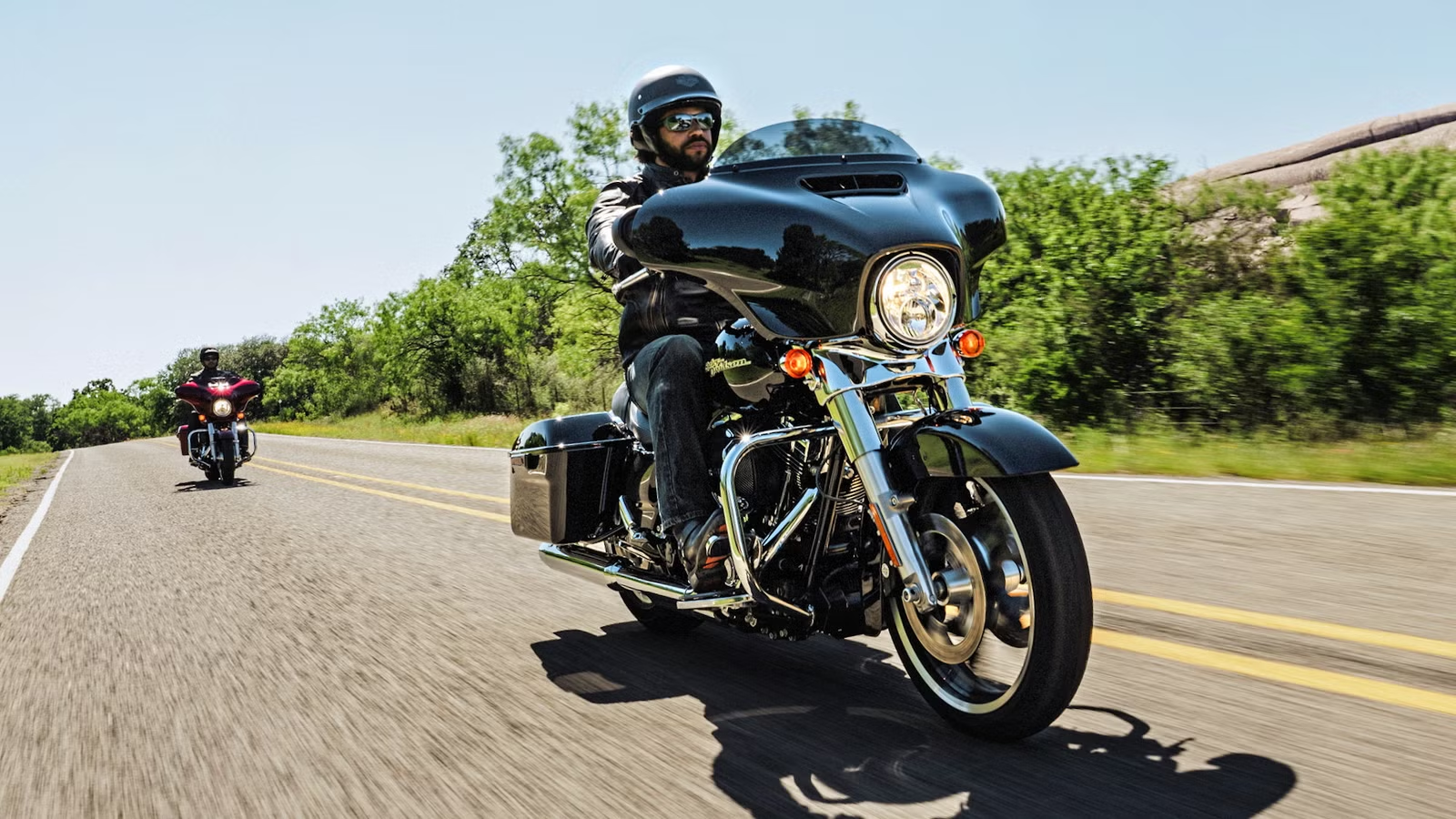
Some Harley-Davidson engines are remembered primarily for how well they held up. Others are remembered for the problems that followed them, and once that happens, the reputation can become much easier to remember than the engine’s full story. That’s a dangerous way to judge a Big Twin, especially one that spent years evolving after its earliest problems appeared. One Harley engine has carried that kind of baggage for decades. Its flaws were real, but so was everything Harley got right afterward. The interesting question isn’t whether the criticism was justified. It’s whether the engine ever deserved to be remembered primarily for it.
The Reputation Came Before The Full Story
How One Mechanical Problem Can Define An Entire Engine

A mechanical weakness doesn’t have to destroy an engine to become part of its identity. Give one failure enough attention, and eventually the failure starts standing in for the entire engine, even when most of the people repeating the story haven’t owned one.
That is how a mechanical weakness can grow into something much larger. A problem that affects certain years, components, or conditions can become shorthand for an entire engine family, even after the design has been revised and thousands upon thousands of motorcycles have continued to use it.
When The Early Problems Become The Whole Story

That creates a difficult question for anyone trying to judge an engine years later. Should its reputation be based primarily on the problems that made the most noise, or on the complete record of what the engine became over its lifetime?

For a Harley-Davidson Big Twin, that record includes more than reliability alone. Development matters, too, along with increasing displacement, broader applications, serviceability, performance, and the sheer number of motorcycles that depend on the design over many years.

One particular Harley engine has spent a long time carrying a reputation shaped by its early problems. The interesting question is whether those problems tell the whole story, or whether the engine that emerged from them was considerably better than the reputation that followed it.
The Other Contenders Nearly Fit
The Shovelhead Has The Right Kind Of Reputation

The Shovelhead would seem like an obvious candidate for a discussion like this. It earned a reputation for running hot, using oil, and developing mechanical problems that became especially pronounced during the 1970s. Yet the engine also received continual revisions, remained in Harley-Davidson’s Big Twin lineup for nearly two decades, and eventually became a sought-after piece of Harley history.

The problem is that calling the Shovelhead better than its reputation almost requires explaining away too much of its later history. Its reputation was shaped by genuine shortcomings, so while individual versions can be much better than the stereotype suggests, the stereotype did not appear from nowhere.
The Evolution Has Almost The Opposite Problem

Then there is the Evolution, which makes this comparison even more interesting. Harley-Davidson introduced it in 1984 with major changes intended to improve cooling, oil control, power, and manufacturing consistency. The company describes the result as an engine that was oil-tight and a major step forward from what came before it.
That makes the Evo a poor fit for our discussion in one important respect. Its reputation is already largely favorable. The more intriguing case is an engine whose problems were real enough to dominate the conversation, but whose complete career gives us considerably more to consider.
The Engine With The Poor Reputation Was The Twin Cam
The Twin Cam 88 Arrived Strong — Then One Part Defined Its Reputation

The engine we’ve been circling is the Harley-Davidson Twin Cam. It replaced the Evolution on Touring and Dyna models for 1999, and Harley was not simply giving the old Big Twin a new set of cases. The Twin Cam 88 brought a new two-cam layout, more displacement, and a redesigned engine architecture intended to handle the demands of Harley’s next generation of motorcycles.
The problem is that one part of that new design became almost inseparable from the engine’s reputation. The early Twin Cam 88 used spring-loaded cam-chain tensioners, and the wear those tensioners could experience became one of the engine’s most discussed weaknesses. Harley eventually offered an upgrade that replaced those components with the hydraulic tensioner design used on the Twin Cam 96, along with a higher-capacity oil pump.
The Twin Cam Kept Getting Better

That change is important because it shows something a simple reputation doesn’t: Harley didn’t build the original Twin Cam 88 and leave it alone. The platform grew to 96 cubic inches in 2007, then to 103 and 110 cubic inches. All the while, Harley continued making internal changes as the engine developed. By the time the Twin Cam reached the end of its run, it was a considerably more mature design than the engine that first put the name on the map.

That doesn’t erase the weaknesses of the early engines. It does mean that judging every Twin Cam by the reputation created by those early years is like judging an entire engine family by its first major problem. The more useful question now is what this engine got right once Harley had learned where the weak points were.
What The Twin Cam Got Right
Harley Kept Finding Reasons To Use It

One of the strongest arguments for the Twin Cam is simply what Harley-Davidson continued asking it to do. The engine didn’t live in one motorcycle or one narrow corner of the lineup. It powered Touring and Dyna models when it debuted, moved into Softails, and eventually appeared in everything from big touring machines to trikes. By the later years, Harley was offering the architecture in several displacements, including 96, 103, and 110 cubic inches.
That kind of spread matters to a mechanic because it creates something more valuable than a good specification sheet: familiarity. A platform that supported whole families of motorcycles gives technicians, parts suppliers, and owners a much larger body of experience to draw from when something needs attention.
Maturity Counts For More Than Peak Performance

The Twin Cam also became increasingly configurable and serviceable as Harley developed it. Harley’s current LongBlock program still lists replacement and upgrade options for several Twin Cam versions, including factory-style upgrades that incorporate later hydraulic tensioners and a higher-volume oil pump on early engines.
That doesn’t make every Twin Cam equally trouble-free, and it certainly doesn’t erase the weak points we’ve already discussed. It does show why writing off the entire family based on its earliest problems misses something important: Harley kept developing the engine because there was a lot worth keeping.
The Problems Were Real
The Early Twin Cam Earned Some Of The Criticism

This is where it is important not to rewrite history. The early Twin Cam 88 had a genuine weakness in its cam-chain tensioners, and that weakness was serious enough to become one of the defining talking points about the engine. Harley-Davidson’s own Screamin’ Eagle upgrade documentation specifically describes its hydraulic tensioners as a replacement for the spring-loaded units used on the Twin Cam 88 and says the newer design will significantly outlast them.
That is not the language of an internet rumor that got repeated until it became folklore. Harley eventually offered a factory-backed upgrade that replaced those spring-loaded tensioners with the hydraulic design used on the Twin Cam 96. Its service documentation also identifies the earlier Twin Cam applications requiring specialized procedures and tools for cam and tensioner work, underscoring that this was a real maintenance concern rather than a theoretical one.
But The Problem Wasn’t The Whole Engine

The mistake is taking one well-known weakness and using it to describe every Twin Cam that followed. Harley changed the cam-drive hardware, increased displacement, revised the platform, and eventually moved far beyond the original 88.
That does not make the early engines bad, and it does not make every later Twin Cam trouble-free. It simply means the criticism needs to be attached to the right engine, the right years, and the right components. Once you do that, the Twin Cam’s reputation starts looking less like a verdict and more like the first chapter of a much longer story.
Better Than Its Reputation
The Twin Cam’s Second Life Is In The Used Market

The Twin Cam may have left Harley-Davidson’s new-bike lineup after 2017, but it remains a major part of the Harley world. There are still years of Twin Cam-powered Touring, Softail, and Dyna motorcycles on the road, and Harley-Davidson continues to support multiple Twin Cam applications through its LongBlock program and factory replacement parts.
That gives the engine a different kind of importance today. A rider shopping the used market isn’t choosing an abstract piece of Harley history. They’re choosing an engine family with a long production run, multiple versions, widespread parts support, and decades of accumulated knowledge about what works, what wears, and what deserves attention.
Judge The Twin Cam By Its Full Career, Not Its First Problem

That’s really where the Twin Cam deserves a second look. The early tensioner problem was real, and owners who dealt with it had every reason to remember it. But that is not the same as saying the entire Twin Cam family was fundamentally flawed.
Harley kept developing the engine, increasing displacement, revising its hardware, and using it across a huge portion of the lineup. By the time the Twin Cam reached the end of its production life, it was a far more mature engine than the one that arrived in 1999.

The Twin Cam never needed to be perfect to matter. It only needed to be better than the reputation created by its worst-known problem. And when you look at the whole engine instead of just the headline, it was.
Source: Harley-Davidson

Related posts




Latest Post


No Comments