
Ducati’s Ugliest Superbike Has Aged Into One Of Its Coolest
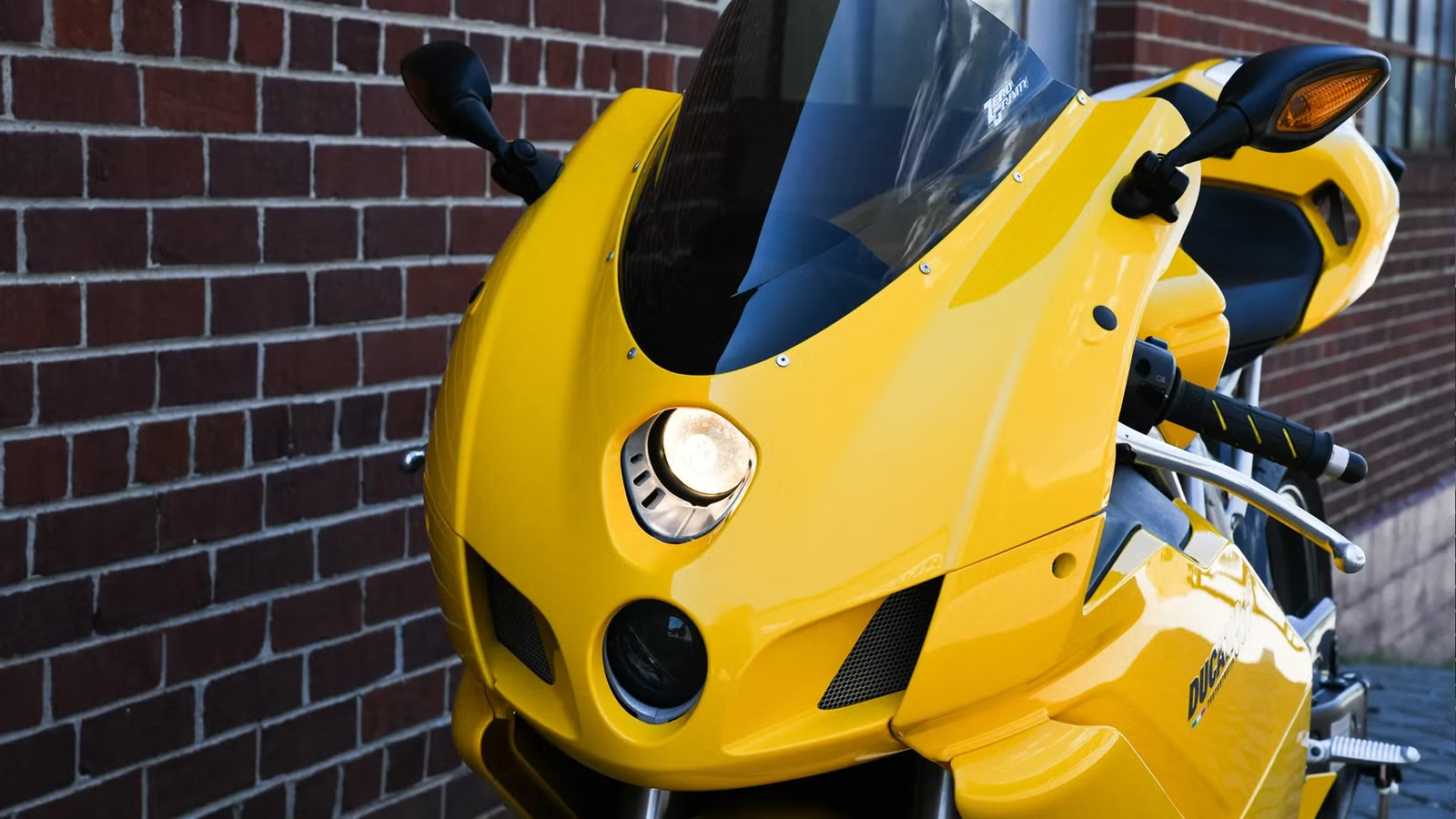
Ducati has always been known for stunning motorcycles, especially after it released the 916 in 1994. But while its bikes have tended to bring Italian automotive passion to the masses, there’s one bike that stood out as the black sheep of the family. Featuring some divisive design choices coupled with modern engineering, the once-hated bike has since gone on to become one of its coolest.
When Superbike Design Was All About Looking Fast

Superbikes never needed to have an explanation. You’d see the design — the fairings, the tucked-in riding position, the race-inspired stance — and immediately know what it was made to do. And, throughout the 1990s, motorcycle manufacturers increasingly treated superbike design as an extension of their racing programs, especially with the influx of homologation specials arising from the 1988 start of the World Superbike championship. Regular riders could suddenly have something that resembled a proper race bike, with the bodywork being a key part of that.
With the advent of these race-inspired bikes, aerodynamics quickly became a defining part of their identity. The fairings were smoother, proportions were more compact and, in some cases, the headlights were one of the few ways to distinguish these as road bikes. Bikes like the Honda CBR900RR Fireblade, the Suzuki GSX-R750, and the Kawasaki Ninja ZX-7R were all designed with one purpose: speed.
This created somewhat of a loop for designers: each bike had to look faster, be faster, and more exotic than the last, while retaining some cohesion for riders to follow. But with each new model came a growing familiarity. Riders needed something different, even if they didn’t know what that was yet.

Ducati Was About To Leave Its Most Famous Design Behind

When it comes to the most beautiful motorcycles, the Ducati 916 has a strong argument. When it arrived in 1994 as the successor to the Ducati 888, its sculpted bodywork, compact proportions, and under-seat exhaust made it instantly recognizable. In distinctive Ducati Red with a white patch behind the seat, it ruled both the roads and the track — winning both the riders’ and constructors’ World Superbike championships three times between 1994–1996.
The 916 gave way to the 996 in 1998, and the 998 in 2002, both of which increased displacement and improved performance while largely keeping the same stunning design. But this success created a problem. Iterating on an already popular design could make it stale and, by the early/mid 2000s, designs were moving away from the softer “jellybean” aesthetic and towards sharper, more aggressive lines. A flagship needed to bear this in mind.
Ducati turned to its design talisman Pierre Terblanche, who had already established himself with the genre-bending Ducati Supermono. He did away with the formula that he himself had helped to create and which had proved so popular, going entirely off-piste and creating something truly different. The only problem was, the people liked the old formula.
The Ducati 999 Was Its Most Controversial Superbike

When the Ducati 999 was unveiled as a replacement for the 998 in 2003, it was clear that Ducati had gone in a different direction. Sure, the name/number was slightly larger than its predecessor, and sure, it was red and had two wheels, but what people were looking at wasn’t a refinement of the previous model. It was different.
For a start, the graceful, flowing lines that had proved so popular were gone. In their place was something decidedly more mathematical-looking, as though each line was a technical choice rather than an emotive one. It had purpose, sure, but character, not so much. Cast your eyes backwards and you’d notice a tail section that seemed taller, exhausts that still remained underneath the seat, and that the single-sided swingarm had disappeared. Okay. But look at the front of the bike and you’d see that rather than two side-by-side headlights that gave the bike a comforting, familiar pair of eyes, it instead had two stacked circular headlights like some sort of horrible, two-eyed Cyclops.
It was, understandably, divisive at launch. The 916 was a legend among the motorcycle community partly for its proportions, which seemed to flow effortlessly from front to rear. It was a high bar to clear and, for some, Terblanche’s design was too angular and devoid of that gorgeous Italian design that Ducati was famed for. To others, though, the 999 was a bold attempt to take Ducati into a new era, and a clear signpost that it was leaving some of its heritage in the past. But beauty is only skin deep, and to look at the 999’s exterior only is to miss more of what made it such an interesting bike.

Beneath the angular bodywork was a liquid-cooled 998 cc V-twin that made 124 HP (one horse more than the 998), with Ducati’s desmodromic valve system and fuel injection, while the chassis was designed with the stresses and strains of high-performance riding in mind. To that end, it had an aluminum trellis-style frame and adjustable suspension, giving it the hardware expected for a flagship superbike. While racing hardware is often expected of a superbike, it was actually part of a stronger connection to the competition side of the company. British rider Neil Hodgson rode a 999 to the WSBK title in 2003, with fellow Brit James Toseland taking the 2004 title. Clearly, this wasn’t just a case of Ducati being different for the sake of being different. The 999 proved, on debut, that it was more than just its looks. It was a bona fide championship winner. And, in racing, form always follows function.
That’s what makes the 999 so interesting in retrospect. It’s easy to look at the appearance and only see the departure from the 916-line of styling, along with the, frankly, uglier headlight format. But the 999 asks a question of what a rider wants from a superbike — is it flowing features, character, and organic lines, or is it simply performance?
The passage of time has allowed people time to acclimatize to the 999 and not see it through the lens of the 916. Ducati did, admittedly, stop using vertically stacked headlights (though the 749 of the same era also featured them) and it can now stand on its own. What seemed strange is now an identity all of its own.
The Ducati 999 Was More Than Just A Styling Experiment

It would be easy to look at the 999 and dismiss it as a styling exercise. Something intended to garner attention and headlines rather than sales. But bikes like that don’t win championships, and they certainly don’t win the first nine consecutive races of a season as Hodgson did in 2003. To do that, they need something decidedly more powerful between the fairings, even on the road-going version. And for the 999, it was its 998 cc Testastretta V-twin engine.
The engine had the strong, powerful performance you’d expect from a flagship Ducati, while the bike itself was designed to handle it. The adjustable suspension, Brembo brakes, and aluminum chassis combined with the power from the engine to create a visceral yet balanced ride.
Ducati took the 999 even further, releasing 999S and 999R variants that pushed power to 134 HP and 150 HP respectively. These were properly powerful, properly serious superbikes. But some people just couldn’t get past the form that they came in.
Why The Ducati 999 Has Finally Gotten Its Due

Thankfully, the years have been kind to the Ducati 999. Any change is usually met with cynicism and, when it comes to the 916 – the bike that partly helped to save Ducati – it’s understandable why people would see any deviation from the design as sacrilege. But, years later, that comparison doesn’t matter as much. The 999 is a bike in its own right, and with its own legacy.
Unlike the 916’s timeless look, the 999 looks decidedly early 2000s. Just like flip phones, low-rise jeans, or trucker hats. Ironically, all things that are coming back into fashion now. But it’s a character that’s hard to replicate, and even harder to pull off. Values are following, as 999s are gradually gaining in value; a regular 999 will set you back around $12,000, while a 999R is around $16,500. Not bad for a bike that people didn’t like on launch.
The 999 remains as a bike that forged its own legacy. It wasn’t happy to follow the pattern set out by its predecessors and, while that path might have been a trickier one, it’s a more interesting bike for it. What was once Ducati’s ugliest superbike is now one of its most unique, as while this ugly duckling didn’t change, peoples’ perceptions of it did.
Sources: Motorcycle Specifications, Motofomo, Motorcycle News, Classic.com, Hagerty

Related posts




Latest Post



No Comments