
1972 Plymouth Road Runner GTX: Chrysler’s Denied Six-Pack
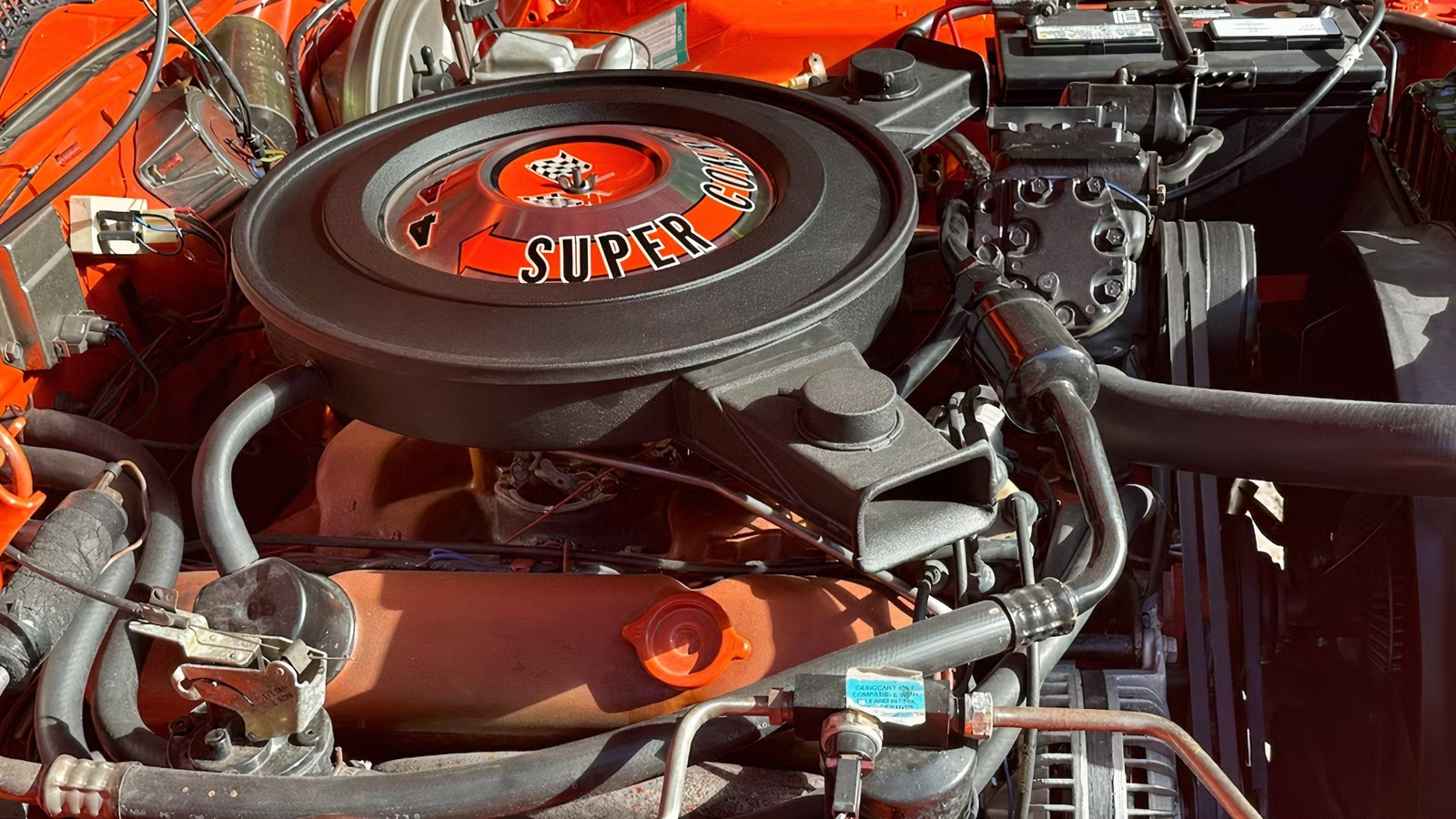
Some muscle car legends get louder with every retelling. This one got quieter, because Plymouth’s own parent company spent years insisting the car in this story simply did not exist. No brochure. No factory paperwork. No official comment beyond a flat denial whenever a collector asked the wrong question. Then a scavenger digging through a salvage yard for spare parts found the proof sitting right there on a data plate, bolted to a car nobody had bothered to protect.
A $150 Salvage Yard Find That Turned Out To Be A 440 Six-Pack Ghost Car

Russell Morgan wasn’t hunting for a legend. He was picking through a North Carolina salvage yard the way Mopar guys do, looking for parts off anything half-decent. A beat-up Rallye Red 1972 Road Runner sat off to the side, with options that didn’t quite add up for a car this rough: an Air Grabber hood scoop and, stranger still, a factory electric sunroof. Curiosity got the better of him, and he leaned in to check the data plate on the dash.
The fifth digit of the VIN read “V.” Any serious Mopar collector knows exactly what that letter means on a big-block B-body, and it isn’t subtle. A V-code meant a factory 440 Six-Pack: three two-barrel Holley carburetors stacked on a cast-iron intake manifold by that point in production. Problem was, according to Chrysler and basically every Mopar reference book in print, that engine never made it into a 1972 car. Morgan bought the whole thing anyway, clean title included, for $150. When he later tracked down a Chrysler official to confirm the VIN, he got stonewalled. He was told, flatly, that the car was a fake and shouldn’t be talked about.
Why Chrysler Buried Its Own 440 Six-Pack Option


Chrysler didn’t invent the rumor. Its own dealer literature, printed in the spring of 1971, promised the 440 Six-Pack would return for 1972 on both the Road Runner GTX and the Dodge Charger. Then the Clean Air Act’s tightened emissions certification requirements landed, and the triple-carburetor setup couldn’t clear the new bar. A cancellation notice went out to dealers later that same year, citing emission control difficulties, and the option was pulled from the order books before it ever reached general production.
Here’s why that mattered so much more than a simple spec change. Selling an uncertified engine to the public wasn’t just an embarrassing footnote, it was a federal compliance violation under the Clean Air Act. A handful of cars had already slipped out the door in that narrow window between order-taking and the cancellation memo, and acknowledging their existence meant acknowledging Chrysler had let something illegal reach a customer’s driveway. Outright denial was the easier path, and Chrysler stuck to it for decades.
The Engine Chrysler Wasn’t Supposed To Build In 1972

The numbers on paper look almost modest next to the muscle car glory years, and that’s the point where a lot of casual readers get the story wrong. A base 1972 Road Runner ran a 400 cubic inch V8 rated at 225 horsepower. Step up to the optional 440 four-barrel and you got 280 horsepower for $153 extra. The Six-Pack, when Chrysler still intended to build it, was rated at 330 horsepower and 410 lb-ft of torque, a genuine jump over the standard big-block. It was never offered again after that single, brief production window closed. No 1973 or 1974 Road Runner ever carried a factory 440 Six-Pack, whatever secondhand rumors might claim otherwise.
Morgan’s own car matched that spec exactly: a numbers-matching 330-horsepower engine with a high-lift cam, paired to an automatic transmission. It rolled off Chrysler’s St. Louis assembly line in early August 1971, built for a model year that officially never offered the engine it was carrying.
Why The 330 Horsepower Rating Undersells This Engine

The year 1972 marked the point at which the entire American auto industry switched from SAE gross horsepower ratings to SAE net, a measurement taken with all the accessories, exhaust, and emissions equipment actually bolted on rather than stripped off for a friendlier dyno number. That single change made big-block engines look like they’d lost fifty or more horsepower overnight when the hardware underneath had barely budged. A 330 net rating on the ’72 Six-Pack reads modest today, but the same basic engine had been rated at 385 horsepower under the old gross measurement just a year earlier. The car wasn’t weaker than its late-1960s ancestors. It was just being measured honestly for the first time.
Just How Rare Is A 1972 V-Code Road Runner GTX?

Total Road Runner production for 1972 landed at 7,628 units that year, a brutal 50 percent drop from the year before as insurance rates and emissions rules squeezed the whole muscle car segment. That’s the pool everything else gets measured against, and the overwhelming majority of those cars left the factory with the base 400 or the milder 340. Even the standard 280-horsepower 440 was a minority option. The Six-Pack sat at the very bottom of that funnel, a performance option Chrysler tried to cancel before a single customer ever got to order one.
Put that against a car most enthusiasts already treat as the gold standard of scarcity. The 1971 Hemi ‘Cuda convertible, one of the most mythologized muscle cars ever built, saw roughly a dozen units leave the factory, and it commands seven-figure sums at auction on the strength of rarity alone. A 1972 V-code Road Runner GTX exists in numbers that don’t clear that dozen-car threshold either way you count it.
The Survivor Count Debate That Still Divides Mopar Historians

Ask two different sources how many of these cars actually exist and you’ll get two different answers, and both come from people who’ve done real legwork. Jalopnik and Mopar Connection Magazine put the documented total at three: Morgan’s Rallye Red Road Runner GTX, plus two 1972 Dodge Charger Rallyes built in that same narrow pre-cancellation window. One of the Chargers was a red car once owned by Ron Slobe of R&R Salvage, last known to have headed toward the east coast after his passing. The other, painted Top Banana Yellow, never strayed far from Detroit and stayed with the same family for years.
A separate valuation resource, Hagerty, tells a slightly different story, putting the number at five cars believed to have been delivered with the factory Six-Pack, without naming the other two beyond Morgan’s car and the documented Chargers. Nobody disputes that this is a single-digit production run. What’s genuinely unsettled is whether two more of these cars are sitting in a garage somewhere, undocumented, or whether those fifth and sixth cars only ever existed on a factory order sheet that got voided before assembly.
A Plain-Looking Coupe Hiding Chrysler’s Biggest 440 Six-Pack Secret

Park a 1972 V-code Road Runner GTX next to almost anything else from the golden era of Mopar muscle and it doesn’t scream for attention. No Hemi badge, no winged spoiler, nothing that visually separates it from a thousand ordinary Road Runners built that same year. That’s exactly why it slipped through a salvage yard undetected for who knows how long, and why it took someone who actually knew how to read a VIN plate to recognize what was sitting in front of them.
Mopar enthusiasts have spent decades chasing documentation on cars far less consequential than this one, and this is a machine Chrysler itself tried to erase from the record. Every fender tag, every factory broadcast sheet, every restoration that surfaces on one of these cars chips away at a denial that never should have outlived the paperwork that proved it wrong. The rest of the story is still out there in somebody’s garage, waiting for its own version of a $150 find.
Quick Answers About The 1972 V-Code Road Runner GTX
A few of the most common questions collectors ask about this car, answered directly.
What does the V-code mean on a 1972 Mopar VIN?
The fifth digit of the VIN identifies the factory engine. A “V” in that position designates a 440 Six-Pack, the triple two-barrel carburetor setup Chrysler canceled in a narrow window after 1972 order-taking had already opened, before the option ever reached general production.
Why didn’t Chrysler officially sell the 440 Six-Pack in 1972?
The engine failed to clear the EPA’s tightened emissions certification standards under the Clean Air Act. Chrysler sent a cancellation notice to dealers, and selling an uncertified engine to the public would have been a federal compliance violation, which is why the company denied the option ever reached production.
How many 1972 V-code Road Runner GTX cars still exist?
Sources disagree. Some enthusiast publications document three surviving 1972 V-code cars total, one Road Runner GTX and two Dodge Charger Rallyes. A separate valuation source puts the number at five cars believed to have been delivered, without identifying the other two beyond what’s already documented.
Sources: Jalopnik, Hagerty, Mopar Connection Magazine, Bring a Trailer.

Related posts



Latest Post


No Comments