The German Family SUV That Got More Powerful And More Efficient At The Same Time
13 minutes reading
Thursday, 25 Jun 2026 18:00 0 39 autotech
The SUV market is getting more diversified and competitive every year. Effectively, every brand is now making them, and traditional market leaders like Land Rover and Ford have a lot to worry about in the modern market. With improved tech, modern designs, oodles of usability, and good on-road behavior, the modern SUV market has increasingly crossed over from mud-hunting brutes to everyday companions, and there are more to choose from than ever.
German SUVs tend to mean a couple of things: luxury, power, and flawless design. When we think of fuel-efficient and powerful SUVs, it is generally Japanese or Korean iterations from the likes of Lexus and Hyundai that we think of. However, 2026 and 2027 are the years of SUV updates and facelifts, and a three-row SUV made by Volkswagen has just gotten more powerful and more fuel-efficient at the same time.
Front 3/4 shot of red 2026 Toyota RAV4 PHEV parked in parking lotToyota
Across the 2026 and 2027 three-row family SUV market, things have become clearly more techy; today, a family SUV can’t just be good for getting people and pets in. Things have moved from a simple screen to full cabin integration very quickly.
Models like the new Grand Highlander now run a 12.3-inch setup in higher trims, with Toyota’s latest multimedia system bringing all sorts of connectivity. The 2027 Hyundai Palisade will come equipped with semi-autonomous refinement, with dual 12.3-inch curved displays, a more advanced Highway Driving Assist rig, and smoother stop-and-go adaptive cruise control.
2027 Kia Telluride SXP front 3/4 shotKia
Even the well-priced 2027 Chevrolet Traverse, which has a starting price of around $43,000, gets an 11-inch driver display, a large central touchscreen controlling tri-zone climate control, drive modes, and navigation, plus Google Built-In.
The SUV segment has become a software platform, and today, a family SUV can be seen as lacking without traffic updates, a good sound system, different drive modes, big screens, and a host of driver-assist features. Even if you can carry plenty and offer generous seat space.
More Power Without The Fuel Economy Penalty
Front 3/4 action shot of 2026 Kia Niro Hybrid driving on roadKia
Near the top of most people’s lists are fuel economy and power. Many are happy to trade away huge horsepower and speed for better fuel economy in a family SUV, but some options in today’s market mean you don’t have to. The 2026 Grand Highlander Hybrid MAX gets a 2.4-liter turbocharged engine paired with motors to shift out 362 horsepower.
More importantly, its powertrain is designed to fill torque gaps, so there is little to no lag at low speeds. The Grand Highlander Hybrid MAX weighs in at 4,905 pounds, but despite this, it can still tow 5,000 pounds while still achieving 27 combined mpg.
The new Mazda CX-90 follows a similar recipe, albeit executed slightly differently. You get a 3.3-liter mild-hybrid inline-six good for 280 horsepower and 332 pound-feet of torque as standard, which can achieve 25 combined mpg. The CX-90 can carry up to 75.2 cubic feet of stuff around, and has a starting price of under $40,000. Efficiency is no longer a nice bonus for a powerful engine, and the best three-row family SUVs are adopting this mantra while still offering real SUV usability.
The Most Refined Volkswagen You Can Buy Today
Volkswagen’s best-kept secret in the SUV world offers smooth driving, comfort, and value that is hard to match in 2026.
The 2027 Volkswagen Atlas Just Got A Whole Lot Better
Front 3/4 shot of 2027 Volkswagen Atlas parked at auto showBrett Evans / CarBuzz / Valnet
Available to order sometime near the fall, the 2027 Volkswagen Atlas three-row SUV has been given a very noticeable facelift and a number of upgrades compared to its 2026 sibling. Aside from the bolder look, nicer cabin, and better tech, it gets upgrades where things matter most in the modern market.
Base Trim Engine
2.0-liter turbo Inline-4
Base Trim Transmission
8-speed automatic
Base Trim Drivetrain
All-Wheel Drive
Base Trim Horsepower
269 hp
Base Trim Torque
273 lb-ft
Make
Volkswagen
Model
Atlas
Segment
Midsize SUV
Volkswagen says four trims are expected for the new Volkswagen Atlas: the S, the SE, the SEL, and the SEL Premium. They are expected to have the following estimated prices.
2027 Volkswagen Atlas
S
SE
SEL
SEL Premium
Expected MSRP
$40,000
$45,000
$50,000
$55,000
More Power Makes This Three-Row SUV Easier To Live With
Close-up shot of 2027 Volkswagen Atlas engine bayVolkswagen
The biggest upgrade the new Atlas will benefit from is a more powerful engine compared to last year’s still-capable iteration. It will have the following engine specifications.
Spec
2026 Volkswagen Atlas
2027 Volkswagen Atlas
Engine
2.0-Liter Turbocharged Inline-Four
2.0-Liter Turbocharged Inline-Four
Transmission
Eight-Speed Automatic
Eight-Speed Automatic
Horsepower
269 hp
282 hp
Torque
273 lb-ft
258 lb-ft
Both the 2026 and 2027 Atlas have an EA888 turbo-four under the hood, but the 2026 model is running an “Evo4” mill while the 2027 model gets an “Evo5” engine. Torque output is slightly down, but VW says you will still be able to tow up to 5,000 pounds with it when properly equipped, and overall high-rev acceleration will be smoother. The main difference between the two engine configurations, aside from power output, comes down to tuning and a better cooling system, which improves things where it matters most for saving money: filling up.
Improved Efficiency Lowers The Costs
Close-up shot of 2027 Volkswagen Atlas rear badgeVolkswagen
Both the 2026 and 2027 Atlas models are equipped with a FWD configuration as standard, with 4Motion AWD available on all trims. FuelEconomy.gov says that a front-wheel-drive 2026 Atlas can achieve a maximum of 23 combined mpg (20 mpg city/27 mpg highway). It also says that the all-wheel-drive models can achieve 22 combined mpg (20 mpg city/26 mpg highway).
Close-up shot of 2027 Volkswagen Atlas 4Motion badgeVolkswagen
For the 2027 model, though, FuelEconomy.gov says that the front-wheel-drive Atlas models can achieve an estimated 25 combined mpg (22 mpg city/29 mpg highway), while the all-wheel-drive models can achieve 23 combined mpg (20 mpg city/27 mpg highway). That may not sound like a lot, but you do get more power from the engine, and it is estimated to cost less in gas per year at base level, with comparable costs on 4Motion AWD. The estimated fuel costs for both the 2026 and 2027 Atlas models are as follows.
2026 VW Atlas
2026 VW Atlas 4Motion
2027 VW Atlas
2027 VW Atlas 4Motion
Cost To Drive 25 Miles
$4.51
$4.72
$4.15
$4.51
Annual Fuel Cost
$2,700
$2,850
$2,500
$2,700
12 Three-Row SUVs Ranked By Real-World Cost Per Mile
Not all three-row SUVs cost the same to own and drive. We rank 10 models by real-world cost per mile, from best to worst.
Why The Atlas Now Stands Out In A Crowded Segment
Front 3/4 shot of 2027 Volkswagen Atlas parkedVolkswagen
The three-row SUV market is very alive at the moment. Brands are getting better at providing family-friendly space while still maintaining good fuel efficiency and a modern, comfortable ride. The latest refresh for the Atlas doesn’t just bring a few more horsepower and better efficiency; most things about it look newer and better suited to today’s roads.
Another big change for the new Atlas is the use of VW’s MQB Evo architecture. This isn’t just a tweaked version of the old MQB version, but a properly updated modular platform that brings a stiffer structure and more modern electrical integration. That means a more stable ride on the highway and, if VW ever wants to turn the Atlas into a hybrid, an easier platform to work from.
Front shot of 2027 Volkswagen Atlas parkedVolkswagen
Then there is the new look; it is a smart clean-up rather than a full rethink. The 2027 Atlas retains its upright look and remains very much a boxy family SUV, but everything has been tightened and smoothed so it looks more in step with VW’s newer design language.
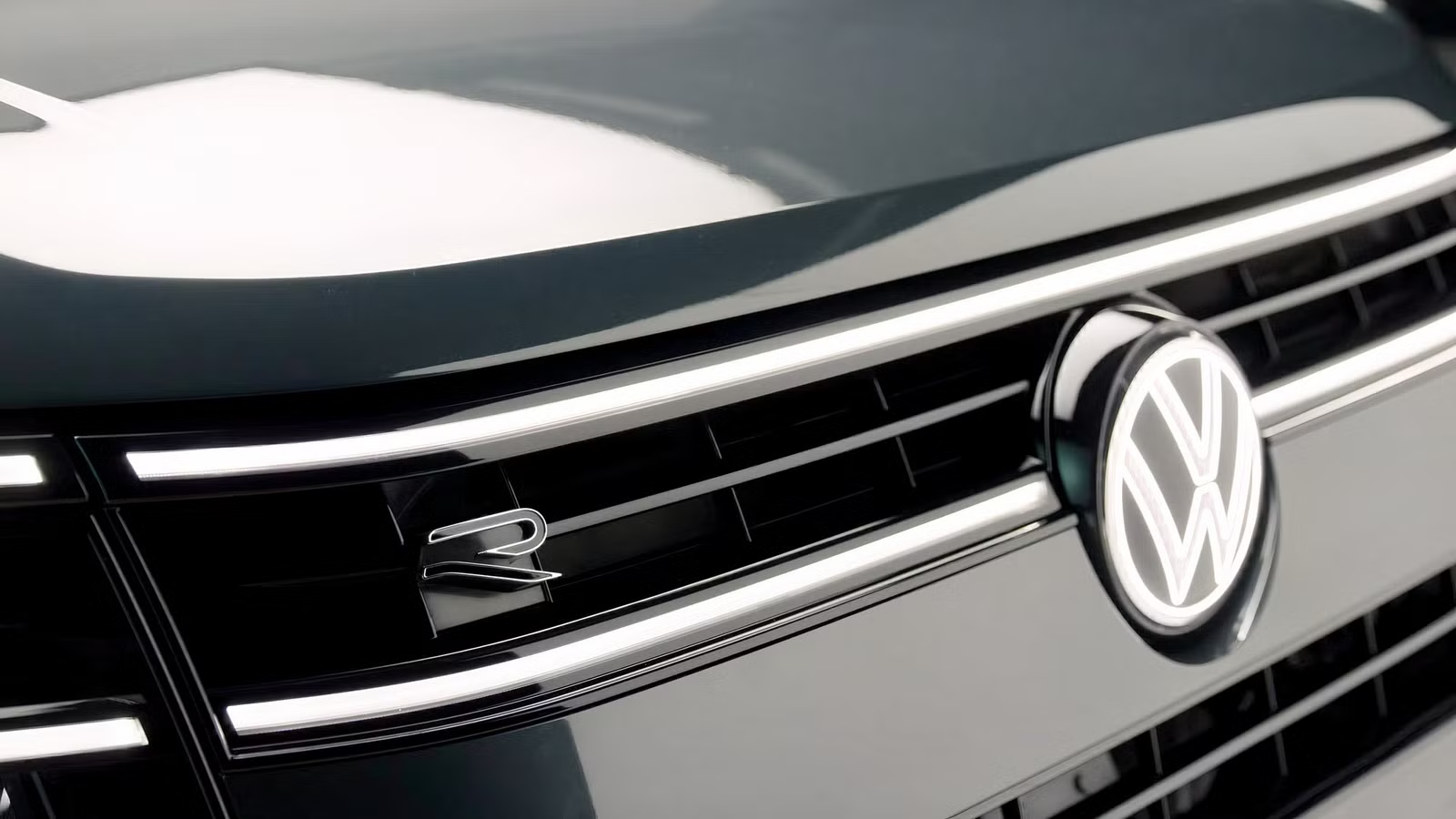
Up front, the headlights are slimmer, and they’re now tied together by a light bar that runs across the nose into the VW badge. The result is a wider-looking front end and a more modern stance. The grille is also cleaner, sitting lower and looking less busy, while smoothed-out side panels replace the more creased ones from the 2026, and the rear gets a full-width lighting element that links the taillights paired with a tidier-looking tailgate design.
Few Three-Row SUVs Balance Space And Efficiency This Well
VW has thrown a lot at the Atlas redesign to make it look and feel more like a modern three-row family SUV, but they haven’t forgotten that it actually still has to be used. Alongside the better fuel economy and updated exterior, the new Atlas takes on some of the more revered three-row SUVs in terms of versatility.
As standard, the new Atlas seats up to seven people, while second-row captain’s chairs are available (which takes seating capacity down to six). It offers an estimated total passenger volume of 154 cubic feet, and space across all three rows is generous. Some other three-row SUVs have more legroom in the third row, but the new Atlas still holds its own. It has the following interior dimensions.
Headroom
Shoulder Room
Hip Room
Legroom
Front Row
41.3. Inches
61.5 Inches
58.4 Inches
41.7 Inches
Second Row
40.4 Inches
60.5 Inches
58.6 Inches
37.6 Inches
Third Row
38.3 Inches
54.9 Inches
45.1 Inches
33.7 Inches
On top of that, there is also a generous amount of cargo space. Behind the third row, there is 20.6 cubic feet of space; behind the second, 55.5 cubic feet; and a maximum cargo capacity of 96.6 cubic feet. Bearing in mind that the Atlas is a mid-size three-row SUV, these figures are quite impressive.
The second-row bench seats are 60/40 split and fold flat, and the third row is 50/50 split and also folds completely flat. Yes, something like the 2027 Kia Telluride Hybrid will be available with a turbo-four hybrid good for 329 horsepower and up to 31 combined mpg, but it can only hold a maximum 89.3 cubic feet of cargo.
Updated Powertrain Fixes One Of Its Biggest Weaknesses
Profile shot of 2027 Volkswagen Atlas parkedVolkswagen
According to J.D. Power ratings, the 2026 Volkswagen Atlas is rated 75 out of 100 overall. This isn’t a bad rating, but models like the Chevrolet Traverse get 84 out of 100, and the Honda Pilot gets 83 out of 100. The gap between these models doesn’t work in its favor; however, the Atlas is still one of the most refined VWs you can buy in a competitive market.
Many owners rate the Atlas highly for what it does best: space, comfort, and relaxed driving. Cabin comfort and seating are often rated highly (owners on Kelley Blue Book rate it 4.4 out of 5 for comfort and 4.5 out of 5 for styling), with many noting that it feels more premium than the relatively low price tag suggests. Where complaints have crept in is due to consistency.
Some owners mention that the engine in the 2026 model can feel less than polished when you have fully loaded the Atlas or when you need a bit sharper acceleration. Others say that the stop-start and low-speed responses are not always as smooth as those of something like the Pilot. These are not deal-breaker issues, but they do prevent the previous model year of the Atlas from being all-around refined.
Now, with the latest visual updates, the adoption of the MQB Evo platform, and the addition of the Evo5 turbo-four, the 2027 Atlas looks set to reach the long-term levels of refinement that the rest of the build has achieved. There is still no word on a hybrid powertrain for the Atlas, but in terms of smooth turbo-four power from the long-running EA888, the new Atlas looks to be ticking all the right boxes and building on the solid foundation laid down by the Touareg and Tiguan models. A recent CarBuzz test drive of a 2027 VW Atlas prototype sums it up well.
VW has now learned how to harness the essence of what consumers liked about those cars, namely the German build quality and premium features, but offer them at a budget-friendly price. If the Atlas can pull off the same trick as the Tiguan but in the three-row segment, VW might be able to put up a serious fight against the Hyundai Palisade and Kia Telluride.
6 Three-Row SUVs That Deliver Premium Space Without Premium Costs
You don’t have to pay premium prices to have the most spacious SUV for your large family. These mainstream three-row midsize SUVs have lots of room.
The 2026 Volkswagen Atlas Is The Family SUV Sweet Spot
Front shot of 2027 Volkswagen Atlas parkedVolkswagen
Looking at the new VW Atlas in terms of value for money, it is very compelling from the outset. With a starting price around $40,000, that puts it in the same ballpark as the 2027 Telluride ($39,190), the 2027 Santa Fe ($39,000 expected), and the 2026 Grand Highlander. CarEdge estimates that an Atlas three-row SUV will cost you, on average, $56,928 to own over five years, and rates it “C-” for its value rating.
CarEdge also says that a Telluride will cost you $59,969 over five years, and rates it “D+” for value rating; a Santa Fe will cost you $55,051 over the same time, and a Grand Highlander will cost you $47,873 over the same time. So while some of its closest rivals are cheaper to own over time, not all of them are. It can also be argued, especially with the newest updates, that the new Atlas brings considerably more refinement and class while still balancing costs.
Shot of 2027 Volkswagen Atlas interior showing cabinVolkswagen
Inside, the Atlas is set to go fully digital, with a 12.9-inch central touchscreen paired with a 10.3-inch digital gauge display as standard, while a 15-inch touchscreen is available on higher trims. Wireless Apple CarPlay and Android Auto are standard, OTA updates are included, and a 14-speaker Harman/Kardon audio system is available on the top trim. VW has integrated most secondary controls into the screen, but key shortcuts and haptic-style touch zones remain to avoid the “buried” menu feel common to many modern SUVs.
Entry-level models will feature soft-touch materials and straightforward cloth or leatherette seating, while higher trims bring increasingly premium upholstery, including contrast stitching, quilted leather, nicer door panel materials, and a more refined dashboard. Ambient lighting is standard across all trims; air conditioning is provided across all three rows, while heated and ventilated front seats and heated rear outboard seats are available.
Close-up shot of 2027 Volkswagen Atlas taillightVolkswagen
The new Atlas still isn’t at the fuel-efficiency levels of something like the Niro Hybrid (53 combined mpg), and it may not match the cargo capacity of the Chevy Traverse (97.6 cubic feet), but it delivers considerably more in the way of refined German luxury without the German price tag.
The refresh has delivered a fine balance of real usability, improved fuel efficiency, more power, and a handsomely updated exterior without the price going overboard, and without sacrificing the comfort credentials and practical edge the Atlas has become known for — the definition of real-world improvement in an SUV.
Sources: Volkswagen, FuelEconomy.gov, CarEdge, Kelley Blue Book, and J.D. Power.













No Comments