
Dodge Daytona IROC R/T: Chrysler’s Rarest Turbo Coupe
Chrysler spent the tail end of the 1980s chasing a reputation it hadn’t held in decades: a company that could actually build something quick. The K-car had kept the lights on through the worst of it, but by the early 1990s a small team inside the company had turned that humble economy platform into the basis for something nobody expected. A turbocharged flagship arrived wearing a name borrowed from a famous racing series, built in numbers so small that most dealers never even saw one. It disappeared almost as fast as it showed up, and almost nobody noticed either.
The Forgotten Era Of Chrysler’s Turbocharged Performance Cars

Chrysler’s turbo program in the 1980s gets remembered, when it gets remembered at all, as a punchline. The early Turbo I and Turbo II engines stuffed into K-car derivatives were rough, laggy, and about as glamorous as a rental car. But underneath the jokes sat a genuinely stubborn engineering effort, one that kept pushing the same 2.2-liter block further every couple of years while the rest of the industry assumed front-wheel-drive compacts had no business chasing real performance numbers.
By the end of the decade that stubbornness paid off in a way almost nobody saw coming. Chrysler’s engineers had squeezed genuine horsepower out of an engine family that started life powering grocery-getters, and they did it without the V8 displacement everyone else leaned on. Two cars, built in tiny numbers and sold almost apologetically, ended up carrying that whole era’s reputation. One was a sedan. The other is the car this story is actually about, and it came from an unlikely place: a partnership Chrysler struck with a British racing outfit most Detroit executives had never heard of.
A European Engineering Partnership Nobody Talks About Anymore


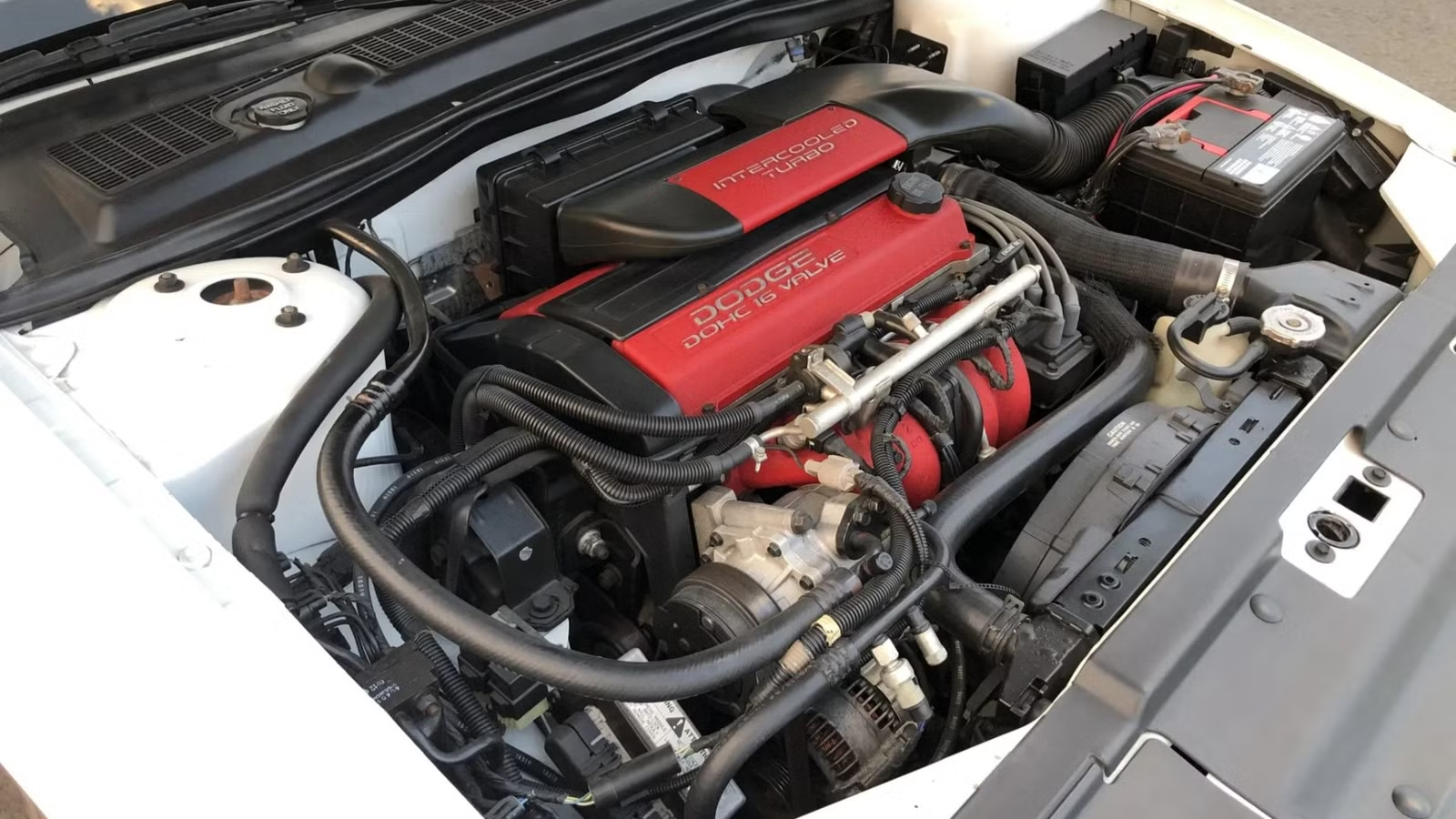
Lotus doesn’t come up much in conversations about American performance cars from this era, and that’s a shame, because the British engineering firm quietly did some of its best work on a Chrysler assembly line. Lotus designed the double overhead cam, 16-valve cylinder head that turned Chrysler’s aging 2.2-liter four into something worth taking seriously, badged internally as the Turbo III. Paired with an intercooled Garrett turbocharger and a direct ignition system, it made numbers that embarrassed cars costing considerably more.
The partnership never got much fanfare, and Chrysler never leaned hard into the Lotus name the way a modern automaker would chase that kind of marketing gold. It just built the engine, dropped it into two of its most overlooked models, and moved on. One of those two cars was a mid-size sedan that briefly humiliated European sport sedans costing twice as much. The other was a coupe, and it turned out to be the last and rarest expression of everything that engine could do.
The 1992 Dodge Daytona IROC R/T Was Chrysler’s Answer To The Icons

That coupe was the 1992 Dodge Daytona IROC R/T, and it deserves a lot more attention than history has given it. Under the hood sat the Turbo III in its most aggressive tune, making 224 hp and 217 lb-ft of torque, routed exclusively through a heavy-duty Getrag five-speed manual because Chrysler never bothered offering an automatic. In a roughly 3,000-pound front-wheel-drive coupe, that combination was good for a 0 to 60 mph run in the low six-second range and a quarter mile in the low 14s at around 98 mph, numbers that stacked up shockingly well against front-engine, rear-drive rivals wearing far more famous names.
Pricing told a different story. A 1993 Daytona IROC R/T stickered at roughly $19,000, which put it about $2,000 above a new Chevrolet Camaro Z28 and roughly $4,000 above a Ford Mustang LX 5.0 hatchback. That gap put the Daytona in an odd spot: genuinely faster than the pony cars it was priced against, but expensive enough that plenty of buyers walked past it toward a cheaper, more familiar badge instead.
How It Out-Accelerated The Cars Wearing Its Own Racing Name

Here’s the detail that makes this car worth remembering. Chevrolet had licensed the IROC name, borrowed from the International Race of Champions series, for its Camaro Z28 starting in 1985, and the IROC-Z badge became shorthand for the fastest Camaro money could buy. That licensing deal expired after the 1990 model year, and rather than renew it, Chevrolet let Dodge pick up the sponsorship and quietly went back to calling its top Camaro a Z28.
Dodge slapped that same IROC name onto the Daytona almost immediately, and the irony writes itself. The last IROC-Z Camaros, built through the 1990 model year with the 5.0-liter TPI V8 and a five-speed manual, ran 0 to 60 mph in about 6.9 seconds in period testing. The Daytona that inherited its name and its racing pedigree beat that time by the better part of a second. A cheap front-wheel-drive turbo four, wearing a badge it borrowed from a car it had never even shared a showroom with, ended up quicker than the Camaro that made the name famous in the first place.
Why This Coupe Is Rarer Than Its Own Sedan Sibling

Rarity is where this car gets genuinely strange. Total production across the Daytona IROC R/T’s entire run landed at 553 units, split across two model years before Chrysler pulled the plug for good. That is astonishingly small for a car sold through a national dealer network, and it gets smaller still when you set it against the sedan that shared its exact drivetrain.
The Dodge Spirit R/T, built alongside the Daytona on the same Turbo III engine and the same Getrag transmission, sold in far greater numbers despite being arguably the less exciting car to look at. Total Spirit R/T production landed at 1,399 units across its own two-year run, meaning Chrysler built roughly two and a half Spirit R/Ts for every Daytona IROC R/T that left the factory. The coupe was the flashier, sportier car of the pair, and it’s the one almost nobody bought.
The Production Number Debate Still Dividing Owners

Ask ten Mopar owners how many Daytona IROC R/Ts actually exist and you’ll get at least three different answers, because the production data on this car is genuinely messy. A specific color count has been repeatedly confused with total production, and that mix-up has calcified into misinformation that’s worth untangling properly here.
The clean version, cross-referenced against dedicated production registries and independent automotive coverage, breaks down like this: Chrysler built 341 examples in 1992 and another 212 in 1993, for a combined total of 553 cars. Within that 1992 run, only 75 were finished in Bright White Clear Coat, a far smaller subset than the full year’s production. That 341 figure gets misapplied to white cars specifically often enough to be worth correcting here, since the mistake actually understates just how rare the car is in any color.
A Turbocharged Experiment Chrysler Chose Not To Repeat

The Daytona nameplate didn’t survive much past its turbo swan song. The 1993 model year was the Daytona’s last, and Chrysler replaced it with the Dodge Avenger, a car built on Mitsubishi’s DSM platform rather than anything homegrown. The Lotus-designed head, the Getrag five-speed, the whole Turbo III program that had quietly powered Chrysler’s best K-car-derived performance cars — it all went away and never came back in that form.
What got lost wasn’t just an engine. It was a specific kind of scrappy, underdog engineering that took a platform nobody respected and turned it into something that could genuinely embarrass cars twice its price and reputation. Chrysler never built another front-wheel-drive turbo four with that kind of ambition, and the segment it briefly dominated eventually got handed over to Japanese imports that took the formula further than Detroit ever bothered to again. The Daytona IROC R/T isn’t remembered as a landmark because almost nobody remembers it at all, and that’s precisely what makes finding one today feel like uncovering a piece of Mopar history everyone else forgot to write down.
Sources: Jackson Simler’s Daytona/Spirit R/T Registry, Bring a Trailer.

Related posts


Latest Post


No Comments