
10 Kawasaki Bikes Worth Owning At Least Once
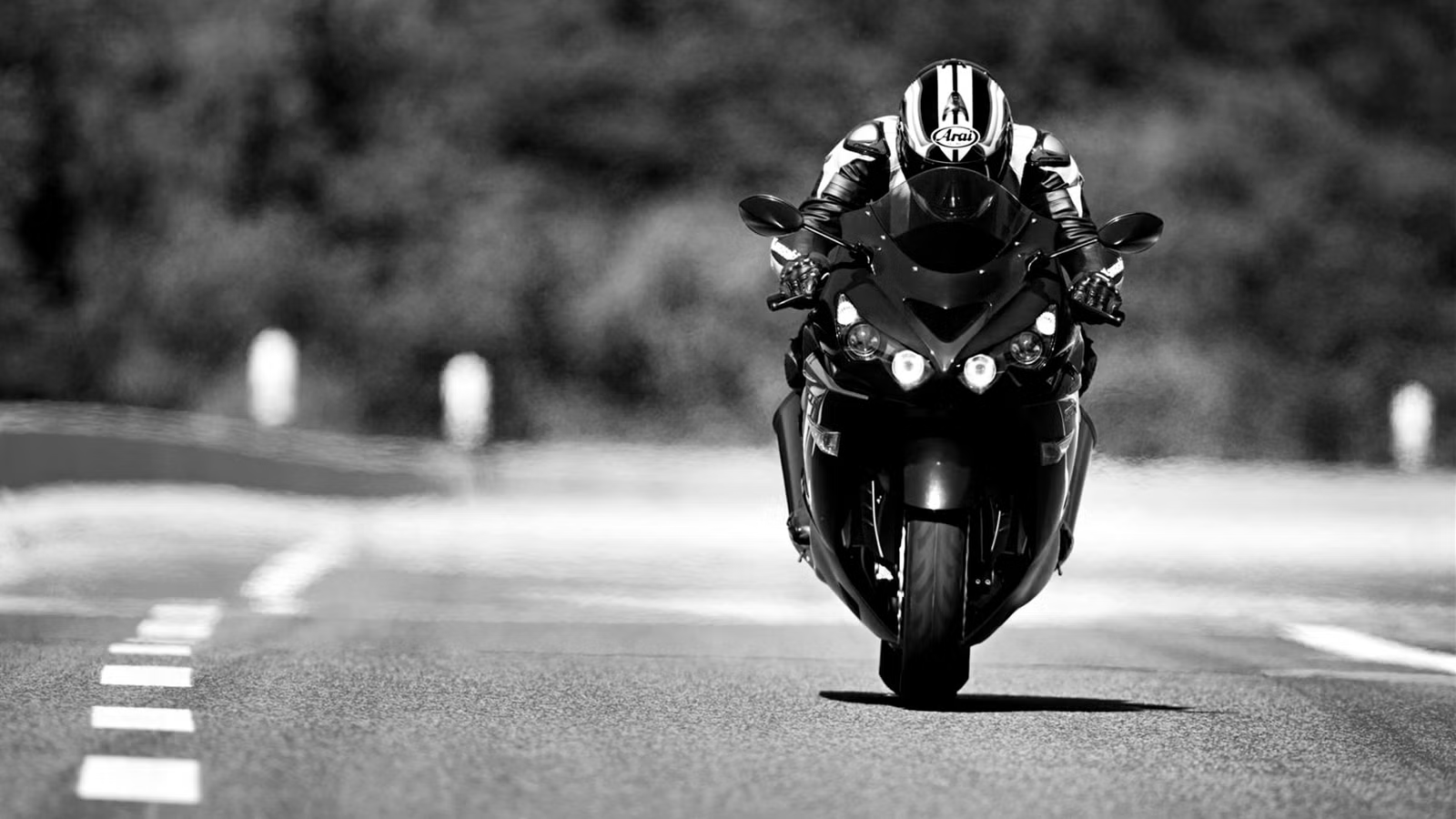
Among the Big Four from Japan, Kawasaki largely serves as a sensible option today. That’s down to its recent focus on usable and accessible motorcycles rather than attacking the exciting end of the segment. However, look at the lineup, and you will find some brilliant bikes well worthy of the exciting tag. So much so that you’ll be tempted to have them in the garage at least once. We’re talking about 10 such bikes from Kawasaki here, three of which are old-school icons.
KLX300SM
Price: $6,049

If fun is what you crave, you need to own the KLX300SM for serious fun-per-dollar. This is Kawasaki’s largest road-legal supermoto, and fun is its USP. It will let you attack trails, learn wheelies, or set a record on a kart track without ever breaking a sweat.

As for the mechanicals, the 300SM is essentially a KLX300 underneath. So you get Kawasaki’s 292cc single-cylinder engine, housed in a semi-double-cradle chassis. This package sits on 43 mm USD forks (9.1 inches of travel) and a monoshock (8.1 inches of travel), topped with 17-inch spoke wheels.
Ninja ZX-4RR
Price: $9,999


The Ninja ZX-4RR is the ultimate entry-level sports bike, thanks to its 399cc inline-four engine. So you get midweight performance (~78 horsepower in EU trim) and a symphonic exhaust note, without the heft or large dimensions of a midweight. It also revs to the moon, breaching 14,000 RPM–something you can’t say about any other sub-400cc machine today.

The RR variant further emphasizes performance. It has premium Showa suspension, comprising adjustable SFF-BP forks and a ZX-10R-like BFRC monoshock. A quickshifter and special livery top things off. You should also know that the MY25 KRT ZX-4RR will save you $300 (if you can find one in stock).
Z7 Hybrid
Price: $12,499

The Z7 Hybrid deserves to be taken home just because of its one-of-a-kind experience. No, there’s no supercharger or earth-shattering inline-four here. Instead, you get the world’s first strong hybrid motorcycle experience. This is courtesy of a blend of a 451cc parallel-twin engine from the Z500 and a mid-mounted electric motor from the Z e1.

So you can pick between full EV, full ICE, or a hybrid riding experience. At the same time, there’s an automatic transmission that does the shifting for you. Kawasaki further claims you can expect serious performance with the E-Boost engaged. Oh, and there are $4,000 discounts on the MSRP right now.
Ninja ZX-14R
Price: $17,599

As it stands, the Ninja ZX-14R doesn’t have a MY26 or MY27 version. That means it’s your last chance to buy this beast new and we’d suggest grabbing the opportunity with both hands. Why, you ask? Well, because this is Kawasaki’s fastest naturally aspiration Ninja ever. It’s courtesy of the 1,441cc powerhouse with almost 200 horsepower and 120 pound-feet.

The torque, along with its long and low nature, helps the 14R do a quarter-mile in under 10 seconds without any upgrades. Performance aside, the bodywork hides a distinct monocoque chassis, adjustable suspension, and Brembo brakes.
Versys 1100 SE LT
Price: $19,499

What you’re looking at is Kawasaki’s most premium crossover touring bike. We get the SE LT version in the US as standard, so this is decked out with everything you’ll ever need on your tours. Some of the highlights include:
- Cornering lights
- Showa electronic suspension
- Color-matched saddlebags
- Six-axis IMU-aided electronic aids
- Adjustable windscreen
- Heated grips
- TFT display with phone connectivity

Rounding things off is Kawasaki’s ultra-refined 1,099cc inline-four engine. This produces 133 horsepower and 82.5 pound-feet, all of which is concentrated under 9,000 RPM. That helps you sit at freeway speeds effortlessly, while ensuring class-leading efficiency.
Ninja H2 SX
Price: $29,999

When the world was stroking out liter-class engines to eke out more power, Kawasaki took help from its other divisions to set a new precedent in the liter-class space. It whipped up a special supercharger to pair with the 999cc engine and built the bike around that. Then, the brand decided to one-up things, birthing a touring and naked bike built around the idea.

And voila! What you have here is the world’s only supercharged touring bike. This isn’t a half-hearted effort, either. Kawasaki has retuned the engine for more kick lower in the RPM, thrown in a new subframe for extra load-carrying ability, and there are a handful of creature comforts as standard. The latter comprises electronic suspension, hill hold, blind spot detection, adaptive cruise control, heated grips, and IMU-based cornering lights.
Ninja H2
Price: $34,400

Almost $35,000 for a Japanese superbike is steep in any universe. Yet, the H2 justifies the moolah. How? By getting you the world’s most powerful superbike package. That’s down to the above-mentioned supercharged engine from the H2 SX, albeit in its most powerful road-legal tune with 240 horsepower.

Everything else is built with speed in mind, too. The design catches the eye first, with sleek lines giving the H2 a distinct look even after 10 years since its debut. A closer look reveals KYB AOS forks and an Ohlins monoshock, which clamp onto a bespoke trellis chassis. Oh, and the paint is self-healing!
Vulcan VN2000
Used Price: ~$4,000-$6,000

The Vulcan VN2000 just might be the ultimate Kawasaki cruiser. It belongs to a time when Team Green actually tried to beat America at its own game, whipping up a cruiser bike with the world’s largest V-twin at the time. That record stood for a long time before Harley’s limited-edition CVO Road Glide RR debuted the 135ci V-twin.

Today, you can have the VN2000 for under $6,000. That is a steal of a deal, considering the package on offer. Speaking of which, you get a 2,053cc V-twin engine, larger-than-life dimensions (length is almost 100 inches), beefy 49 mm forks, and an adjustable monoshock. If you’re lucky, you might find a touring-ready version with saddlebags and windscreen, too.
Ninja ZX-12R
Used Price: ~$5,000-$8,000

The ZX-12R is the predecessor of the above-mentioned ZX-14R. It was built to beat the iconic gen-1 Hayabusa, introducing some mind-bending bits at the time. For instance, the 1,199cc inline-four engine was 26.5 pounds lighter than the Ninja ZX-11. It also used carburized connecting rods, forged pistons, a balancer shaft, and a 12-plate clutch pack. All that helped produce almost 180 horsepower.

Another big innovation was the chassis. In a sea of perimeter frames, the 12R hid an aluminum monocoque chassis (yes, similar to Ducati’s current Panigale). This helped make the form factor more compact than its rivals for extra agility, while also ensuring a near 50-50 weight distribution.
Ninja ZX-7RR
Used Price: ~$25,000

In the last two decades, we haven’t seen Kawasaki whip up an exotic race-spec homologation special. No, the ZX-10RR doesn’t count, because it isn’t numbered and feels like a souped-up ZX-10R rather than a serious race bike. That’s what makes the Ninja ZX-7RR so special. This defines the era when Team Green used to produce literal race bikes for the streets.
Emphasis on the ‘RR’, as this had a handful of upgrades over the ZX-7R. As a refresher, the engine had special 41 mm Keihin flatslide carbs, adjustable steering head angle, adjustable swingarm pivot, and fully adjustable suspension. Another interesting inclusion was a set of six-piston Nissin calipers up top. Reportedly, only 500 examples went into production, so any clean example costs serious money today.
Source: Kawasaki

Related posts
Latest Post


No Comments