
10 Bikes That Prove Reliability Doesn’t Have To Be Boring
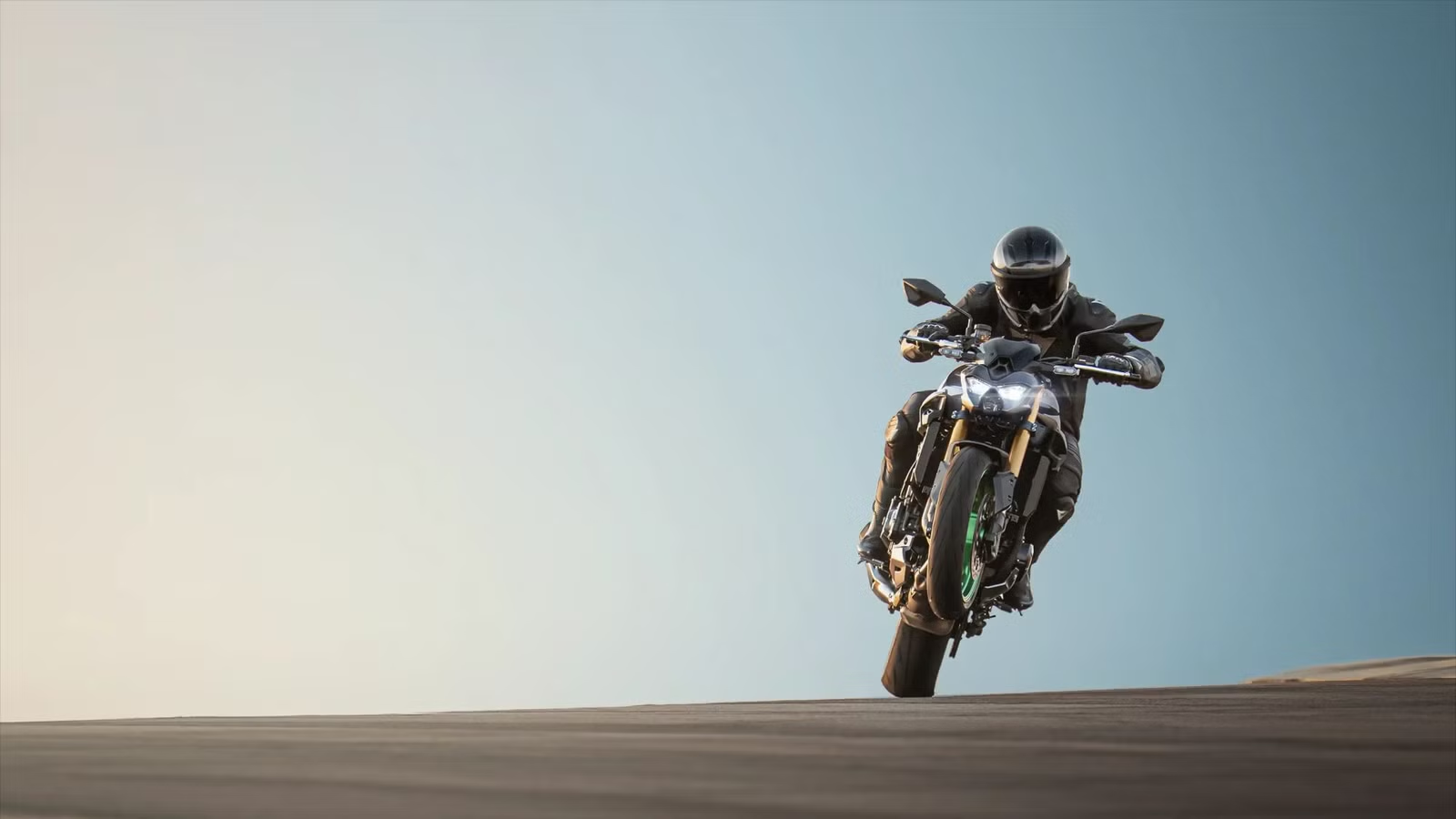
Reliability tends to be discussed as a responsible purchase decision rather than a desirable feature in motorcycles. One could want outright performance as their top priority, and another could rank dependability just as highly. The general notion, however, is that if you pick the proven engine, sensible chassis, straightforward servicing, and conservative engineering, then you’ll have to accept that excitement probably belongs elsewhere.

However, Japanese manufacturers keep proving that the assumption is increasingly difficult to defend. Some of today’s most established powertrains sit inside superbikes, hyper-nakeds, adventure motorcycles, and machines capable of crossing states at decidedly antisocial speeds. Several of them have also been refined through years of production. Arranged here from the lowest to highest current MSRP, these motorcycles combine proven engineering with enough performance or capability to make reliability considerably less boring.
Suzuki SV650
Price: $8,149
The SV650 has been making essentially the same package with just the necessary changes since Suzuki introduced the original in 1999. Its 645cc 90-degree V-twin has evolved substantially since then, but the fundamentals have endured because they work. The current engine uses fuel injection, Suzuki’s dual-throttle-valve system, resin-coated pistons, and SCEM-plated cylinders, while the 90-degree layout provides perfect primary balance without requiring a balancer shaft.


What saves the SV650 from becoming merely a sensible naked bike is how eagerly that V-twin responds. Suzuki gives it a 10,000 rpm redline, and its strong midrange combines with a narrow chassis and 437-pound curb weight to make back roads far more interesting than the modest specification sheet would suggest. ABS and Low RPM Assist add everyday usability without burying a simple roadster underneath electronics. Few motorcycles have managed to remain this approachable without becoming disposable as a rider’s experience grows.
Yamaha XSR700
Price: $8,599

Underneath the retro bodywork is one of Yamaha’s most established modern engine platforms. The XSR700 uses the 689cc CP2 parallel-twin, an engine family that has now spent more than a decade powering everything from roadsters to adventure bikes. It remains mechanically straightforward, with a conventional six-speed transmission, cable-operated throttle, and comparatively little electronic complication.

The simplicity, however, shouldn’t be confused with a sleepy riding experience. A 270-degree crank gives the CP2 its distinctive uneven firing character and strong midrange response, while the XSR700 weighs only 410 pounds wet. Yamaha pairs that engine with a short 55.3-inch wheelbase, 17-inch wheels, and Michelin Road 5 tires, producing a motorcycle that changes direction with very little persuasion. There are faster retro roadsters, and certainly more sophisticated ones, but the XSR700’s trick is to deliver enough character and agility that feel exciting.
Suzuki V-Strom 650
Price: $9,299

Suzuki has not announced a 2026 V-Strom 650, making the $9,299 2025 model still the one to get while stocks last. Its age is actually part of the appeal. The 645cc V-twin shares its fundamental layout with the SV650 but is tuned for the broader, smoother delivery expected from an adventure tourer. Suzuki itself has long emphasized the V-Strom 650’s reliability, versatility, and suitability for high-mileage riding.

Excitement here comes from versatility rather than outright performance. A 5.3-gallon tank, 19-inch front wheel, adjustable rear preload, traction control, and upright ergonomics let the V-Strom tackle commuting, winding pavement, and long trips without demanding a specialized motorcycle for each job. Its 470-pound curb weight is manageable by adventure-bike standards, too.
Kawasaki Z900
Price: $9,999

Kawasaki’s 948cc inline-four has been the heart of the Z900 since the model arrived, and the latest version builds new electronics around an established mechanical package. For 2026, Kawasaki quotes 123 horsepower and 73.1 pound-feet of torque, numbers that immediately separate this from motorcycles bought purely because they seem like safe long-term ownership propositions.

The latest Z900 has also become considerably smarter without losing its mechanical appeal. Electronic throttle valves support cruise control, multiple power modes, traction control, an IMU-based cornering management system, and a bidirectional quickshifter. Radial-mounted four-piston front calipers and Dunlop Sportmax Q5A tires give its performance hardware suitable handling backup. Yet the inline-four remains the main attraction.
Yamaha MT-09
Price: $10,899

Few engines make the case against boring reliability as convincingly as Yamaha’s CP3. The three-cylinder family has been in production for more than a decade, although today’s MT-09 and the MT-09 SP use the larger 890cc version introduced later in its development. Yamaha has continued refining the platform rather than discarding the underlying formula, and that maturity now comes wrapped in one of the most electronically sophisticated motorcycles around $11,000.

The manic triple is the reason riders gravitate towards the MT-09. Its crossplane-inspired firing order produces a broad spread of torque with a harder-edged soundtrack and response. At 425 pounds wet, the MT-09 doesn’t have much mass for that engine to move either. Ride modes, lean-sensitive rider aids, cruise control, a quickshifter, and adjustable suspension make the current bike more polished than early MT-09s. Crucially, none of that refinement has sanitized the punchy engine character that established its reputation as a liter-bike threat on real roads.
Yamaha Ténéré 700
Price: $10,999

The Ténéré 700 takes the proven CP2 engine in a very different direction. Yamaha specifically describes the 689cc twin as combining exceptional reliability with exciting power delivery, and the engine’s widespread use across the company’s lineup gives it a deeper track record than many purpose-built adventure-bike powerplants. For 2026, the Ténéré finally gained ride-by-wire throttle, selectable Sport and Explorer maps, switchable traction control, and three ABS settings.

A 21-inch front wheel, 18-inch rear, 9.4 inches of ground clearance, and 8.3 inches of fully adjustable front suspension travel preserve the Ténéré’s focus on actual off-road riding. The bike weighs 459 pounds wet, which remains reasonable for a full-sized ADV. The CP2 doesn’t overwhelm the rear tire with horsepower; instead, its predictable torque and slim packaging let riders concentrate on finding traction, choosing lines, and exploring the terrain where reliability stops being an abstract specification.
Honda Africa Twin
Price: $15,199

Honda’s Africa Twin moves the reliability concept into liter-class territory without abandoning the durability-minded engineering expected from a serious adventure motorcycle. Its 1084cc Unicam parallel-twin keeps the cylinder head compact, while Honda’s layout allows the engine to sit where it contributes to useful mass centralization. The platform has also now had several model years of CRF1100L development behind it.

The base 2026 Africa Twin remains particularly convincing because its hardware backs up the adventure styling. A 21-inch front wheel, 18-inch rear, 9.1 inches of fork travel, 8.7 inches at the rear, and a six-axis IMU-controlled electronics package prepare it for substantially rougher use than the average road-biased ADV. Riders can also choose Honda’s DCT, but the manual bike keeps the experience more traditional, combining big-twin torque, real dirt capability, and modern electronic assistance without turning either pavement or trails into a chore.
Kawasaki Ninja 1100SX SE
Price: $15,799

Kawasaki enlarged its long-running sport-touring inline-four formula to 1,099cc for the Ninja 1100SX, rather than abandoning the engine design that made the preceding Ninja 1000SX such an effective everyday performance motorcycle. The result produces 134 horsepower and 83.2 pound-feet of torque, with revisions aimed at giving riders stronger performance lower in the rev range as well as more relaxed highway gearing.

The SE version makes the reliability-versus-excitement argument particularly difficult to dismiss. Kawasaki adds an Öhlins S46 rear shock, Brembo M4.32 front calipers, braided front brake lines, and heated grips to an already comprehensive electronics package. Cruise control, an IMU, cornering ABS, traction control, riding modes, and a bidirectional quickshifter make long trips easier without removing the reason for choosing a Ninja badge. At 516 pounds fueled, it isn’t a lightweight supersport, but that mass buys wind protection and comfort while leaving enough performance for a fast road to remain genuinely entertaining.
Honda CBR1000RR
Price: $17,099

Honda’s CBR1000RR demonstrates that dependable engineering can live at the sharp end of motorcycling. The Fireblade lineage stretches back decades, while the CBR1000RR itself has benefited from more than 20 years of continuous development. For 2027, Honda continues with its 1000cc inline-four, six-speed transmission, aluminum chassis, and modern ride-by-wire electronics rather than treating constant reinvention as a requirement.

Nothing about its intended use is conservative, though. The engine runs a 13.0:1 compression ratio, while a 43mm Showa Separate Function Big Piston fork, Honda Electronic Steering Damper, aerodynamic bodywork, and superbike-focused ergonomics make its priorities obvious. It remains proof that choosing a long-established Japanese platform does not require giving up the performance level that makes superbikes absurdly compelling in the first place.
Suzuki Hayabusa
Price: $19,499

Few motorcycles have spent longer disproving the idea that reliable means restrained. The Hayabusa’s current 1340cc inline-four traces its displacement back through multiple generations, with Suzuki continually revising the internals, fueling, electronics, and emissions hardware rather than discarding a successful basic formula. The latest engine uses lighter pistons, connecting rods, and crankshaft components, while Suzuki specifically cites durability among the Busa’s benefits of its materials and engineering choices.

The Hayabusa was designed around sustained high-speed performance, and the current motorcycle surrounds its enormous engine with Brembo Stylema brakes, adjustable KYB suspension, a six-axis IMU, launch control, a bidirectional quickshifter, cornering ABS, multiple power modes, anti-lift control, and cruise control. Its 582-pound curb weight means this is no lithe superbike, but the combination of tremendous acceleration, aerodynamic stability, comfort, and long-established engineering remains unusually difficult to replicate.
Source: Various Manufacturers

Related posts

Latest Post


No Comments