
10 Discontinued Harley-Davidsons That Slap Harder Than New Bikes
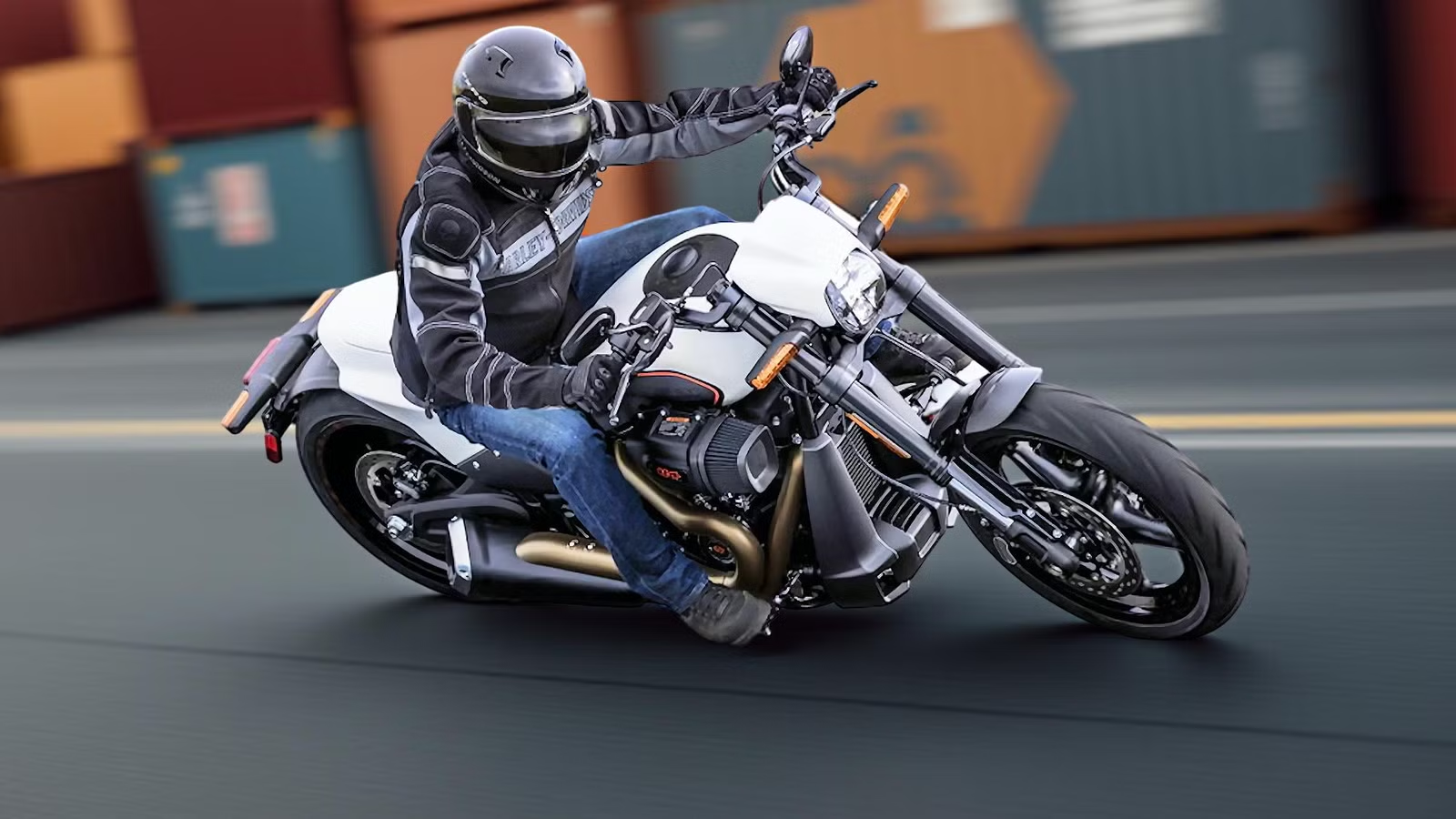
Harley-Davidson has discontinued some motorcycles that offered something today’s lineup can’t quite replicate. Some delivered distinctive engine character, others brought unusual handling or styling, and a few challenged what riders expected from a Harley altogether. Their appeal isn’t simply nostalgia or a belief that older bikes were better. It’s that certain discontinued models combined performance, personality, and mechanical simplicity in ways that still resonate with riders. Whether it’s an air-cooled Sportster or a radically different V-twin performance cruiser, these motorcycles demonstrate that a bike doesn’t have to be new to make a lasting impression.
10
FXR (1982–1994)
MSRP: $10,274 (1994)

The FXR delivered something surprisingly difficult to find in today’s Harley-Davidson lineup: a big, traditional V-twin cruiser that feels genuinely eager to be ridden hard. Its relatively light chassis, steep steering geometry, and triangulated frame gave it a willingness to change direction that many heavier Harleys struggle to match. The rubber-mounted engine kept vibration from becoming exhausting, while the dual-shock suspension helped the FXR maintain its composure when the road turned twisty. It wasn’t just a motorcycle that looked ready to move; its engineering backed up that impression.

The FXR’s real advantage was how directly it connected the rider to the road. Modern Harleys offer more power, refinement, and electronic conveniences, but the FXR delivers a distinctly mechanical experience without relying on riding modes or electronic interventions. Its responsive chassis rewards deliberate inputs, making a winding road part of the attraction rather than simply a route to the destination. For riders who value handling and feedback as much as engine torque, the FXR offers a combination that’s still remarkably appealing.
9
Sportster 1200 Custom (1996–2019)
MSRP: $10,999 (2019)


The Sportster 1200 Custom delivered something today’s Harley-Davidson lineup largely leaves behind: the straightforward appeal of an air-cooled Evolution V-twin in a relatively light, approachable cruiser. Its low seat, forward controls, and traditional styling provided the relaxed riding position many cruiser owners wanted without the bulk of a larger Softail. The 1,200 cc engine supplied plenty of low-end torque for everyday riding, while its uncomplicated design made routine maintenance and customization relatively accessible. It was a motorcycle that didn’t need elaborate electronics or expensive accessories to establish its identity.

The 1200 Custom’s appeal went beyond its familiar engine. Its relatively uncomplicated construction and conventional controls made it approachable for owners who preferred working on their own motorcycles or personalizing them over time. Today’s cruisers offer more technology and increasingly sophisticated features, but the 1200 Custom kept the ownership experience refreshingly straightforward. Its combination of accessible performance, traditional styling, and mechanical simplicity gave riders considerable freedom to make the motorcycle their own without starting with an expensive custom build.
8
Sportster Roadster (XL1200CX) (2016–2020)
MSRP: $11,499 (2020)

The Sportster Roadster took the familiar Evolution-powered Sportster formula and gave it a distinctly different purpose. Its 19-inch front and 18-inch rear wheels, dual front disc brakes, and inverted front fork made it considerably more capable in the corners than a traditional cruiser. Mid-mounted controls, a relatively upright riding position, and improved suspension travel encouraged riders to push harder on winding roads. The 1,200 cc Evolution V-twin delivered familiar low-end torque, but the chassis gave riders a much better opportunity to put it to use. Unlike many Sportsters, the Roadster arrived from the factory ready for far more than just leisurely cruising.

The Roadster’s real distinction was that its sporting hardware came straight from Harley-Davidson rather than from an aftermarket parts catalog. Its responsive handling, substantial braking capability, and traditional air-cooled power made it an engaging motorcycle on roads where conventional cruisers often feel out of their element. It wasn’t a sportbike, nor did it pretend to be one. Instead, it offered a factory combination of cornering ability and traditional Sportster character that remains unusual among cruisers. Riders who enjoy challenging curves didn’t have to modify a conventional Sportster to get that experience.
7
Sportster Forty-Eight (XL1200X) (2010–2022)
MSRP: $12,299 (2022)

The Forty-Eight made a statement before its engine even fired. Its massive 16-inch front tire, peanut fuel tank, low profile, and compact proportions gave it a muscular presence unlike almost any other Harley. The 1,200 cc Evolution V-twin provided plenty of torque, but the Forty-Eight’s appeal wasn’t about chasing performance figures or carving through corners. Its short, purposeful stance and minimalist styling gave it an unmistakable identity, one that made even a short ride feel like an occasion. Its tiny 2.1-gallon fuel tank was a practical limitation, but it also helped create the distinctive proportions that made the Forty-Eight instantly recognizable.

That visual identity came with compromises. The limited range meant more frequent fuel stops, and the riding position wasn’t particularly suited to long days in the saddle. Yet the Forty-Eight never pretended to be an all-purpose motorcycle. Where many cruisers emphasize versatility and comfort, it prioritized attitude and presence. Its distinctive proportions made it recognizable at a glance, and its minimalist design meant there was little need for cosmetic customization. For riders who value a motorcycle’s personality as much as its practicality, the Forty-Eight made no apologies for putting style first.
6
Dyna Wide Glide (1993–2017)
MSRP: $15,999 (2017)

The Dyna Wide Glide embraced a style that most modern cruisers have largely abandoned. Its long, raked-out front end, wide handlebars, forward controls, and distinctive rear fender gave it the unmistakable proportions of a factory chopper. Later models paired that stretched-out stance with the Twin Cam 103, delivering substantial low-end torque that made rolling on the throttle part of the experience. Unlike many custom-style motorcycles, the Wide Glide didn’t require extensive modifications to achieve its distinctive look or personality. It came from the factory with the attitude, big-twin muscle, and commanding presence that defined its appeal.

The Wide Glide’s long wheelbase and raked front end demanded a more deliberate approach to cornering, but that was a reasonable trade-off for its distinctive riding position and chopper-inspired proportions. Rather than trying to make one motorcycle excel at everything, Harley committed to a very specific experience. The combination of big-twin torque and factory chopper styling gave the Wide Glide an identity that went beyond appearance. For riders who want a cruiser that embraces its individuality instead of prioritizing versatility, few modern models offer quite the same combination.
5
Softail Slim (2012–2021)
MSRP: $15,999 (2021)

The Softail Slim delivered something today’s increasingly elaborate cruisers often overlook: the appeal of a genuinely stripped-down motorcycle that didn’t sacrifice big-twin muscle. Its solo seat, chopped fenders, blacked-out components, and fat front tire gave it the unmistakable look of a postwar bobber. Later models received the Milwaukee-Eight 107, adding substantial low-end torque without changing the Slim’s relaxed riding character. Even its frame contributed to the appeal, concealing rear suspension to preserve the appearance of a rigid-frame motorcycle. It combined old-school styling with engineering that made it practical enough for regular riding.

The Slim’s strength was its ability to deliver a satisfying experience without demanding much from the rider beyond a willingness to enjoy the road. Its low seat, straightforward controls, and uncluttered design kept the focus on the engine and the ride. Unlike a true hardtail, its hidden rear suspension provided a more accommodating ride without compromising the bobber silhouette. Modern cruisers may offer more features, but the Slim demonstrated that a stripped-down motorcycle could still be comfortable enough for regular use. That balance of vintage appearance and everyday usability gave it an appeal beyond its styling alone.
4
Cross Bones (FLSTSB) (2008–2011)
MSRP: $16,999 (2011)

The Cross Bones brought the look of a garage-built bobber straight into Harley-Davidson showrooms, and it did so without watering down the concept. Its Springer front end, mini-ape handlebars, sprung solo seat, chopped fenders, and blacked-out finishes gave it an unmistakable identity. The Twin Cam 96B delivered 93.7 pound-feet of torque, while the counterbalanced engine and six-speed transmission made the motorcycle more practical than its vintage appearance suggested. Rather than asking riders to spend thousands customizing a Softail, Harley delivered a factory bobber with the details already in place.

The Cross Bones made its strongest impression through the completeness of that factory-built package. Its sprung seat and concealed rear suspension provided some everyday usability without compromising its hardtail-inspired appearance. It wasn’t particularly concerned with versatility, aggressive cornering, or luxury. Instead, it delivered the attitude of a custom motorcycle straight from the factory, complete with distinctive proportions and old-school details. For riders who want the personality of a customized bobber without having to build one themselves, the Cross Bones offered a particularly compelling alternative to more conventional cruisers.
3
Softail Springer (FXSTS) (1988–2006)
MSRP: $17,195 (2006)

The Softail Springer offered something today’s Harleys can’t replicate: a front suspension system that was as much a part of the motorcycle’s personality as its V-twin engine. Its exposed springs and linkages replaced conventional telescopic forks, giving the Springer a distinctive mechanical presence that no amount of modern styling can duplicate. Paired with the Softail’s concealed rear suspension and big-twin power, it delivered the appearance of a vintage hardtail without the punishing ride of a true rigid frame. Unlike modern cruisers that conceal much of their engineering behind sleek bodywork, the Springer put its mechanical character on full display.

That visible engineering was more than a styling exercise. Watching the front suspension respond to the road gave the Springer a personality that conventional forks simply couldn’t match. It wasn’t designed to compete with modern suspension for cornering precision or outright performance. Instead, it offered a distinctive mechanical experience that made the motorcycle stand out even among other classic-looking Harleys. For riders who appreciate exposed engineering and traditional design, the Springer offered something beyond a familiar cruiser with vintage styling. Its mechanical character was an integral part of the experience, not simply an aesthetic detail.
2
V-Rod Muscle (VRSCF) (2009–2017)
MSRP: $17,449 (2017)

The V-Rod Muscle was Harley-Davidson at its most unconventional. Its liquid-cooled, 1,250 cc Revolution V-twin, developed with Porsche, produced 122 horsepower and delivered performance that put it in a different league from the company’s traditional air-cooled cruisers. Unlike engines designed primarily for low-RPM torque, the Revolution rewarded riders willing to explore the upper end of the rev range. Its 240 mm rear tire, aggressive styling, and drag-bike proportions reinforced its performance-oriented personality. Even its riding position reflected a different philosophy, combining the imposing presence of a power cruiser with an emphasis on acceleration and speed.

The Sportster S and Nightster carry forward some of the V-Rod Muscle’s performance philosophy, but neither completely replicates its riding experience. The Muscle paired high-revving power with a long, low stance and an unmistakable presence that set it apart from conventional cruisers. Its engine encouraged a different approach to acceleration, while its substantial rear tire and distinctive proportions reinforced its power-cruiser identity. Harley’s modern motorcycles offer impressive performance, but the V-Rod Muscle occupied a distinctive niche that the company hasn’t quite recreated. It wasn’t simply a faster Harley; it was a fundamentally different interpretation of what one could be.
1
FXDR 114 (2019–2020)
MSRP: $18,999 (2020)

The FXDR 114 took the Milwaukee-Eight 114 and wrapped it in one of Harley-Davidson’s most aggressive factory designs. Its 119 pound-feet of torque delivered the big-twin muscle riders expected, but the lightweight aluminum swingarm, inverted front fork, and drag-inspired geometry gave it a decidedly different personality from a conventional Softail. The massive 240 mm rear tire, stretched profile, and forward riding position reinforced its performance intentions. Harley didn’t simply give a familiar cruiser a more aggressive appearance; it built a motorcycle around the idea of combining substantial V-twin torque with a distinctly drag-bike attitude.

That combination is what makes the FXDR so difficult to replace. Its powerful engine, unusual chassis, and uncompromising proportions created a factory performance cruiser that stood apart from the rest of Harley’s lineup. The Sportster S offers modern performance, but it doesn’t replicate the FXDR’s big-twin character or drag-inspired stance. Today’s cruisers may be more versatile and refined, but few commit so completely to straight-line muscle and aggressive styling. The FXDR wasn’t designed to please every rider, and that’s precisely why it still makes such a memorable impression.
Source: Harley-Davidson

Related posts
Latest Post


No Comments