
The Japanese Motorcycle That Refuses To Become Outdated
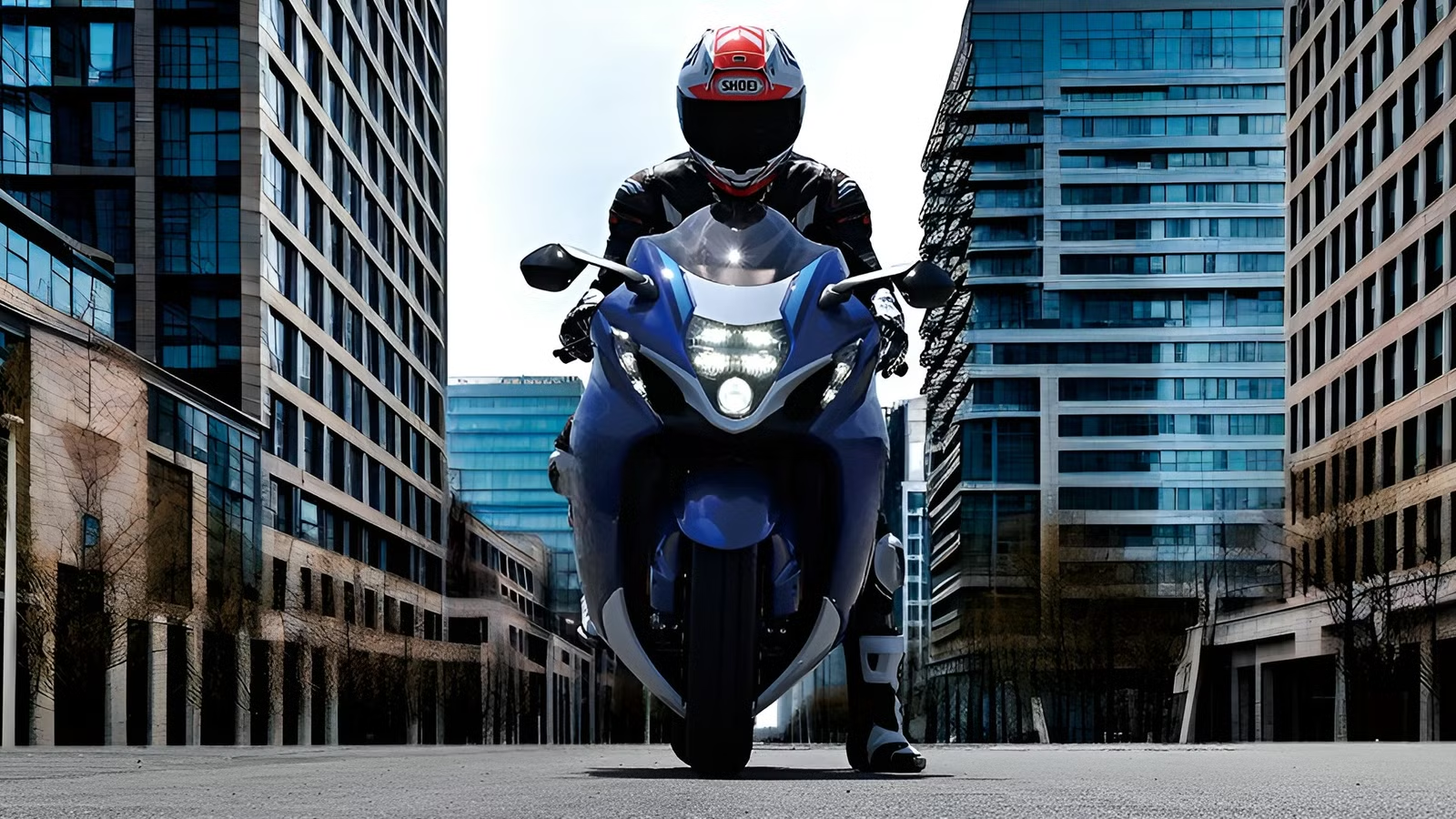
Outdated is a surprisingly subjective label in motorcycling. A bike can lose the horsepower race, skip the latest TFT dash, or carry a design philosophy from another decade and still remain relevant if the fundamentals work. Another can pack cutting-edge tech, generate enormous digital hype, and still disappear from the picture once the pre-launch excitement wears off. This is particularly relevant at the extreme end of the sport bike market, where newer does not automatically translate to better.

Riders and manufacturers are still chasing power and speed, but lasting relevance depends on more than just the numbers. Motorcycles have to remain useful, distinctive, and desirable after social media has moved on to the next big thing. That aspect has changed far less than the technology surrounding it. Which is why one Japanese performance motorcycle has survived shifting fashions, tech trends, tightening emissions rules, and escalating horsepower without abandoning the formula that made it the bike it is in the first place.
Hyperbikes Were Built For A Job Modern Superbikes No Longer Prioritize
The Japanese top-speed battle of the 1990s produced motorcycles like the Honda CBR1100XX Super Blackbird and Kawasaki’s ZX-11. These combined enormous straight-line performance given enough space, coupled with stability, and civility to cover distances. They were fast road motorcycles first, not flamboyantly disguised race bikes swathed in electronic wizardry.


Three decades later, contemporary superbike development has moved steadily toward racetrack priorities. Aerodynamics now include winglets, weight continues falling with extensive use of carbon fiber, riding positions remain aggressive, and horsepower comfortably exceeds what road riders can sensibly and legally exploit. These machines, no doubt, are spectacular, but their usefulness has become increasingly specialized and overwhelmingly detached from the real world.

The big Japanese hyperbike of yore focused on engineering, as, at the time, electronics were still in their nascent stages. Long wheelbases, broad fairings, large-capacity inline-fours, and relaxed power delivery made them heavier, but also unusually good at turning enormous performance into something usable outside a circuit. They could cruise, overtake effortlessly, carry a pillion in relative comfort, and remain composed at speeds where lighter motorcycles become increasingly busy.

Most of that class has since disappeared. Honda abandoned the Blackbird years ago, while Kawasaki’s ZX-14R lasted through the 2025 model year in the U.S. That makes the continued existence of a traditional naturally aspirated Japanese hyperbike in 2026 increasingly unusual. And one name from the Suzuki stables simply refuses to go out of existence.
The 2027 Suzuki Hayabusa Still Uses The Same Basic Formula

The survivor is the iconic Hayabusa, and it isn’t simply a forgotten bike, as the company still prides itself on what it set out to do decades ago. The current third generation came in as the 2022 model year for the U.S. market, but Suzuki resisted the obvious temptation to reinvent it. Instead, engineers retained the fundamentals that had already worked across two generations and concentrated on improving their weaknesses while at the same time bringing it up-to-date with modern elements.

That decision looks increasingly sensible today as the 2027 Suzuki Hayabusa remains long, low, unmistakably substantial, and powered by a naturally aspirated inline-four just as it was back in 1999. At $19,699, it also sits in an increasingly empty part of the market between conventional sport-tourers and significantly more expensive high-performance machinery.
Usable Performance Has Always Been The Engine’s Priority

The 1,340cc liquid-cooled DOHC inline-four produces 187 horsepower and 111 pound-feet of torque. More importantly, Suzuki deliberately concentrated on the low- and midrange response when developing the third-generation Busa, instead of a larger peak figure, while its aerodynamics would still help it achieve an enviable top-speed figure even if restricted. The basic dimensions of the bore and stroke remain 81.0 mm by 65.0 mm, but the current engine received revised pistons, connecting rods, crankshaft oil passages, and numerous other internal changes when the third generation arrived. Suzuki says more than 550 parts were changed across the motorcycle, yet it remains incredibly reliable.
The Hayabusa’s Chassis Is Built For High-Speed Stability

The chassis is equally traditional in concept. Suzuki still uses a twin-spar aluminum frame and swingarm with a 58.3-inch wheelbase, paired with fully adjustable KYB suspension. Curb weight is 582 pounds, so nobody will confuse it with a GSX-R1000, but outright agility and on-track performance were never the main objective for the Busa. The weight also contributes to the planted feel of the bike that has defined the model right from the beginning.

The long wheelbase offers rock-solid stability on the highway, and that’s where the Hayabusa shines brightest. Brembo Stylema four-piston front calipers act on 320 mm discs for confident stopping power, while the tire width remains at a familiar 120 section for the front and 190 for the rear. Seat height is also at a manageable 31.5 inches that, upon first contact, gives off more approachable vibes than intimidation for anyone swinging a leg over it for the first time.
Selective Modernization Keeps The Hayabusa Current

The reason the Hayabusa does not actually feel outdated even going into 2027 is because Suzuki left the right things alone and modernized the areas where age would have become a genuine disadvantage. Take the cockpit, for instance: it still refuses to follow current trends completely. Suzuki surrounds a small TFT information display with enormous analog speedometer and tachometer dials which do admittedly look old-fashioned beside giant tablet-style TFTs, but it is wonderfully appropriate here.

But in other areas where tech matters, Suzuki’s Intelligent Ride System now includes an IMU, cornering ABS, traction control, anti-lift control, engine-brake adjustment, launch control, selectable power delivery, hill-hold assistance, cruise control, an active speed limiter, and a bidirectional quickshifter. Riders even get three preset riding modes plus three customizable modes. And these are the kind of features that help extract the best performance from the 180 hp-plus motorcycle.

Suzuki further revised the launch-control engine-speed settings and introduced Smart Cruise Control in 2025 that carries over to the 2027 model as well. Using the quickshifter to change gears no longer cancels cruise control. The electronics therefore support and enhance the original concept rather than changing it. The Hayabusa hasn’t become an adventure-tourer wearing sport-bike bodywork, nor has Suzuki tried turning 582 pounds of hyperbike into a racetrack scalpel. The technology simply makes its considerable performance easier to access.
Kawasaki’s Ninja H2 SX Shows How Expensive Reinvention Can Become

The closest modern interpretation of the same high-speed, long-distance idea is arguably the 2026 Kawasaki Ninja H2 SX SE. Its supercharged 998cc inline-four produces 207 horsepower, and Kawasaki adds adaptive cruise control, blind-spot detection, forward-collision warning, semi-active suspension, a 6.5-inch TFT display, and a substantial suite of IMU-based rider aids. It is unquestionably the more technologically ambitious machine. It also costs $29,999, a full $10,500 above the standard Hayabusa, explaining why Suzuki’s less radical approach continues to work.

The Hayabusa gives up on tech like adaptive cruise control, electronic suspension, radar assistance, and some outright horsepower, but retains nearly everything that originally made the hyperbike format compelling. Its engine remains enormously flexible, its aerodynamics still serve a functional purpose, and its electronics now cover the features most riders actually use in real-world riding. And twenty-seven years after the original arrived, Suzuki never tried to make it compete with every new motorcycle technology at once, but it simply kept updating a remarkably durable idea.
Source: Suzuki

Related posts
Latest Post



No Comments