The Hardworking American V8 That Meets An Unfortunate Demise In 2027
8 minutes reading
Sunday, 27 Sep 2026 09:00 0 8 autotech
V-8 engine options remain popular for large American pickup trucks because they deliver low-end torque, essential for heavy-duty towing and hauling. Naturally aspirated designs provide immediate throttle response and structural durability, featuring fewer complex forced-induction components that could fail under sustained heavy loads.
There has been a dedicated effort to wind down V-8 engine production in recent years. This is due to stricter emissions regulations, a lack of market demand caused by higher fuel costs, and noteworthy improvements in modern downsized engine and electrification technologies. For 2027, a significant engine in Ford’s lineup will no longer be present.
Ford Motor Company established the standard for truck power plant engineering in 1932 by introducing the Flathead V-8, making multi-cylinder engine architecture accessible to everyday commercial truck buyers. This initial innovation set in motion nearly a century of continuous V-8 development aimed directly at high-capacity work trucks.
During the mid-to-late 20th century, Ford introduced heavy-duty engine families specifically designed to meet demanding commercial standards. The Y-Block and Ford Truck series gave way to the legendary 385-series big-block V-8. Highlighted by the 460-cubic-inch displacement engine, the 385-series delivered exceptional low-end torque and severe-duty reliability for F-Series trucks, Econoline commercial vans, and medium-duty haulers.
A blue F-250 Super Duty Tremor equipped with the 7.3-liter V-8 Godzilla engine, towing a trailer. Ford
In modern commercial applications, Ford continues this heritage with the Triton V-8 lineup, the 6.2-liter Boss V-8, and the powerful 7.3-liter Godzilla V-8. The naturally aspirated Godzilla engine employs a pushrod overhead valve layout, a cast-iron block, and variable cam timing. This design maximizes continuous low-RPM torque while eliminating complex turbocharging components. By consistently prioritizing structural durability, ease of fleet maintenance, and substantial towing capacities, Ford maintains its role as a premier manufacturer of heavy-duty truck power plants.
Ford’s Babyzilla Doesn’t Survive In 2027
2027 Ford Super Duty Carhartt Package F-350Ford
Ford streamlined its 2027 Ford F-250 Super Duty lineup by discontinuing the entry-level 6.8-liter Babyzilla gas V-8. Introduced in 2023 as the base engine for XL models, the 6.8-liter shared its architecture with the larger 7.3-liter, but featured a reduced bore and stroke.
Ford eliminated the 6.8-liter powerplant primarily to reduce production complexity and reduce operational costs across its manufacturing footprint. Producing two distinct naturally aspirated gas V-8 engines with overlapping applications created redundant assembly logistics. By standardizing the 7.3-liter V-8 across the entire Super Duty series from entry-level commercial XL trims to top-tier consumer models, Ford achieves greater economies of scale.
This powertrain consolidation optimizes fleet manufacturing while providing base-model buyers with greater displacement standards. To accommodate strict corporate average fuel economy targets and tighter emissions regulations without sacrificing durability, Ford adjusted output calibrations on the single remaining gas V-8. Eliminating the secondary 6.8-liter option allows Ford to focus engineering resources exclusively on tuning the Godzilla platform for severe-duty reliability.
The Babyzilla Fits Entry-Level Trims Well
Ford
The standard 6.8-liter V-8 engine featured in the 2026 Ford Super Duty produces 405 horsepower at 5,000 RPM and 445 pound-feet of torque at 4,000 RPM. Ford pairs this naturally aspirated, overhead-valve engine exclusively with its heavy-duty TorqShift 10-speed automatic transmission, utilizing the TorqShift-G variant on select light-duty trim configurations. Depending on the cab, bed, drive configuration, and axle ratios, trucks equipped with the 6.8-liter power plant deliver a maximum conventional towing capacity of 14,800 pounds for F-250 configurations and upward of 18,000 pounds when properly configured for gooseneck or fifth-wheel setups.
Ford does not publish official 0 to 60 MPH acceleration times or maximum top speeds for heavy-duty commercial trucks due to their primary focus on payload and towing performance. Independent testing indicates that gas-powered Super Duty models equipped with base V-8 engines achieve 0–60 MPH times in approximately 6.8 to 7.5 seconds depending on the specific cab size and four-wheel-drive equipment. Top speed remains electronically governed at approximately 96 MPH to respect commercial tire load limits and maintain stability across heavy-duty frame configurations.
The Babyzilla Wasn’t The Most Popular Engine Option
Front 3/4 action shot of 2025 Ford F-250 Lariat towing a trailerFord
The heavy-duty 2026 Ford Super Duty maintains steady market demand as a primary driver within the F-Series portfolio, which delivered 357,801 total units through the first half of 2026 to remain the best-selling truck lineup in the United States. While Ford groups overall F-Series sales totals together without publishing isolated public tallies for individual engine configurations, industry sales mix distributions indicate that the base 6.8-liter V-8 accounts for roughly 15 to 20 percent of overall Super Duty orders.
Commercial fleet operations and work-focused XL trims represent the majority of these 6.8-liter orders, where lower acquisition costs take precedence over higher output ratings. In comparison to Ford’s broader truck offerings, the full-size F-150 continues to capture the vast majority of consumer volume, while midsize options like the Maverick demonstrate rapid growth by securing a record 46,507 first-half hybrid sales alone. Collectively, these truck lines helped Ford lead all domestic competitors with 576,288 total truck and van deliveries in the first six months of 2026.
Ford’s Practical And Effective Engine Design
Ford
The 6.8-liter V-8 stands out because it blends traditional heavy-duty pushrod architecture with modern electronic efficiency. Built on a high-strength cast-iron cylinder block topped with lightweight aluminum cylinder heads, the engine uses a 4.22-inch bore and a 3.68-inch stroke. This short-stroke design allows the engine to rev smoothly while maintaining structural rigidity under continuous commercial use. Rather than utilizing overhead camshafts, the engine relies on a single in-block camshaft operating roller rocker arms and two valves per cylinder.
This compact valvetrain configuration narrows overall package dimensions, leaving good clearance inside the engine bay for easier serviceability. Port fuel injection keeps the intake valves clean and reduces system complexity compared to direct-injection setups. Additionally, a variable-displacement oil pump dynamically alters lubrication pressure based on load, reducing parasitic power losses during light operation while preserving long-term component durability during heavy towing cycles.
The Babyzilla’s Servicing Requirements And Recall History
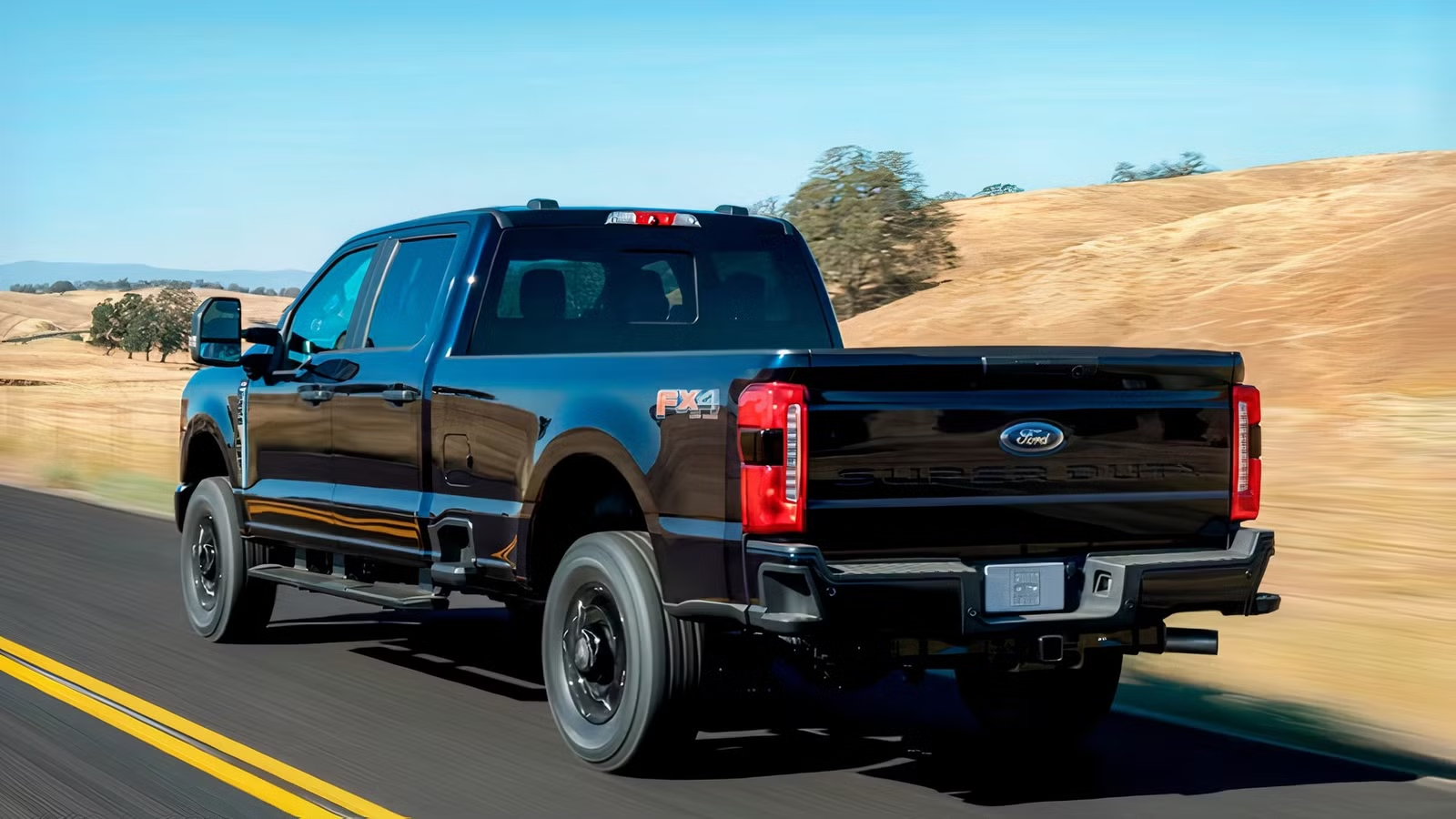
Rear 3/4 action shot of 2025 Ford F-250 Super Duty in black being driven on roadCarBuzz
Regular servicing for the 6.8-liter V-8 aligns with Ford’s standard heavy-duty maintenance schedule. Engine oil changes occur at intervals of 7,500 to 10,000 miles under normal operating conditions, utilizing approximately 7.1 quarts of 5W-30 synthetic blend oil. Heavy commercial usage or severe towing conditions shorten these intervals down to 5,000 miles. The TorqShift 10-speed transmission requires fluid and filter exchanges every 150,000 miles under standard duty, though severe-service fleet operation necessitates shorter 60,000-mile fluid cycles. Routine service visits average between $120 and $200 for standard oil and filter changes, with major 30,000-mile and 60,000-mile service milestones ranging from $400 to $800 depending on air filter replacements and drivetrain fluid checks.
While the internal mechanicals of the 6.8-liter engine and its 10-speed transmission display solid core durability, specific Super Duty model years experienced safety recalls related to drivetrain components. Select 2023 through 2026 models faced a recall addressing potential driveshaft friction weld failures that could result in driveshaft separation and a loss of drive power. Additionally, certain 2025 and 2026 Super Duty trucks faced recalls for improperly heat-treated rear axle shafts that could break under load, as well as a recall concerning steering column gear shifters that could detach due to improper welds. These issues stem primarily from external assembly and supplier components rather than core internal flaws inside the 6.8-liter block or valvetrain itself.
The Godzilla Is The Ideal Engine Option For The Super Duty
Ford
The 7.3-liter Godzilla V-8 serves as the flagship naturally aspirated gas powerplant for the Ford Super Duty platform. Built on a heavy-duty cast-iron block with aluminum cylinder heads, the 7.3-liter uses a pushrod overhead-valve architecture with a 4.22-inch bore and 3.98-inch stroke, featuring variable cam timing and composite port fuel injection. Under updated SAE J1349 testing procedures for 2027 model ratings, the engine generates an official output of 420 hp at 5,350 RPM and 445 lb-ft of torque at 4,250 RPM. Ford pairs the 7.3-liter exclusively with its heavy-duty TorqShift 10-speed automatic transmission, utilizing the full heavy-duty unit across the lineup. Equipped with proper axle ratios, trucks powered by the 7.3-liter deliver a maximum conventional towing capacity reaching up to 18,200 pounds and a fifth-wheel or gooseneck towing limit extending up to 19,500 pounds, alongside a maximum payload capacity of 4,175 pounds.
Standardizing the 7.3-liter Godzilla as the single-gas V-8 option for 2027 provides clear manufacturing and operational advantages for both Ford and its commercial customers. Maintaining two separate gas V-8 architectures with identical block dimensions created unnecessary production complexity and fragmented supply chain logistics. Ford simplifies assembly lines while giving work truck operators immediate access to maximum naturally aspirated pulling capability without requiring an upgrade by making the higher-capacity 7.3-liter standard across all trim levels. This engine provides a reliable, cost-effective alternative for fleet buyers who require serious heavy-duty payload and towing capacities but wish to avoid the steep acquisition costs, strict DEF emissions requirements, and specialized maintenance expenses tied to the 6.7-liter Power Stroke diesel engine.
Base Trim Engine
7.3L Powerstroke V8 ICE
Base Trim Transmission
TorqShift 10-speed automatic
Base Trim Drivetrain
Rear-Wheel Drive
Base Trim Horsepower
430 HP @5500 RPM
Base Trim Torque
1200 lb.-ft. @ 1600 RPM
Make
Ford
Model
F-250 Super Duty
Segment
Full-Size Pickup Truck
Sources: Ford, MotorReviewer, RepairPal, Kelley Blue Book, and the NHTSA.











No Comments