
A Tesla Drove Itself From Florida To Ohio, But One Moment Forced The Driver To Take Over
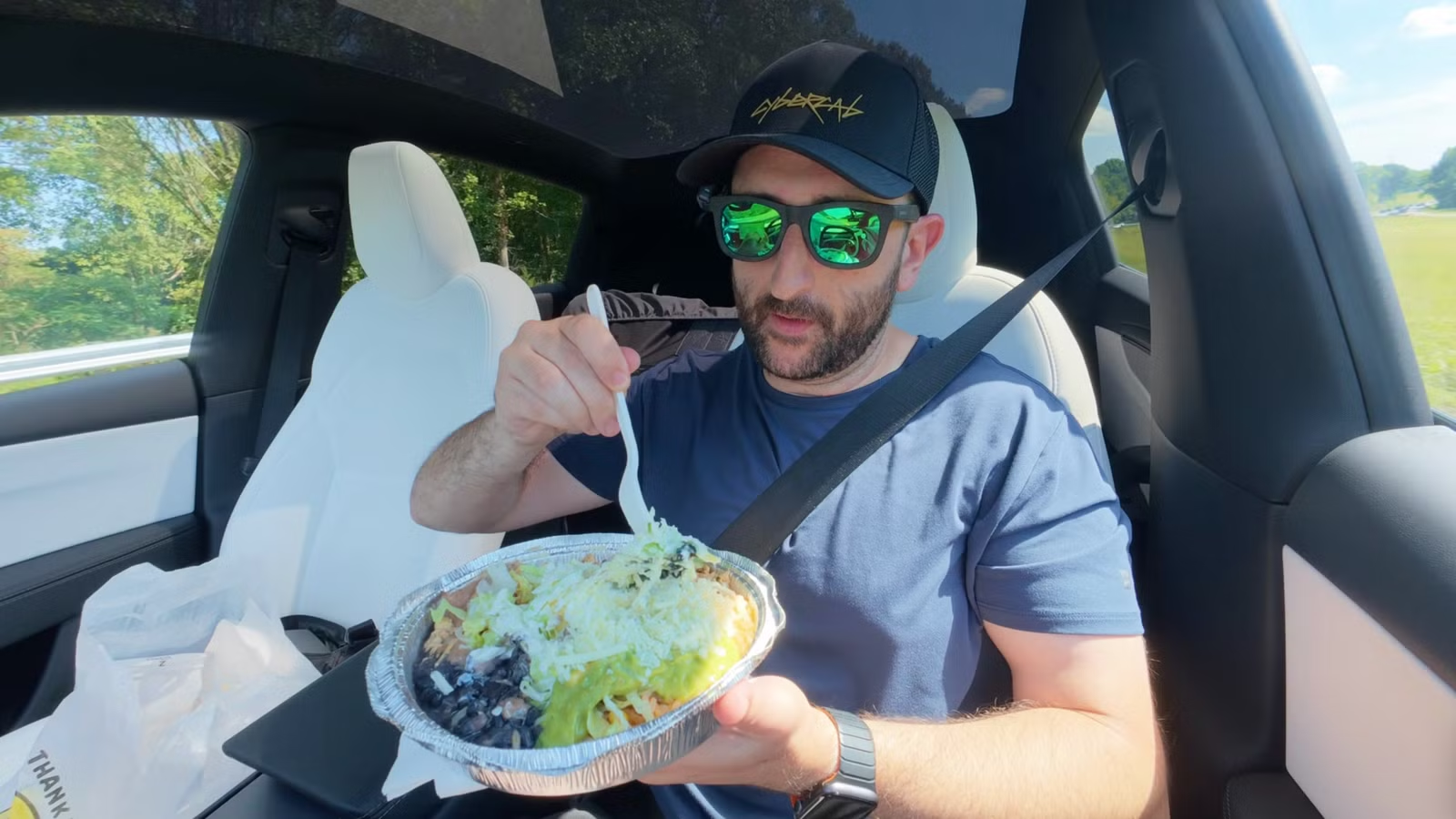
A Tesla Model Y running Full Self-Driving (Supervised) carried its owner from Fort Pierce, Florida, to the Columbus, Ohio, area in roughly 19 hours spread over two days. The car handled nearly all the driving, steering between Tesla Superchargers along the East Coast while he watched the road.

Along the way, he ate lunch from the driver’s seat, took in the fall colors of the Blue Ridge Mountains, and slept in the back of the car overnight. One stretch on the first day still ended with him taking over, and it came down to a condition that FSD continues to struggle with.
Tesla’s FSD Can Handle Long Highway Hauls, But Still Needs A Human Touch
Tesla’s Full Self-Driving (Supervised) can steer, change lanes, and follow navigation on its own, but it remains a Level 2 driver-assistance system. The driver has to keep watching the road and be ready to take control at any moment. NHTSA has stated this plainly, saying the person behind the wheel is fully responsible for driving and following traffic laws.

Long interstate trips play to the system’s strengths, with clear lane markings and steady traffic between charging stops. FSD also routes the car to the right Superchargers along the way, so the owner doesn’t have to plan each charge himself.
For most of this trip, the owner used the Mad Max speed profile, which Tesla added with FSD v14.1.2 in October 2025. Tesla says it brings higher speeds and more frequent lane changes than the Hurry profile, and on this drive it held 85 mph where Hurry would have settled around 80 mph. The profile has also drawn attention from federal regulators, who asked Tesla for more information about how it works.
A Florida Downpour Made This Model Y Hand Control Back To Its Owner

The YouTuber behind Drive Electric Today filmed the entire return leg of his trip, letting his Model Y drive him from Florida back home to Ohio on FSD. His first charge came at a 40-stall Supercharger in Fort Pierce, the largest site he had ever seen, before the car headed north on I-95.

Just north of Melbourne, a severe thunderstorm cut visibility to about five car lengths. The screen showed a “camera visibility limited” warning, so he took control and switched on his hazard lights like the drivers around him. Once the worst of the downpour passed, he re-engaged FSD, and the car turned the hazards off by itself.
Tesla’s owner’s manual lists poor visibility from heavy rain, snow, or fog among the conditions that limit the system. That weakness matters because FSD relies on cameras alone, with no radar or lidar to see through heavy rain.

NHTSA upgraded its investigation into FSD’s performance in reduced visibility to an Engineering Analysis on March 18, 2026, covering about 3.2 million vehicles. The agency’s concern is that FSD may not recognize when its cameras can’t see properly and warn the driver in time. On this trip, the warning came early enough for a calm handover, which is exactly the behavior regulators want FSD to show every time.
Camping At Cracker Barrel And Waiting For A Stall Made Up The Drive Home
After the storm, the car drove on to a Cracker Barrel in Brunswick, Georgia, which has 16 Superchargers in its parking lot. He set up an air mattress in the back and ran Camp Mode for about 7.5 hours with the cabin set to a chilly 62°F. The car used 13% of its charge overnight, close to Tesla’s own estimate of about 1% per hour.
He called the stop a complete success, and Superchargers are appearing at more Cracker Barrel locations, including sites permitted in Jacksonville, Florida, and Knoxville, Tennessee.

On the second day, which began at 8:00 a.m., he asked Grok for coffee near the Ridgeland, South Carolina, Supercharger, and it found a shop right next door. The next stop, in Cayce, South Carolina, was completely full, and he waited about 15 minutes for a stall, the first time that had happened to him.
He ate lunch while FSD drove, with the Model Y’s cabin camera tracking his eyes the whole time. Looking away from the road for too long, even to glance at food, triggers a warning to refocus, and five ignored warnings lock the driver out of FSD until the strikes clear. Snacking on FSD divides owners, with some treating it as a perk of long drives and others arguing that a driver holding food can’t react quickly enough in an emergency.
A reminder he had set with Grok flagged the Blue Ridge Mountains coming into view near Fancy Gap, Virginia. He pulled in at home after 9:30 p.m., closing out a day of close to 14 hours with only minor disengagements along the way.
Source: Drive Electric Today, Tesla

Related posts


Latest Post


No Comments