Kia’s EV9 GT-Line Is The Tahoe Rival Buyers Aren’t Discussing
8 minutes reading
Saturday, 26 Sep 2026 22:00 0 6 autotech
American buyers looking for a practical and capable three-row family hauler continue to opt for the Chevrolet Tahoe in 2026. Chevy’s full-size SUV represents the gold standard for space, towing power, and highway presence. Electric three-row vehicles exist, but options usually require choosing between cramped rear seats or six-figure luxury price tags.
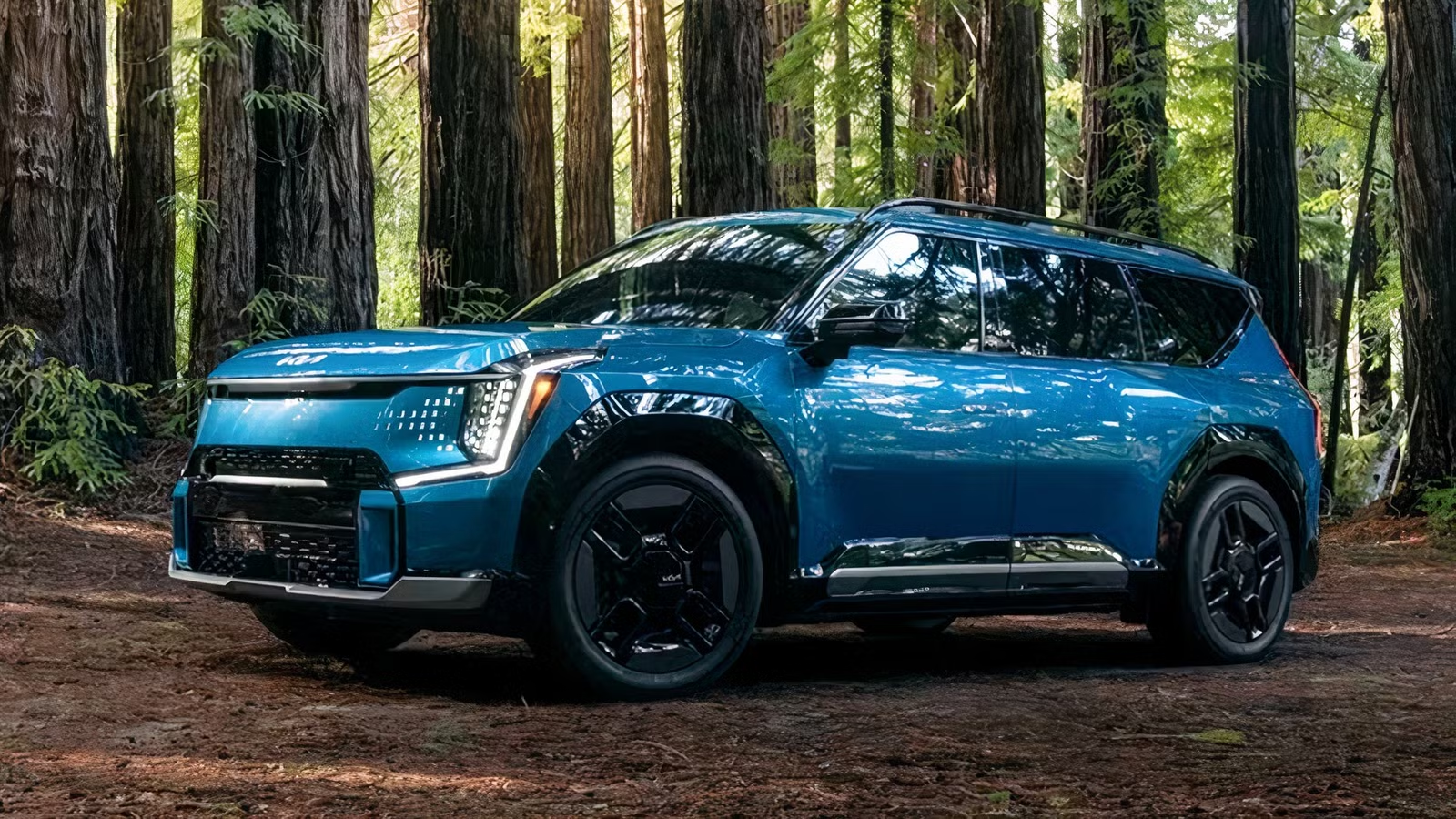
The Kia EV9 GT-Line changes that narrative by offering full-size proportions and advanced technology. Despite this, mainstream buyers with large families rarely compare it to traditional gas giants. Comparing these two vehicles exposes a dynamic worth diving into, as the Kia undercuts high-trim gas SUVs on purchase price, while achieving long-distance capability.
Pricing And Packaging Deliver An Unlikely Value Advantage
Rear shot of the 2024 Kia EV9 on the roadKia
The 2026 Kia EV9 GT-Line dual-motor AWD carries an MSRP of $71,900. This pricing strategy directly challenges the upper end of the full-size gas SUV segment. A Chevrolet Tahoe Premier starts at $77,895, while the flagship Tahoe High Country reaches $82,995. Lower Tahoe trims like the LT are available for $65,995. This reflects a lower upfront cost, but it comes at a noticeably shorter list of premium standard features. The GT-Line comes standard with features that match or outclass Chevy’s flagship trims. Buyers looking at high-spec family haulers save several thousand dollars when considering the EV Kia.
Close up shot of the 2024 Kia EV9’s rear seats Kia
The EV9 GT-Line features the E-GMP 99.8 kWh battery pack powering a dual-motor layout. The system produces 379 horsepower and 516 pound-feet of torque. This results in instant acceleration that puts the 5,800-pound EV in the same league as a flagship sports car down a straight patch of road.
Thanks to its flat floor, the cabin provides adult-friendly space across all three rows. The second-row captain’s chairs slide and recline, while the third row offers 32.0 inches of legroom for passengers. With all seats raised, cargo capacity stands at 20.2 cubic feet, expanding to 81.7 cubic feet with the rear rows folded.
CarBuzz
The Tahoe still maintains an edge in absolute volume, offering 25.5 cubic feet behind its third row, 34.9 inches of third-row legroom, and up to 122.9 cubic feet of maximum cargo capacity. However, the EV9 GT-Line matches the Tahoe’s practical day-to-day utility while undercutting its price tag and delivering a far quieter cabin.
The Realities Of Range And Capability
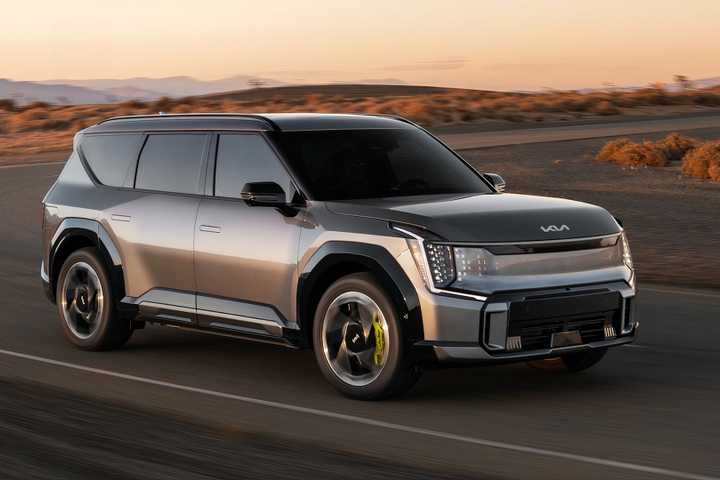
Action shot of the 2024 Kia EV9 GT-Line driving on the road.Kia
Manufacturer-claimed specifications favor the Kia EV9 GT-Line, but it loses some points when subjected to highway efficiency, charging infrastructure, and heavy towing. Aerodynamic drag affects Kia’s attractive but large and boxy electric aesthetic, specifically at higher speeds.
While the EPA rates the EV9 GT-Line at 270 miles of combined range, driving at 70 MPH drops real-world range down to 180 miles, depending on ambient temperature, terrain, and climate control usage. A gas-powered Tahoe easily covers 400 to 450 highway miles on a single 24-gallon tank, allowing drivers to pass multiple exit ramps without planning stops.
Tracking shot of a 2026 Chevrolet Tahoe towing a trailerChevrolet
Towing capabilities highlight an even wider divide. The Tahoe hauls up to 8,400 pounds when properly equipped, making it a natural choice for pulling heavy travel trailers or large boats. The EV9 GT-Line maxes out at 5,000 pounds. This capacity handles small pop-up campers, utility trailers, or personal watercraft, but hitching a heavy load to an EV severely impacts range. Towing near the EV9’s weight limit cuts highway efficiency by up to 50 percent, reducing practical range between charging stops to roughly 90 miles.
DC fast-charging performance helps offset the Kia’s shorter range. Built on an 800-volt architecture, the EV9 GT-Line accepts peak charging speeds of up to 210 kW. At an operational 350 kW-rated charger, battery energy rises from 10 percent to 80 percent in approximately 24 minutes. However, achieving those charge speeds relies on finding functioning high-output stations along primary travel corridors.
Charging Stops And Route Planning Alter Travel Routines
Front 3/4 shot of 2026 Chevrolet Tahoe driving on roadChevrolet
To evaluate how these differences affect family travel, consider a standard 320-mile trip from Atlanta, Georgia, to Jacksonville, Florida with a family of four, luggage, and a full tank or charge.
In the Chevrolet Tahoe Premier, the journey continues without requiring any refueling or stops. When driving at steady highway speeds, it is only likely to consume three-quarters of a tank. The driver completes the trip in under five hours, stopping briefly only if passengers request a restroom break.
Photo of a Kia EV9 charging at an Electrify America charging stationElectrify America
In the EV9 GT-Line, the same 320-mile route requires strategic planning. Leaving Atlanta with a full charge provides it with an estimated 220 miles of real-world highway range. After driving 170 miles down Interstate 75 to Macon, Georgia, the battery state-of-charge drops to 15 percent. The driver now has to pull into a fast-charging hub, where the EV9 plugs recovers energy via a 350 kW DC fast charger.
The system takes 24 minutes to boost the battery back to 80 percent, adding roughly 160 miles of highway range while the family stretches and grabs food. The Kia completes the remaining 150 miles to Jacksonville, arriving with approximately 20 percent battery remaining.
The electric journey takes roughly 30 minutes longer overall. On well-supported highway corridors like I-75, the stop integrates smoothly into standard travel plans. We also have to consider the possibility of fast chargers that may be out of service, occupied, or constrained to lower speeds, turning a predictable 24-minute stop into an extended wait.
Total Ownership Costs Depend On Driving Patterns And Charging Access
Cory Fourniquet / TopSpeed
Determining whether the EV9 GT-Line serves as a true Tahoe alternative depends on overall usage, including how and where a family drives. In a suburban daily commuter scenario, an EV9 GT-Line covers 1,000 miles per month running school carpools, work commutes, and weekend sports outings within a 50-mile radius. Charging overnight at home using a Level 2 charger, the Kia EV9 GT-Line consumes roughly 370 kWh monthly. At the national average residential rate of 16 cents per kWh, electricity costs about $59 per month. The EV9 GT-Line’s lower MSRP also yields lower monthly vehicle payments.
Front 3/4 shot of 2025 Chevrolet Tahoe in gray parked in parking lotChevrolet
The Chevrolet Tahoe Premier consumes roughly 62 gallons of gasoline monthly when averaging 16 mpg combined. At $3.50 per gallon, fuel costs about $217 per month, while the higher initial purchase price of $77,895 increases monthly loan payments. In this suburban routine, the EV9 GT-Line delivers significant monthly savings alongside a quieter, smoother daily drive.
The balance shifts for frequent cross-country travelers who haul heavy recreational equipment or boats across regional state lines multiple times per month. Frequent reliance on public DC fast chargers at higher commercial rates erodes operating cost advantages for the EV9 GT-Line. Range degradation while towing forces stops every 90 to 110 miles, significantly lengthening travel times. The Tahoe handles heavy trailers easily, using its V-8 engine, 400-mile highway range, and five-minute gas station fill-ups to preserve hassle-free travel schedules.
Key Takeaways Before Choosing Between Gas And Electric
Aerial shot of the 2024 Kia EV9 GT-LineKia
The Kia EV9 GT-Line stands out as a genuine competitor to full-size gas icons like the Chevrolet Tahoe, but it addresses a specific set of needs. The South Korean electric SUV challenges the idea that families must spend over $80,000 or compromise on third-row legroom to transition to an electric vehicle.
Families wanting to cater to routines that consist of suburban commuting, local errands, and occasional highway road trips along well-equipped charging stations will find the EV9 GT-Line to be a fitting option. It provides superior technology, smooth performance, and lower operating costs at a lower initial purchase price.
For buyers who regularly pull heavy trailers, take remote road trips, or prefer uninterrupted 400-mile highway stints, the traditional V-8 Tahoe remains the more practical choice.
Owner Satisfaction Is A Noteworthy Talking Point
2024 Kia EV9 GT-Line DashCory Fourniquet / TopSpeed
Beyond the numbers, the difference between real-world reception of these two SUVs is clear when looking at ownership reviews and ratings. J.D. Power‘s consumer-verified grading system gives the EV9 range a 73/100 overall score, consisting of 67/100 for quality and reliability, 82/100 for the driving experience, 77/100 for resale, and 73/100 for the dealership experience.
The Tahoe completely outperforms its EV rival with an 83/100 consumer-verified overall score. This includes 81/100 for quality and reliability and 84/100 for the driving experience, resale value, and dealership experience. Depreciation is another factor that weighs heavily against the Kia. iSeeCars indicates that the EV9 will depreciate by $34,537 or 62.9 percent over five years. The Tahoe only loses $22,998 or 41.8 percent of its initial purchase value over the same time period.
Over a five-year ownership period, the electric Kia EV9 requires substantially less routine servicing and lower overall maintenance costs than a gas-powered Chevrolet Tahoe. The Kia EV9 eliminates traditional engine maintenance such as oil changes, spark plug replacements, air filter swaps, and transmission fluid flushes. Its scheduled service mostly focuses on cabin air filter replacements, tire rotations, brake fluid flushes, and EV system inspections, leading to lower regular service bills over the initial five years. In contrast, a Chevrolet Tahoe requires regular oil changes and ongoing upkeep of its internal combustion engine and complex driveline components, resulting in higher projected five-year maintenance and repair expenses, according to ownership cost estimates from CarEdge.
Base Trim Engine
EV
Base Trim Transmission
Automatic
Base Trim Drivetrain
Rear-Wheel Drive
Base Trim Horsepower
215 HP
Base Trim Torque
258 lb.-ft.
Base Trim Battery Type
Lead acid battery
Make
Kia
Model
EV9
Segment
Midsize SUV
Sources: Kia, Chevrolet, the EPA, J.D. Power, CarEdge, and iSeeCars.












No Comments