
The Cruiser That Quietly Gets Better Every Year
Every so often, a rider parks a five-year-old bike next to the current model year and realizes the two are, mechanically, almost the same motorcycle. A new color here, a fresh decal there, maybe a badge swapped out. But the engine, the comfort, and the chassis are quietly carried forward. Brands do this to keep the nostalgia alive, but riders have always wanted more than a paint chart, and that frustration runs especially deep among performance cruiser motorcycle owners.

A rare few motorcycles take the opposite approach. Instead of a new paint job or a flashier set of decals, brands keep reworking these bikes every single year while the silhouette stays exactly the same. These are updates that actually put a grin on a rider’s face instead of just a fresh coat on the tank. Bikes built this way are hard to find. Luckily, there’s one American V-twin that has been getting better, quietly, every year since it first launched.
Why Performance Cruiser Owners Keep Reaching For The Aftermarket Catalog
Every new launch and every model year refresh raises the bar a little. Riders expect newer tech, sharper suspension, and a few more horses under the tank each time a manufacturer rolls out an update. But sometimes those updates are limited to cosmetic changes, and this is fairly common in the case of performance cruisers. Brands refresh the paint scheme, add a few decals, throw on some chrome, and to keep the American V-twin nostalgia alive, leave everything else exactly the same.

Riders, however, have always wanted more than that. They want the bike to actually work the moment the road stops going in a straight line. To turn in without drama. To stop hard at the first squeeze of the lever. To hold its line through a corner instead of wallowing through one. All of this without losing the unmistakable rumble of a V-twin. Getting there usually means installing several aftermarket accessories, a trade-off riders have accepted for years just to make a stock bike behave the way it should have in the factory.
The American Cruiser Formula: Great Looks, Frozen Chassis, Aftermarket Required

Historically, the American cruiser segment has been stubborn. A model gets its look nailed down and remains practically frozen in time. Manufacturers have always chosen personality when it comes to cruisers. This led them to concentrate on styling, chrome, and customization while keeping chassis development and handling ranked far lower on the priority list.
The bikes turn some heads, but at the cost of long wheelbases that reduce agility, twin rear shocks that offer limited suspension travel, and flexible frames, along with narrow forks and conservative brakes that struggle to inspire confidence. Very limited development in these areas has left riders adapting to the motorcycle, instead of expecting the motorcycle to rise to the occasion. If you wanted it to handle better, it was on you to build it. However, there’s one performance cruiser that has time and again proved that updates are not always cosmetic. Instead, it has worked on offering a better deal to the rider. Not only in terms of cosmetic upgrades, but also in handling, braking, and performance.
The Harley-Davidson Low Rider S Brings Something New Every Time

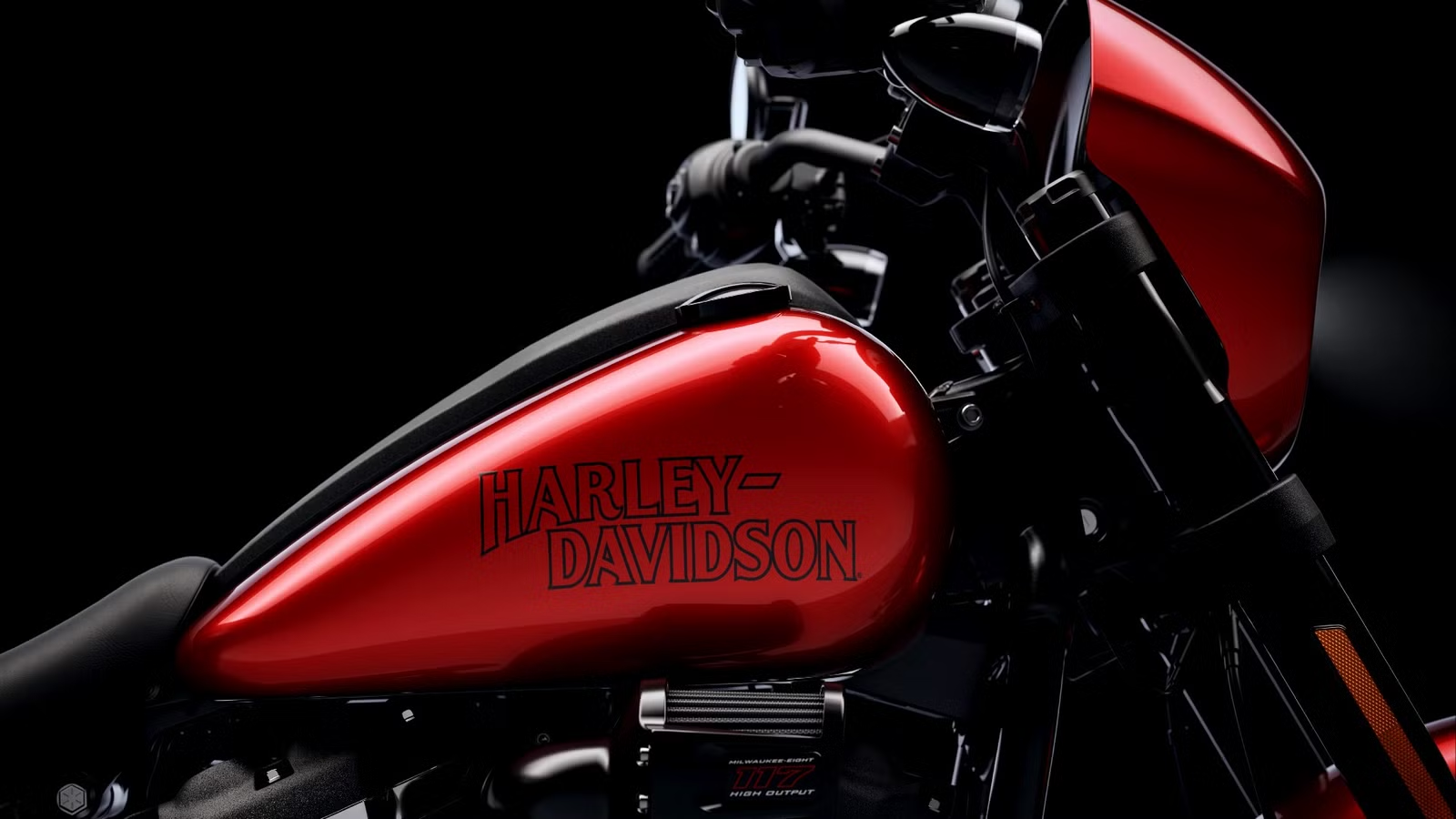
With the Low Rider S, Harley-Davidson has finally addressed the update dilemma of the performance cruisers instead of leaving it to the aftermarket upgrades. Shattering that Do-It-Yourself tradition, H-D focused on delivering the much-needed updates straight out of the factory. Instead of offering a stripped-down version, the motorcycle comes equipped with the essentials that were once sold as accessories. While focusing on that part, the bar and shield badge maker also worked on the styling part. This makes the Harley-Davidson Low Rider S a performance cruiser that actually speaks for itself.
The 2026 Low Rider S Costs $1,000 Less Than Last Year’s Model

Traditionally, when a motorcycle receives a major update, the price tag aggressively inflates. However, Low Rider S flipped that script entirely. Despite the updates, Harley-Davidson has kept the cost in check, or in fact, it has managed to reduce it. The 2026 Low Rider S carries an MSRP of $18,999, which is a clear $1,000 price drop from the 2025 model. That means riders are quite literally paying less for more, which is the opposite of how pricing usually moves on a performance machine.
Same Silhouette, Completely Different Machine: A Decade Of Stealth Upgrades

The Low Rider S nameplate originally debuted on the older, twin-shock Dyna platform. While it nailed the aggressive styling, it had handling limitations when pushed hard into a corner. Harley-Davidson solved this problem by migrating the model to the Softail chassis. Since that major structural shift, the motorcycle has seen a steady stream of continuous factory upgrades.
Without altering its signature silhouette, Harley has systematically bumped up the engine displacement, revised the suspension geometry for better lean angles, and relocated the instruments into the rider’s natural line of sight. It might look exactly the same as it did in its early days, but the mechanics underneath are refined with almost every iteration. That’s a significant shift from the old Harley ownership experience.
From 114 To 117 Cubic Inches — And A Factory Tune That Used To Cost Extra

The powertrain evolution has been relentless. The 2020 Low Rider S was launched with the 114-cubic-inch Milwaukee-Eight engine, which was a massive upgrade in refinement and torque over older models. But Harley wasn’t done. For the 2022 model year, the S adopted the 117-cubic-inch version of the same architecture, adding five percent more torque. Today, the latest iterations pump out 128 pound-feet of torque and 114 horsepower, delivering massive low-end grunt, ensuring instant passing power on the highway.

This performance increase isn’t just a simple byproduct of more displacement. Harley specifically equipped the motorcycle with a forward-facing Heavy Breather intake and aggressive camshaft profiles right off the showroom floor. By ditching the standard, more restrictive air-box, the engine breathes significantly better. This optimized airflow widens the powerband entirely, making the motorcycle pull aggressively through every gear rather than just chasing peak numbers on a spec sheet. Along with this, the 1,917cc 45-degree V-twin also packs other features like a long-stroke design and four valves per cylinder.
Evolved Riding Dynamics To Match Rider Expectations

Underpinning the sporty Harley-Davidson Softail is a traditional cradle frame. It elevates overall rigidity, translating to much better high-speed riding stability. Beyond that, like all proper cruiser bikes, the seat height is kept low at an accessible 27 inches; the mid-mounted foot pegs and a motocross-style handlebar set on four-inch risers pull the rider forward, helping the Low Rider S remain a manageable power cruiser for a wider range of riders.
The Low Rider S is a heavy-duty machine, stretching across a 63.6-inch wheelbase and weighing in at 670 pounds. Its bulky five-gallon fuel tank and 93-inch overall length give it a dominating physical footprint on the street. Yet Harley-Davidson managed to hide that sheer bulk through clever ergonomics. However, to make a 670-pound motorcycle actually stay composed under hard braking and deep lean angles, Harley had to seriously evolve the hardware connecting the bike to the pavement.
A Monoshock Swap Unlocked 31 Degrees Of Lean Angle And Dual-Disc Braking

Earlier iterations of the modern chassis had a flaw: the suspension lacked sufficient travel. Harley addressed this directly by fitting a taller, longer-stroke rear monoshock originally developed for the Fat Bob. That single change increased rear wheel travel by a full inch to 4.4 inches, elevating the bike’s tail section. More importantly for aggressive riders, the taller ride height steepened the available lean angle to 31.3 degrees, giving the chassis enough ground clearance to attack sweeping corners without immediately scraping hard parts.
To offer better stopping power, H-D swapped out the traditional single-disc setup on the Low Rider S and offered dual 300mm front discs with four-piston calipers, and a single 292mm disc coupled to a two-piston floating caliper. This factory-installed hardware provides the exact kind of aggressive, fade-free braking bite that performance riders demand.
Cornering ABS, Three Engine Tunes, And Ride Modes — All Now Standard

One of the key upgrades, yet the most overlooked one, was the repositioning of the instrument cluster off the fuel tank and up onto the handlebar riser. It features a very simple, old-school instrument cluster: an analog tachometer with a digital speedometer inside the negative LCD. This repositioning offers a better viewing angle while riding on the highway. Not only that, but the Low Rider S has also seen several upgrades under the skin.
Earlier, the bike had a basic equipment kit that included standard ABS and traction control. But over the years, Harley has introduced modern rider aids to the Low Rider S. That included a full rider safety enhancement package with cornering ABS, cornering traction control, three distinct engine tunes, and refined ride modes (Road, Rain, and Sport). It also gets a USB-C charging port as standard.
The Indian Sport Chief And Suzuki Boulevard Can’t Match The Low Rider S On Price, Power, Or Tech

The Harley-Davidson Low Rider S goes up against the Indian Sport Chief. The Indian Sport Chief also deploys a punchy V-twin with good torque. However, the Low Rider S offers a better value proposition with its affordable price tag, more power, and more torque.

It also goes up against the Suzuki Boulevard M109R. However, it might feel short on features as it lacks rider aids and even has only a five-speed gearbox. Mechanically, it’s still an impressive motorcycle, though it still won’t match the character that other American big-twin cruisers offer. With constant updates, Harley-Davidson has genuinely made the Low Rider S a strong case of its own. It has been sharpened over the years, which is why it is arguably one of the best cruisers in its segment.
Source: Harley-Davidson

Related posts

Latest Post


No Comments