
The Used Indian Bike That Can Replace Every Other Motorcycle In Your Garage
Indian Motorcycle built its modern reputation on solving real-world problems for real-world riders — an approachable cruiser in the Scout, a genuinely comfortable long-hauler in the Chieftain, and a torque-rich liquid-cooled bagger in the Challenger. Usually, Indian’s idea of versatility means giving buyers exactly what a category expects, done exceptionally well.

However, tucked into the brand’s recent history is a motorcycle that tried something stranger: being a commuter, a canyon carver, a flat-track homage, and a legitimate sport bike rival, all in one chassis. It never quite got the credit it deserved. Now that Indian has quietly killed it off, it’s never been cheaper to find out what you missed.
Indian’s Current Lineup Misses Out On Truly Versatile Bikes
Indian’s current U.S. lineup is heavily concentrated around cruisers, baggers, and touring motorcycles. The 2026 range includes the Scout family on the cruiser side, while the Roadmaster and Pursuit families occupy the touring end of the spectrum. Those motorcycles are built for specific types of riding, with features such as low seating positions, substantial bodywork, saddlebags, and long-distance comfort. That is not a criticism of the formula.


For riders who specifically want a relaxed cruiser or a big touring machine, it works. The problem starts when one rider wants everything from the same garage. Keeping separate motorcycles for commuting, weekend canyon runs, and touring sounds romantic until the practical stuff arrives. Each bike needs its own registration, insurance, tires, battery maintenance, and service. Then there is the storage problem. Even in a spacious garage, three motorcycles occupy considerably more room than one well-rounded machine.
What An Actual All-Rounder Needs To Deliver

A genuinely versatile motorcycle needs a fairly unusual combination of traits. First, the ergonomics have to be neutral enough for everyday riding. A bike that forces its rider into an extreme crouch becomes tiring in traffic, while a stretched-out cruiser can feel awkward when the road suddenly turns technical. A sensible upright riding position is the middle ground.

Then comes the engine. An all-rounder needs enough low- and mid-range punch to make normal street riding effortless, but enough rev range and top-end excitement to keep a backroad interesting. The chassis also needs to play along. It cannot be so heavy or cumbersome that city riding becomes a chore, yet it needs enough composure for sustained highway speeds. Ideally, the brakes and suspension should be much better than the bare minimum. Indian already built something remarkably close to that recipe.
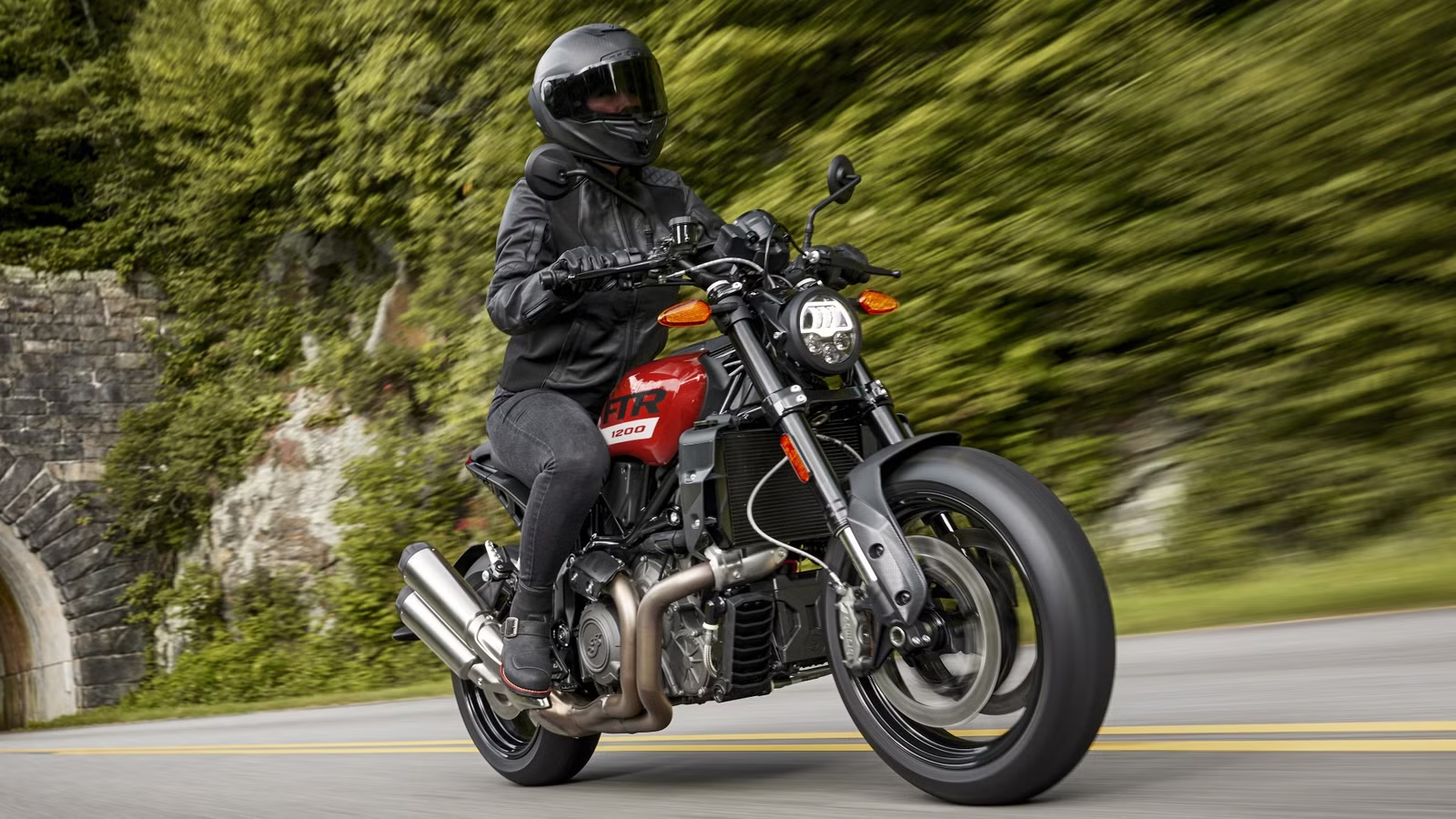
The Indian FTR 1200 Is America’s Street Tracker Built To Do Everything
Base Price: $13,499 (MY2024)

That bike is the Indian FTR 1200. It arrived in 2019 as a road-legal interpretation of the FTR750, the flat-track racer that had spent years dominating American Flat Track competition and, in the process, made Indian look genuinely dangerous again. The FTR1200 borrowed the 750’s attitude — narrow tank-less silhouette, wide bars, aggressive stance — and backed it with a proper 1,203cc V-twin. By the time Indian wound the lineup down, the FTR had grown into a five-bike family.
The standard FTR started at $13,499. The FTR Sport, with its chin fairing and touchscreen dash, ran $15,749. The FTR R Carbon, loaded with Öhlins suspension and carbon bodywork, opened at $17,249. Two limited-run collaborations sat above that: the FTR X 100% R Carbon at $18,999 and the FTR X RSD Super Hooligan at $18,499, both based on the R Carbon and both capped at a few hundred units worldwide. Earlier in the model’s life, a scrambler-styled FTR Rally also existed, priced around $14,499, before Indian trimmed it from the range ahead of the final model year.
Why Did It Get Discontinued?

Indian never gave the FTR a proper send-off. The news arrived buried in a Polaris earnings call in early 2025, where the company disclosed costs tied to “winding down” the FTR product line. Nothing about safety, nothing about a redesign in waiting — just a rough year for Polaris overall, weak retail numbers across its powersports portfolio, and a corporate decision to redirect investment toward models Indian considers more central to its future.
That timing matters for used buyers. Dealers spent much of 2024 and 2025 clearing remaining FTR inventory, often well below sticker, and resale values on the secondary market softened as word got around that the model was done for good. None of that reflects anything wrong with the motorcycle itself. It reflects a spreadsheet decision at a company managing a rough sales year. “Discontinued” here just means a smaller, cheaper pool of bikes to shop from — not a bike that got worse.
Powered By A 1,203cc V-Twin Engine With High-Revving Character

Every FTR trim shares the same liquid-cooled, DOHC 1,203cc V-twin, good for 120 hp and 87 lb-ft of torque, redlining around 9,000 rpm — high for a V-twin of this size, and part of the reason why the FTR never quite reads as a cruiser engine wearing a naked bike’s clothes. According to Indian, power builds early and stays flat through the midrange, which is the useful kind of torque for actual street riding rather than the peaky kind that only shows up at redline.
Sport and R Carbon trims add selectable ride modes — Rain, Standard, and Sport — that reshape throttle response and intervene differently with traction and wheelie control. Rain mode turns the bike genuinely docile for wet commutes; Sport sharpens throttle response enough to make the front wheel a suggestion rather than a rule. Compared with a Harley-Davidson Sportster S or a Ducati Monster, the FTR splits the difference: less refined at idle than the Ducati, considerably more willing to rev than the Harley.
Attention Has Been Paid To Chassis And Mass Centralization

The FTR’s styling trick is that its “tank” isn’t a tank at all — it’s an airbox cover. The real 3.4-gallon fuel tank sits under the seat, which drops the bike’s center of gravity and noticeably quickens turn-in for a machine that weighs around 500 pounds wet. That mass centralization, more than the horsepower figure, is what makes the FTR feel smaller than its spec sheet suggests.
Holding it together is a tubular steel trellis frame, paired with a fully adjustable suspension — inverted Sachs forks and a piggyback mono-shock on base and Sport trims, adjustable Öhlins front and rear on the R Carbon and above. Braking comes from dual 320mm front rotors gripped by radially mounted Brembo four-piston monobloc calipers, genuinely sport bike-grade hardware that a lot of naked bikes in this price range simply don’t offer.
The Used Market Sweet Spot: Depreciation Is Your Best Friend

New FTRs ranged from roughly $13,500 to $19,000 depending on trim. On today’s used market — CycleTrader and Autotrader listings currently span from around $8,000 for higher-mileage base models up to $16,000 for clean, low-mile R Carbons — most well-kept examples land somewhere in the $9,000-to-$12,000 range. That’s real money saved for a bike that still packs Brembo brakes, adjustable suspension, and a 120-hp engine most brand-new mid-weight nakeds or entry-level cruisers under $10,000 can’t touch on paper.
Trims To Look For On US Classifieds

The FTR base is the minimalist choice. It uses the simpler analog-style instrument cluster and skips the more elaborate electronic package. For riders who value a straightforward connection with the motorcycle, that simplicity has real appeal. The FTR S and later FTR Sport are more attractive for buyers who want technology.
The Sport gets a Ride Command display, three ride modes, lean-sensitive ABS, stability control, traction control, and wheelie mitigation. The FTR Rally takes the platform in a slightly different direction, using a larger 19-inch front wheel, an 18-inch rear, and taller ProTaper handlebars aimed at a more upright, rugged feel. Indian specifically developed the Rally around urban riding and backroad adventures.
The R Carbon is the enthusiast’s version. It brings carbon-fiber bodywork, 17-inch cast wheels, Öhlins fully adjustable suspension, and the electronic package. For a garage-replacement role, the Sport may arguably make the most sense simply because it combines the road-focused 17-inch wheel setup with useful electronic assistance and adjustable suspension.
What To Check Before Buying A Used FTR 1200

The FTR’s most consistent complaint, going back to launch reviews, is fueling: a jerky, surging throttle response at low rpm and when cold, sometimes bad enough to stall at a stop sign, most noticeable in Sport ride mode. It’s a known quirk rather than a mechanical time bomb, and many owners simply ride around it.
More concretely, the FTR has been the subject of several NHTSA recalls, worth checking against a specific bike’s VIN before buying: a 2019 circuit-breaker defect that could cause an unexpected stall, a 2019-2022 coolant junction that could leak, a 2019-2022 ABS module software issue that could trigger brake lights without the brakes being applied, and a narrower 2022 recall covering fuel tanks assembled with leak-prone holes. A dealer can confirm whether a given VIN already had the fix applied.
Maintenance And Long-Term Ownership Costs

Routine service intervals sit around every 5,000 miles, in line with most modern liquid-cooled V-twins. The bigger long-term question is parts availability now that the line is dead. Indian has given no indication it will stop supporting FTR owners, and dealer networks still stock consumables and OEM parts, but specialty items — R Carbon-specific Öhlins components, for instance — may get harder to source a few years out. Buying from a dealer with FTR-trained service techs, rather than a pure private-party deal, is worth the small premium for that reason alone.
Source: Indian Motorcycle

Related posts


Latest Post


No Comments