
This Italian V4 Sounds Like Every Inline-Four Superbike Is Missing Two Cylinders
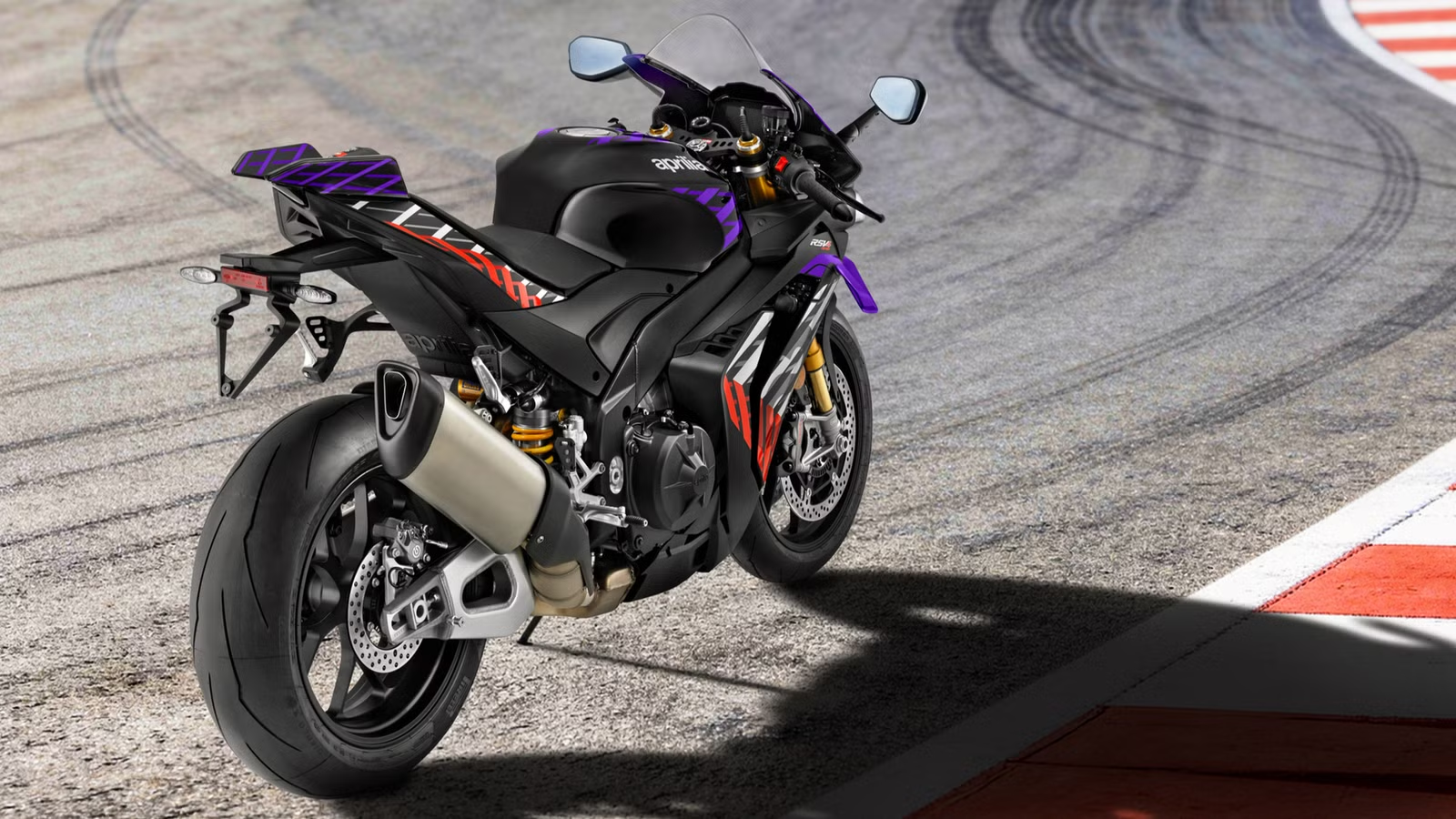
If you look up the history of superbikes, you will find that inline four-cylinder motorcycles have dominated this segment for a long time, thanks to their ability to deliver high-RPM power in a predictable and linear manner. This trend was disrupted thanks to a motorcycle that changed the way we look at four-cylinder superbikes, especially the way they sound. An Italian bikemaker decided to challenge the norms, by introducing a 65-degree V4 engine that sounded like it came fresh off the MotoGP grid. An engine that instantly makes traditional inline-four motorcycles sound feeble — as if they were missing two cylinders. More importantly, it added an element of character that made the motorcycle feel soulful, not like an appliance.
65-degree Firing Order: The Physics Behind The Sound

The reason the way inline-four Japanese superbikes sound the way they do lies deep in their engines. These bikes have a conventional 180-degree flat-plane inline-four engine that fires a cylinder every 180 degrees of crankshaft rotation. This even symmetrical firing sequence delivers a smooth, continuous power delivery, but the downside is a monotonous high-pitched whine at high revs. The resultant exhaust note sounds more like an electrical appliance than a proper racing machine.
A narrow-angle 65-degree V4 completely flips the script. Owing to the cylinder banks sitting at a compact 65-degree angle, the firing intervals are asymmetric. Instead of evenly spaced firing order, the engine fires unevenly across its four cylinders. At low revs, this irregular firing order produces a deep, gravelly rumbling baritone. As the revs rise, the tone shifts to an intimidating intake growl. Close to its 13,000 rpm redline, the exhaust note morphs into a loud, metallic howl that sounds like a thoroughbred MotoGP bike.
That’s not all. The V4 comes with theatrics as well in the form of sharp overrun crackles and pops every time you chop the throttle at high revs, or rapidly downshift through the gears. It’s a sharp contrast to the clinical buzzing exhaust note of conventional inline-four superbikes.

The Machine Behind It All: Aprilia RSV4 Factory

The motorcycle responsible for this pivotal shift from traditional inline-fours is the Aprilia RSV4 Factory. When Aprilia first revealed the original RSV4 back in 2009, it was quite the radical statement. The RSV4 was developed alongside Aprilia’s World Superbike (WSBK) program, aiming to show the world that a compact V4 engine platform can deliver both class-topping performance and sharp dynamics as well. Over the years, the RSV4 platform has undergone improvements but the basic V4 premise remains the same.
In current trim, the RSV4 Factory gets a massive 1,099 cc V4 powerplant that delivers an impressive 220 horsepower and 92 pound feet of torque. This comes wrapped in a lightweight chassis. In fact, the entire motorcycle weighs just 445 pounds, delivering an explosive power-to-weight ratio of 989 horsepower per ton.
The V4 engine configuration offers a lot more than heady horsepower numbers and an evocative soundtrack — it delivers genuine performance advantage on the racetrack. Due to the irregular firing intervals, there are distinctive gaps between power strokes. This brief pause allows the rear tire to regain traction and hook up while accelerating out of corners. In contrast, the continuous stream of torque delivered by a high-revving flat-plane inline-four motorcycle can easily break traction. The V4 layout allows the RSV4 to put down most of its 220 horsepower to the ground in a brutal but highly effective manner.
The Other Rebels: Ducati Panigale V4 and Yamaha YZF-R1

While the traditional flat-plane inline-four remains the default layout for many liter-class superbikes, there are a few notable bikemakers that have deviated from the norms to produce their own interpretation of the four-cylinder superbike. The closest that comes to the Aprilia RSV4 Factory’s V4 is its Italian neighbor, the Ducati Panigale V4. Unlike Aprilia’s 65-degree layout, though, the Panigale V4 uses a 90-degree V4 derived from their Desmosedici Stradale MotoGP bikes. This engine features a 70-degree offset crankpin layout known as “twin-pulse”. This setup allows the V4 to fire its cylinders in rapid pairs, giving the Panigale a deep, booming, exhaust note that sounds like a V-twin at low revs, and turns into a heavy bassy roar at high revs.
Then you have a Japanese motorcycle that uses an inline-four engine layout but does not sound like one. It’s the Yamaha YZF-R1 with its CP4 engine. The R1’s inline four-cylinder engine uses a crossplane crankshaft that staggers the firing order to 270-180-90-180 degrees sequence. This helps the inline four-cylinder engine to surpass the traditional inline-four traction limitations, while also delivering a V4 engine soundtrack without the complex engine architecture.
If you were to establish a superbike sound hierarchy, the Aprilia RSV4 Factory with its 65-degree V4 would be at the top, followed by the Ducati Panigale V4’s 90-degree “twin-pulse” engine architecture, and the Yamaha YZF-R1’s crossplane inline-four CP4 engine, followed by the traditional flat crank inline-fours.
Why Riding An Aprilia RSV4 Factory Ruins Other Inline-Four Superbikes For You

Once you ride an Aprilia RSV4 at full throttle through an enclosed tunnel, consider conventional inline-four superbikes are forever ruined for you. This Italian superbike is a prime example of sensory overload. The roaring intake under your chest, the quickshifter delivering lightning-fast downshifts followed by its own pops and crackles, and that metallic V4 scream bouncing off the concrete walls, is an emotionally enriching experience.
That said, to be fair, living with this 220-horsepower motorcycle comes with its own sets of compromises. In stop-and-go traffic, the narrow 65-degree V4 traps heat, sending it right to you. Also, the rear cylinder bank’s proximity to your thighs means a good roast if you aren’t wearing proper leather riding gear. Then there are the track-focused ergonomics and firm chassis setup that makes relaxed commuter riding almost impossible. However, most enthusiasts happily accept these tradeoffs. After all, the Aprilia RSV4 isn’t a mere point A to B motorcycle, it is a piece of rolling theater.

Related posts





Latest Post


No Comments