
Cadillac Says Every CELESTIQ Is Unique, So What Actually Makes Each Build-To-Order Car Different?
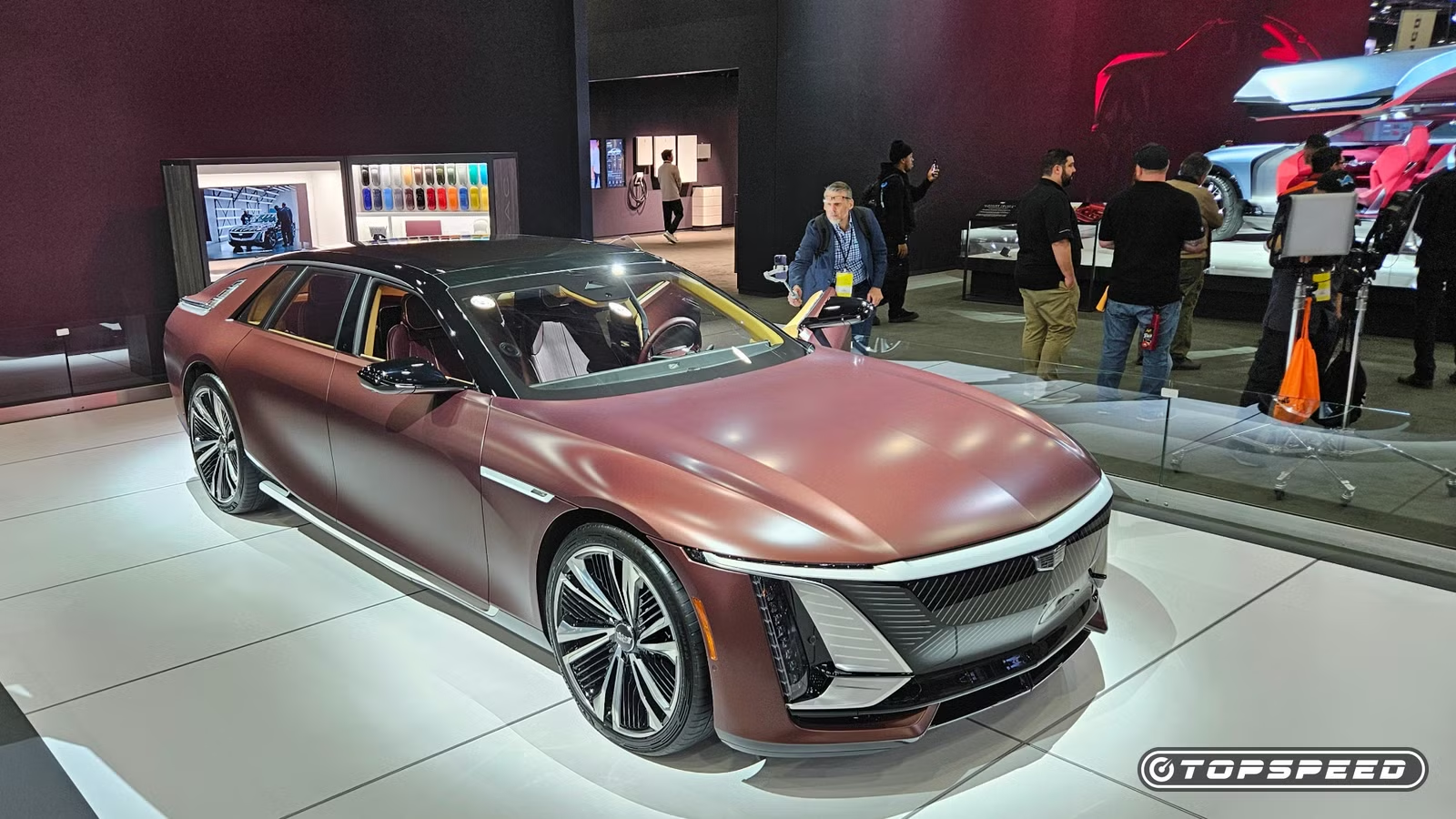
Cadillac’s CELESTIQ isn’t sold the way any other luxury EV is sold. There’s no configurator, no fixed trim ladder, and no MSRP sticker in the traditional sense. Instead, buyers commission a car from scratch, working with a dedicated concierge and Cadillac’s design team to produce a specification that will never be repeated. The first client-ordered example was handed over in June 2025, and as the program matures, it’s worth breaking down exactly what “one of one” means when Cadillac says it.

For luxury EV buyers used to shopping trim levels and option packages, the CELESTIQ process looks closer to commissioning a piece of furniture or a bespoke suit than buying a car. That distinction is the entire point. Cadillac is betting that provable, documented uniqueness beats limited-run scarcity, and it’s built an entire physical and human infrastructure around proving it.
The CELESTIQ Starts As A Blank Canvas, Not A Spec Sheet
Cadillac describes the starting point of a CELESTIQ commission as a blank canvas. Clients choose colors, materials, and finishes across a range the automaker calls expansive, working outward from nothing rather than narrowing down from a preset list of trims.

That structure changes how the car gets priced. There’s no single MSRP because there’s no single car to price. Cadillac says the blank-canvas starting point sits in the low $400,000s, with the final number shaped entirely by how deep a client goes into curation. Build timelines shift the same way. A simpler commission moves faster than one loaded with custom detailing, and Cadillac doesn’t pretend every build takes the same amount of time.
Every Client Gets A Concierge Pulled From Outside The Car Business

Rather than staffing the CELESTIQ program with traditional automotive retail talent, Cadillac recruited its concierge team from fashion, entertainment, fine art, and design backgrounds, including people who’ve worked with major artists, brands, and luxury residential interiors. The logic tracks: a client who wants a paint shade pulled from a specific textile or painting needs someone fluent in that kind of conversation, not a typical sales process.
The concierge guides the commission from the first meeting through handover, working alongside the client’s CELESTIQ Certified Dealer. Clients also get direct access to Cadillac Design itself. Bryan Nesbitt, GM’s Senior Vice President of Global Design, has described the collaboration as a chance for a client to turn their vision into what he called a one-of-one piece of moving sculpture.
The Commission Happens Inside A Restored Saarinen Building

Clients commission their CELESTIQ at Cadillac House at Vanderbilt, a facility built specifically for the program on the GM Global Technical Center campus in Warren, Michigan. The Global Technical Center earned National Historic Landmark status in 2014 and was the first major commission awarded to architect Eero Saarinen, whose neo-futurist sensibility also shaped the CELESTIQ’s design language.
The building itself started as the campus restaurant, the room where GM’s designers and engineers ate lunch and argued over ideas. It won an American Institute of Architects Honor Award in 1955 and still carries Saarinen’s original material palette: travertine, terrazzo, and stainless steel, with a stepped floor and glass curtain wall looking out over the campus dome, a lake, and an Alexander Calder fountain. The centerpiece is a 36-foot gold screen by sculptor Harry Bertoia, built from individually enameled steel plaques, one of only a handful he ever produced.
Cadillac House is named for Suzanne Vanderbilt, who joined GM Design in 1955 and worked in the Cadillac studio during an era when almost no women held design jobs anywhere in the industry. She designed two unique Cadillacs, held two patents related to interior safety, and mentored designers for two decades before retiring in 1977. Clients who can’t travel to Michigan still begin their commission virtually through Cadillac House, with the same one-on-one access to the concierge and design team.
Why Cadillac Is Betting Rarity Beats Scale In The Ultra-Luxury EV Market

The competitive logic here is straightforward. Most rare cars earn their status over decades, through low survival rates or a production run that turned out smaller than planned. The CELESTIQ skips that waiting period. Every car carries a documented, client-authored specification from day one, which means it can’t be duplicated by a later buyer or reconstructed by a restorer working off old build sheets. Provenance exists the moment the commission is finalized, not decades later.
Cadillac delivered its first client-ordered CELESTIQ in June 2025 at a private ceremony at the Global Technical Center, with the handover staged back at Cadillac House at Vanderbilt, the same building where the commission began. That loop, from first sketch to final delivery in the same room, is the part of the experience that’s genuinely hard for a competitor to replicate with a standard configurator and a delivery center in a strip mall.

Related posts






Latest Post


No Comments