
The Touring Bike That Gives Sport-Bike Agility Without Losing Comfort
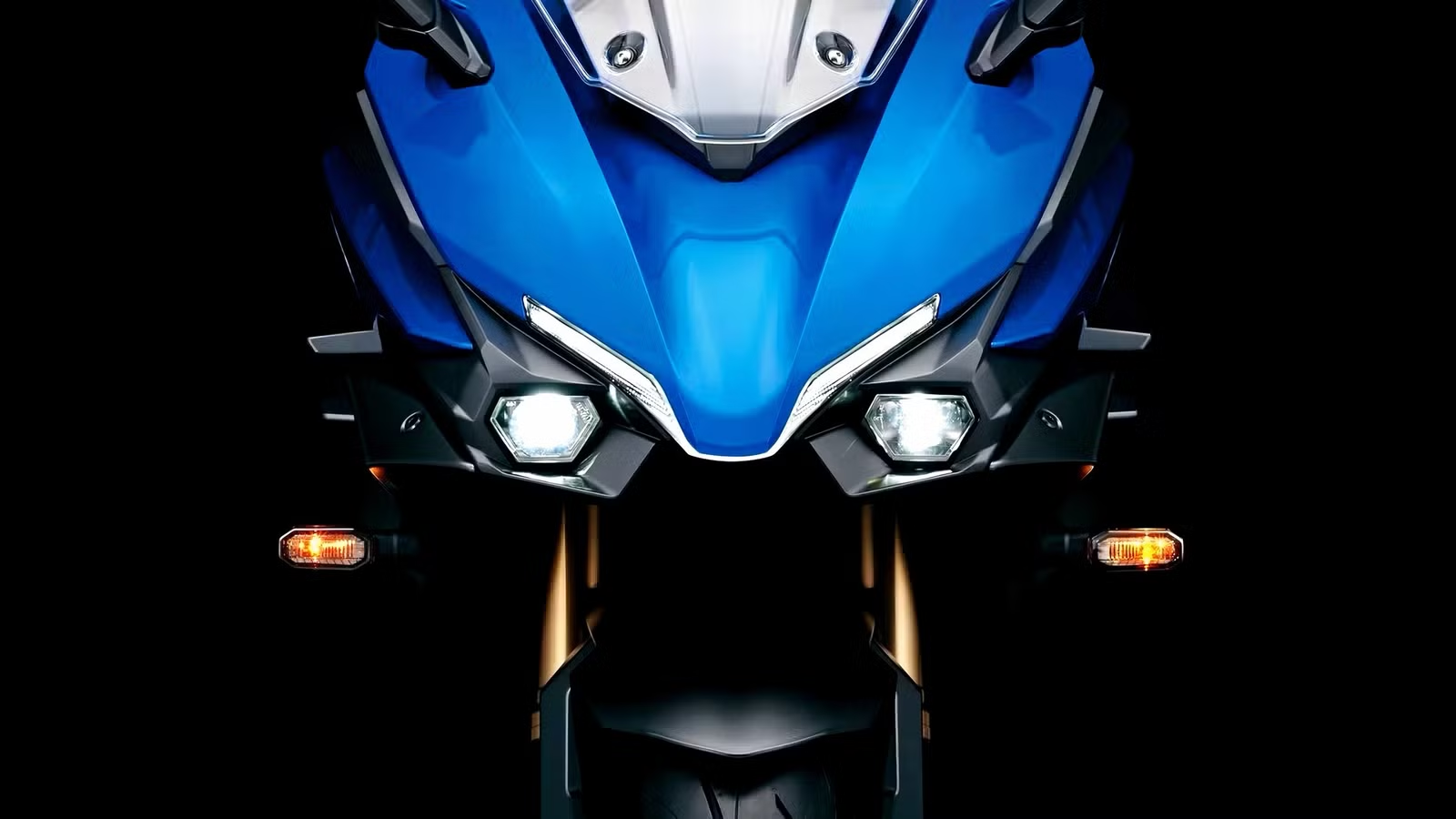
There was a time when adding touring ability to a fast motorcycle mostly meant accepting the compromises that it came with. There were plenty of compromises, too. Limited fuel tank capacity, barely any provisions for luggage, and a passenger meant a suffer fest for both the rider and pillion. There were workarounds which meant that the motorcycle became easier to live with over a distance, but rarely sharper because of the additions, and comfort was still a far cry away.

Suzuki is particularly good at demonstrating how broad the performance-touring spectrum has become as its current lineup stretches from one of the fastest grand-touring motorcycles ever put into production to a new middleweight crossover. Both are meant to cover distance, yet they go about it in completely different ways. Which leaves a rather interesting middle ground for riders who want more speed and chassis ability than a crossover, but don’t necessarily want the size, weight, or riding position of a hyperbike.
Suzuki Has More Than One Idea Of A Fast Touring Bike
The legendary and uber-reliable Hayabusa remains at the extreme end of Suzuki’s road-going performance spectrum. Its 1,340cc inline-four, 5.3-gallon tank, substantial aerodynamic bodywork, and 58.3-inch wheelbase make sustained high-speed travel almost part of its job description. Yet at 582 pounds, it also shows what happens when outright performance, stability, and wind protection are prioritized over low mass. It can cover enormous distances quickly, but nobody is going to mistake it for a lightweight liter bike once the corners become tight. Oh, and luggage carrying is going to be fairly limiting still.


Suzuki’s SV-7GX approaches distance from almost another angle. Its familiar 645cc V-twin sits inside a tubular steel frame, with 17-inch wheels, an upright riding position, a 4.6-gallon tank, a three-position windscreen, rear carrier, and touring-friendly seating. At 465 pounds, it adds useful road-trip equipment without carrying the bulk traditionally associated with a larger tourer. But it lacks outright performance and the chassis, though agile in its own right, is never going to feel like anything remotely derived from the GSX-R line.

These two motorcycles present the sport-touring problem when biased at either end of the spectrum. One starts with serious performance and accepts the weight needed to support it over the distance, but doesn’t care about your comfort or the luggage you’re planning to take with you, while the other keeps weight and output modest as it builds touring practicality around a middleweight platform. Between them sits a sport-tourer that not only has the GSX name but also the GSX-R’s liter-bike performance intent while making room for panniers and a passenger to enjoy the thrills together in comfort.
The Suzuki GSX-S1000GT+ Is Essentially A Liter Bike Built For Distance

That brings us to the Suzuki GSX-S1000GT+, sold in the U.S. for 2026 exclusively as the factory luggage-equipped version. Its $14,399 MSRP includes standard side cases, while its basic architecture remains closely related to the GSX-S1000 naked bike rather than a purpose-built heavyweight tourer. Suzuki uses a twin-spar aluminum frame with spars running directly between the steering head and swingarm pivot. The braced aluminum swingarm itself comes from the GSX-R1000.

With its 5.0-gallon fuel tank filled but excluding the side cases, Suzuki lists its curb weight at 498 pounds. The 57.5-inch wheelbase is also compact enough that the GT isn’t carrying touring-bike heft beneath its bodywork. All of it translates to predictable handling, stability, and the ability to negotiate tight technical roads without the cumbersome response associated with much heavier open-class tourers. It still feels like a substantial liter bike, but the appearance doesn’t translate to its actual ability to handle when the corners tighten.
The 999cc Inline-Four Still Has GSX-R DNA

At its heart is Suzuki’s familiar 999cc DOHC inline-four. This engine can be traced back through Suzuki’s GSX-S family to the long-stroke GSX-R1000 engine, although the touring application is different from the superbike. Suzuki changed the cam profiles to reduce valve lift and overlap, helping broaden usable performance while improving emissions and drivability. Suzuki rates it at 150 horsepower and 78 pound-feet of torque.

That gives the GT the kind of performance reserve expected from a liter-class sport bike without demanding high revs every time you want to overtake. A six-speed transmission, assist-and-slipper clutch, and bidirectional quickshifter complete the drivetrain. The quickshifter is especially appropriate here as it adds some theater when you’re attacking a sequence of corners, then simply makes life easier when you’ve been riding all day.
Conventional Suspension And Electronics Keeps Things Simple

Suzuki hasn’t hidden the GT’s handling behind sophisticated suspension electronics. The 43mm KYB inverted fork provides manual preload, compression, and rebound adjustment, while the rear shock offers preload and rebound adjustment. The setup is tailored for the GT and isn’t a transferred unit from the naked GSX-S1000, so it also isn’t bound to just one type of riding over any given weekend.
A wider handlebar gives the rider useful leverage over the front end, while Dunlop Roadsport 2 tires keep aid with sticky grip in varied road conditions. Four-piston Brembo Monobloc calipers clamp 310mm front discs to offer strong braking performance even with a loaded bike with luggage and a passenger. There is, however, one significant electronic omission. The GT has ABS and five-level traction control but no IMU, meaning neither system is lean-sensitive.
Its Touring Equipment Doesn’t Smother The Sport Bike Underneath

It’s easy to compromise on the sport bike genes when comfort is added to the bike. Suzuki handles things thoughtfully to maintain the GSX-S1000GT+’s core DNA. Comfort starts with a 31.9-inch seat and an upright riding position that places considerably less load on the rider’s upper body and wrists compared to a superbike. Rubber-mounted handlebars and vibration-absorbing footpeg inserts further acknowledge that riders might stay aboard the S1000GT for several hours rather than a few sessions around a track. The full fairing is wind-tunnel developed, with the lower cowl, mirrors, and surrounding bodywork shaped to manage airflow around both the rider and passenger.

The standard screen is fixed, which is less convenient than adjustable alternatives, but Suzuki offers a taller touring screen as an option. Heated grips are optional as well. Cruise control comes standard, and Suzuki updated it for 2025 so it continues operating while the rider shifts using the quickshifter. The 6.5-inch TFT brings smartphone connectivity, while three selectable throttle-response modes alter how quickly the engine responds without reducing maximum output. Then there are the standard hard cases, which add the much-needed luggage-carrying capability for such a motorcycle.
The Kawasaki Ninja 1100SX SE ABS Makes The Choice Much Harder

The 2026 Kawasaki Ninja 1100SX SE ABS comes as a solid contender if you’re shopping for this category of motorcycle. At $15,799, it costs $1,400 more than the Suzuki, but its 1,099cc inline-four produces a lower 134 horsepower and a higher 83.2 pound-feet of torque. The Kawasaki’s extra displacement gives the Ninja more torque, thus improving rideability at lower revs.

The SE also brings considerably more sophisticated chassis hardware. Kawasaki fits an Öhlins S46 rear shock, Brembo front calipers and discs, stainless-steel braided front brake lines, and heated grips. It retains the standard Ninja’s Bosch IMU, lean-sensitive KIBS braking, cornering traction control, ride modes, cruise control, bidirectional quickshifter, and four-position adjustable windscreen.
The Kawasaki is undoubtedly the better-equipped premium sport-tourer, particularly if electronic rider aids and higher-grade suspension matter to you. The GSX-S1000GT+, on the other hand, is simpler and considerably cheaper, yet its GSX-R-derived chassis and higher-output engine keep it convincingly close on the sporting side of the equation.
Source: Suzuki

Related posts





Latest Post




No Comments