
If the GR Supra’s Manual Turbo-Six Formula Really Is Ending, the Nissan Z Just Became the Last One Left Standing
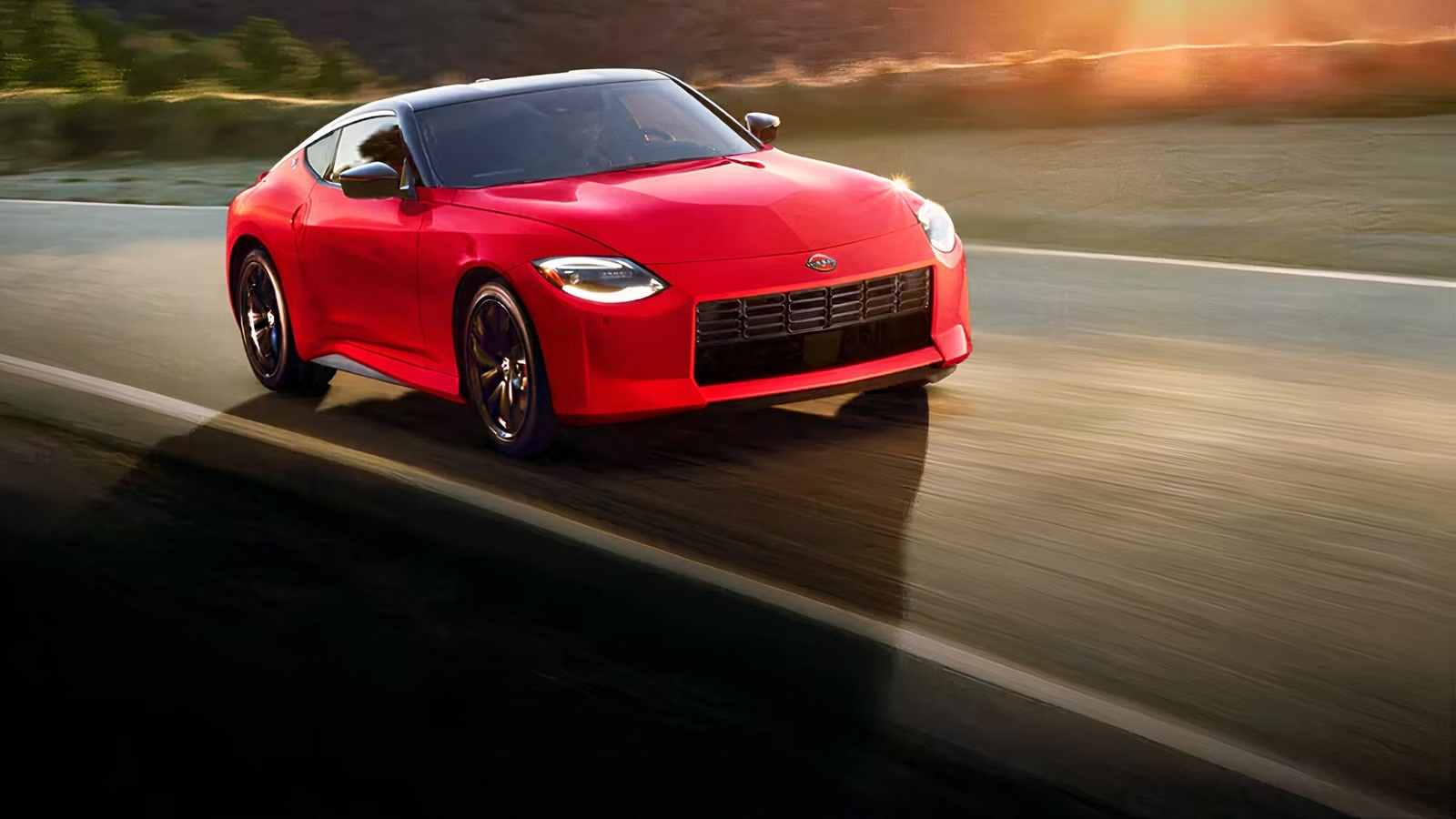
The Toyota GR Supra 3.0 is heading into its final production year in 2026, and when it goes, it takes a specific formula with it: a manual gearbox bolted to a turbocharged six-cylinder engine in a rear-wheel-drive Japanese coupe. Once that happens, the Nissan Z stands alone as the only car left offering that exact combination.

This isn’t a story about which car is faster or which engine sounds better. It’s about a shrinking category collapsing down to one survivor, and what that means for buyers who specifically want a manual transmission paired with turbocharged six-cylinder power, not a naturally aspirated four or six, not a dual-clutch automatic, and not an EV pretending to shift gears.
The GR Supra’s Six-Year Run Is Ending Right When It Mattered Most
The current GR Supra launched in 2020 as the fifth generation of the nameplate, built on a bespoke platform co-developed with BMW and powered by the German brand’s B58 3.0-liter turbocharged inline-six. Toyota paired that engine with a six-speed iMT manual that uses shortened gear ratios and throttle-blipped downshifts to make the swap-in transmission feel factory-intentional rather than bolted on as an afterthought.

Six years later, that generation is done. The 2026 model year is the last call for the GR Supra 3.0, meaning the clock is now running on the only other car in Japan’s current lineup that offers a manual behind a turbocharged six. Once Toyota’s production line stops, the Nissan Z isn’t one of two options anymore. It’s the only one.
The Z and Supra Were Never Really Fighting Each Other

It’s worth being clear about what’s actually ending here, because the Z and Supra were never twins competing for the same buyer. The Supra rides on a stiff, bespoke coupe platform shared with the BMW Z4, weighs around 3,400 pounds, and rides on a comparatively short 97.2-inch wheelbase. Its adaptive suspension, rigid aluminum control arms, and electronic rear differential push it toward being the more track-focused of the two, especially in Nismo trim.
The Z, by contrast, is built on the FM platform inherited from the 370Z, weighs closer to 3,500 to 3,535 pounds, and stretches to a 100.4-inch wheelbase. It uses a mechanical clutch-style limited-slip differential and passive dampers instead of adaptive suspension, which gives it a more old-school, grand-touring character. Where the Supra breaks traction in a controlled, engineered way, the Z lets go more readily, rewarding a driver who wants to work the car rather than let electronics manage it.
The engines tell the same story of two different philosophies solving one problem. The Supra’s B58 is a single twin-scroll turbocharged inline-six that Toyota tuned to deliver full torque around 1,800 rpm, giving it a nearly naturally aspirated feel despite the turbo. The Z’s VR30DDTT is a twin-turbocharged V6 shared with the Infiniti Q60 Red Sport and related to the GT-R’s engine family, building boost in a way that’s more rev-dependent and, according to the source comparison, feels notably more analog for a modern powerplant. The Z produces more horsepower on paper, but the Supra has a reputation for being underrated at the factory rating.
Why the Manual Matters More Than the Numbers

Both cars offer automatic transmissions that post quicker lap times and faster shifts than their manual counterparts. That’s not really the point for the buyer this story is about. A manual transmission in a turbocharged six-cylinder coupe isn’t there to win a stopwatch battle, it’s there to put the driver in the loop, matching revs on a downshift and feeling the car respond to input rather than a computer’s calibration.
Outside the Supra and Z, Japan’s current sports car lineup doesn’t offer this pairing anywhere else. The GR Corolla, BRZ, and MX-5 all stick with four-cylinder or naturally aspirated setups. That narrows the manual-turbo-six formula down to exactly two cars today, and to one once the Supra’s final 2026 units roll off the line.
The Z’s Own Future Isn’t Guaranteed Either

The Nissan Z carries on for now with a 2027 model year confirmed, but its long-term future is genuinely uncertain. Nothing in Nissan’s current plans locks in another generation, and the broader industry pressures pushing the Supra out the door, electrification, emissions rules, and the wider shift to dual-clutch automatics, apply just as much to the Z.
That makes this less a changing of the guard and more a countdown. The Z isn’t inheriting this category because it out-competed the Supra. It’s inheriting it because it’s the last one left when the music stops, and there’s no guarantee the music doesn’t stop for the Z too.
Whatever happens next, this moment is worth marking. Two genuinely different cars, a bespoke BMW-based platform against a 370Z-derived chassis, an inline-six against a V6, ended up occupying the same shrinking sliver of the market almost by accident. Once one of them is gone, buyers who want a manual gearbox paired with a turbocharged six-cylinder engine in a Japanese coupe won’t have a choice to make anymore. They’ll just have the Z.

Related posts



Latest Post


No Comments