
The V6 Muscle Car That’s Faster And More Desirable Than Its V8 Sibling
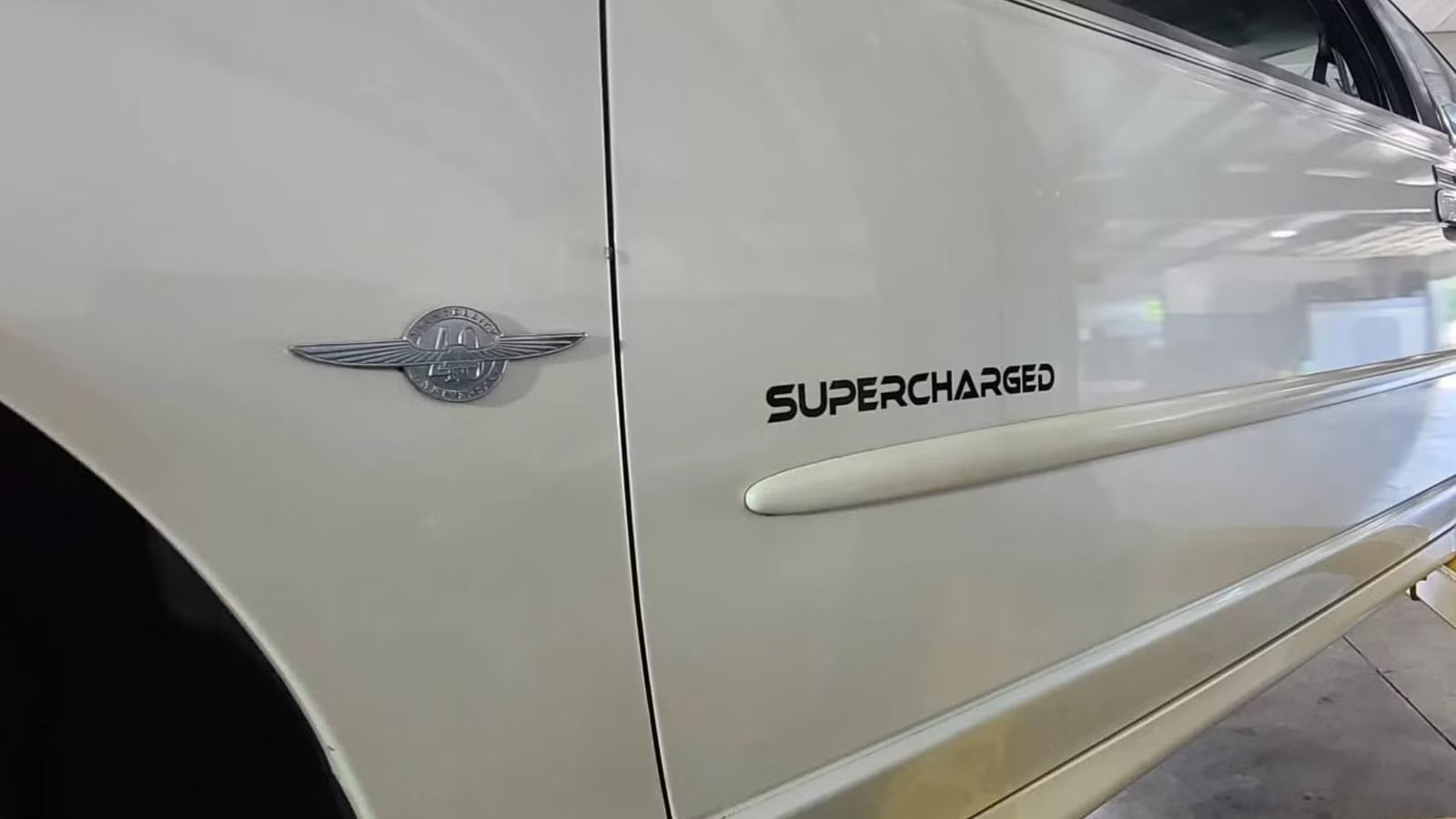
To many enthusiasts, the V8 is king. It’s not just the performance of V8 engines that make them so beloved. Their character is also a huge part of it. Nothing quite beats a V8 burble when you want an engine with lots of personality. But they’re not always the best engines for outright performance. That’s something that a few cars have proven over the years, including the one we’re going to talk about now. Not only could it beat V8s with a V6, but it was also surprisingly advanced for its time.
Muscle Cars Don’t Always Need A V8

The best and most celebrated Muscle Cars tend to have a V8 under the hood. That’s just been the accepted standard for years. It isn’t always the case, though. There have been examples of some great cars that achieved proper muscle car performance, but without using a V8. One of those cars is, surprisingly, from an automaker that has stuck by the V8 muscle car when many others haven’t.
Some Of Ford’s Best Performance Cars Didn’t Have Big V8 Engines
Ford has produced plenty of great V8-powered performance cars over the years. In fact, it still does, with the absolutely crazy Mustang GTD and Mustang Dark Horse SC being the pinnacle of that. But it’s also known for making brilliant performance models that don’t need a V8 for V8-beating power. Many of those, like the Ford Sierra RS Cosworth, were made for the European market. But there was one that Ford sold from the late ’80s to the mid-’90s that was exclusively for North America.

The Ford Thunderbird Super Coupe Is A V6-Powered Gentleman’s Muscle Car That Smoked V8s

The Thunderbird Super Coupe (produced from 1989–1995, during the tenth-generation Thunderbird’s run) is often overlooked in the annals of Ford’s performance car history. That’s entirely understandable. It completely flew over the heads of a lot of enthusiasts, even at the time. It absolutely shouldn’t have done, though. Why? Because what was under the hood was truly special. Typically, you’d expect a large American Ford coupe like this to have a V8 engine. Other variants of the tenth-generation Thunderbird actually did have Ford’s standard-issue V8 at the time (initially the 5-liter Windsor V8, and then the 4.6-liter Modular V8). But Ford did something a bit different. It took the 3.8-liter Essex V6, and put an Eaton supercharger on it.
The addition of that Eaton supercharger unlocked some brilliant performance. The otherwise fairly normal Essex V6 now produced 210 horsepower and 315 lb-ft of torque. That power received a further upgrade in 1994, bumping things up to 230 horsepower and 330 lb-ft of torque. This was decidedly more than anything the 5-liter or 4.6-liter V8-powered tenth-generation Thunderbirds ever produced. The 5-liter V8 produced 200 horsepower and 275 lb-ft of torque, while the 4.6-liter V8 produced 205 horsepower and 265 lb-ft of torque.
It Was Surprisingly Advanced For An American Car Of Its Time

The supercharger wasn’t the only thing about the Thunderbird Super Coupe that was actually quite advanced for an American car of the time. The platform the tenth-generation Thunderbird was based on (the MN12) was also pretty modern in its engineering. This was reflected in how the Thunderbird Super Coupe had fully independent rear suspension, adjustable shock absorbers, and anti-lock disc brakes on all four wheels. While that’s commonplace now, that wasn’t the case at all back in 1989 when this car first showed up.
To further prove how advanced the MN12 platform was for its time, it also underpinned the similarly underrated Lincoln Mark VIII. While the Lincoln used the 4.6-liter modular V8 instead of Ford’s supercharged V6, much of that same ethos of trying to make a car that was genuinely advanced for an American model was there.
You Could Have It With A Manual Transmission
It’s pretty clear from everything we’ve seen so far that Ford wanted the Thunderbird Super Coupe to be the enthusiast’s choice. Nothing demonstrated that more clearly than this variant’s availability with a 5-speed manual transmission. This unit was sourced from Mazda via the Japanese giant’s working relationship with Ford, and it made the Thunderbird Super Coupe the final Thunderbird variant to be available with a manual transmission. It was also the only tenth-generation Thunderbird variant that had a manual transmission. If you wanted the power of the V8, you had to settle for an automatic.
Of course, the 4-speed automatic transmission was still available as an option on the Super Coupe. But if you’re a true enthusiast, you’ll want to go for the manual for its extra involvement and rarity.
It’s Becoming One Of The Most Valuable Tenth-Generation Thunderbird Variants
The tenth-generation Ford Thunderbird is still one of the cheapest ways to get yourself into a Personal Luxury Car, or a gentleman’s muscle car. But the Super Coupe is starting to stand out from the other variants as something that could be genuinely collectible. The best examples are commanding prices that, while still in bargain territory, are absolutely trending upwards. An 18,000-mile example from 1990 that had been owned by its original owner since new sold for $13,000 in 2026. The previous year, a 9,000-mile example from 1989 sold for $16,000. As a comparison, a 1996 Thunderbird 4.6 LX with just 26,000 miles on the clock sold for $12,526 in 2026, and that’s as expensive as those V8-engined variants seem to go.
Taking just those recent sales into account, it really does seem like the Thunderbird Super Coupe is starting to get real enthusiast demand. People are finally realizing how great this variant is, once they get past the fact that it doesn’t have a V8.
Sources: Bring A Trailer, Ford

Related posts

Latest Post


No Comments