
The British Naked Bike That Just Attacked Honda’s CB650R On Price
The middleweight segment is easily the hottest it has ever been. This is true for all popular kinds of two-wheelers, be it adventure bikes, sports bikes, or touring bikes. All big brands have whipped several machines with modular mechanical bases, ensuring competitive prices to push each other into offering more and more value. This approach is now seeping into the somewhat neglected naked/roadster bike segment, too.

The biggest move in recent times has come from Honda, which has slashed the prices of the CB650R. So it undercuts many of its rivals, even the ones with half the cylinders and less power. But just as we’ve seen before, this aggressive strategy has now inspired other brands to do the same. And a British giant is the first to attack Honda.
The CB650R Offers Immense Value, Thanks To Its New Price
Last year, the CB650R bore a $9,399 MSRP. That was higher than most of its rivals, positioning it in the premium end of the 650-700cc naked roadster space. Although somewhat justified by its unique inline-four powerhouse, the value prospect remained alright. Honda knew it had to make amends, which is why the price has been slashed for 2026. It currently sits at $8,699, a sizable $700 less than before.


More importantly, this is now the most affordable inline-four bike you can purchase (even beating the 399cc Kawasaki Ninja ZX-4R). To make matters sweeter, you still get the same package as 2025. So the class-defining E-Clutch is standard, there’s a new TFT, and the design has become more mature than the MY24 bike. You also get a proven inline-four engine with over 90 ponies, beating parallel-twin rivals like the Yamaha MT-07 and Suzuki GSX-8S by a fair margin.
The Best Naked Bike Of 2026 So Far
This performance naked bike stands out for doing everything well without sacrificing the character that makes motorcycles emotionally engaging.
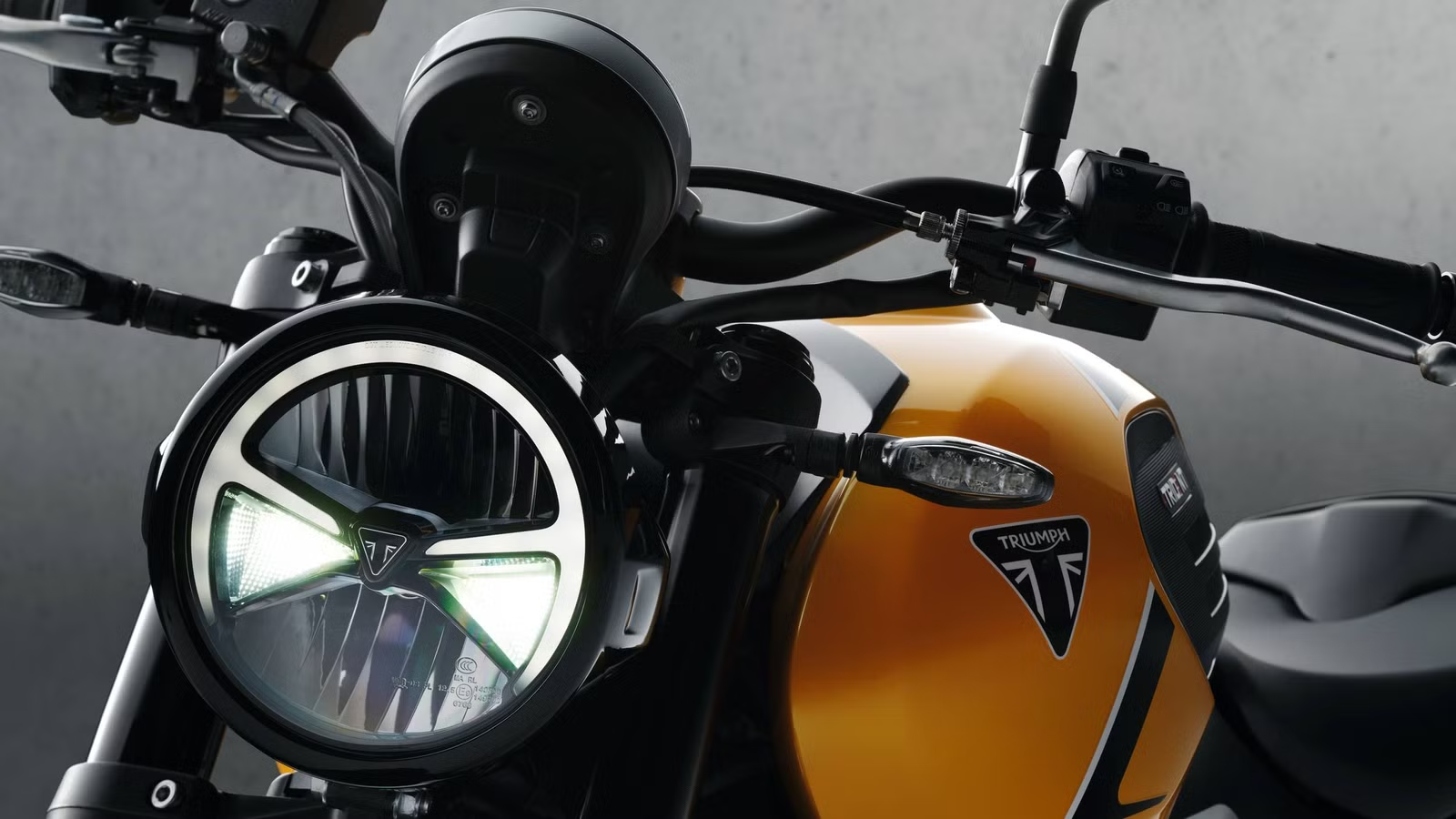
Triumph Has Now Taken A Similar Approach With The New Trident 660

Now, it appears this move has not only gathered the attention of customers but also the brand’s rivals. We say this because Triumph has just announced a similar price revision for its CB650R-rivaling triple-cylinder roadster. Case in context is the 2026 Trident 660 that debuted a few months ago.
It features some notable tweaks for the new model year, so the bikemaker hiked the prices by a small amount at the time. It was announced with an MSRP of $8,995, undercutting the then-CB650R’s MSRP. Now, post the CB’s price revision, the British giant has slashed the price by a couple of hundred dollars, down to $8,745. Although a smaller price cut, the two arch-rivals are now separated by just $46. This marks a serious attack from Triumph on Honda.
We have seen fantastic reviews from journalists and riders for the updated Trident 660, highlighting how competitive and desirable this model is proving to be in the market. Now, as well as gaining more power, sharper style, and enhanced capability, the Trident 660 has gained a tempting new price. This will hopefully make it an even more compelling choice for customers. – Chief Commercial Officer Paul Stroud
The 2026 Trident 660 Is More Capable Than Ever Before

Upon its debut, the Trident 660 aimed to be a simple middleweight roadster for riders who found the Street Triple too aggressive and Speed Twins too vanilla. Now, five years later, the 660 has had some notable updates in recent times that make it more capable and sportier than ever without taking away the overall simplicity. That, along with the price cut, helps the bike offer brilliant value for the money Triumph is asking. Here’s everything you get:
A Triple-Cylinder Powerhouse With Over 90 HP

For the longest time, the Trident’s 660cc triple-cylinder engine ran a laidback tune with around 80 horsepower and 47 pound-feet. In its latest avatar, the powerhouse now has updates like three individual 44 mm throttle bodies, a larger airbox, a revised cylinder head, and a raised redline of 12,650 RPM.
That bumps the output to 94 horsepower and 50 pound-feet, where 80 percent of the torque is available right from 3,000 RPM. The tractable delivery also helps ensure a claimed 45 miles per gallon, as you enjoy the six-speed transmission. For reference, this output is slightly higher than the CB650’s 93 horsepower and 46.4 pound-feet, and the Trident makes its power earlier in the revs.
Steel Perimeter Chassis Pairs With Showa Suspension

Housing the engine is a steel perimeter chassis. This relies on Showa 41 mm SFF-BP USD forks and a Showa monoshock for ironing out bumps, where only the rear has adjustability (preload and rebound). Both ends attach to 17-inch cast aluminum wheels, where the front has dual 310 mm discs and the rear has a 255 mm rotor mounted. All three have Nissin calipers to shed speed.
Although the same size as the CB, the Trident should stop faster due to its more compact dimensions. The weight difference, in particular, is a massive 27 pounds in favor of the Triumph (429 pounds Vs 456 pounds). Likewise, the Trident’s saddle height and wheelbase measure less than the CB’s.
|
Motorcycle |
Wheelbase |
Seat height |
Weight |
Rake |
|
CB650R |
57 inches |
31.9 inches |
456 lbs |
25.5 degrees |
|
Trident 660 |
54.7 inches |
31.7 inches |
429 lbs |
24.5 degrees |
A Naked Bike Built For Speed, Comfort, And City Sanity
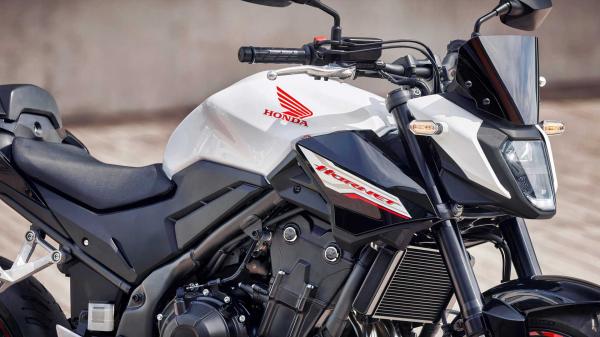
The Honda CB500 Hornet’s 471cc liquid-cooled parallel-twin engine is tuned for usable punch rather than bragging rights.
A Six-Axis IMU Brings Necessary Rider Aids

The latest Trident comes armed with likable features from the factory, some of which help it beat the CB650 easily. Chief among these is the six-axis IMU, which enables cornering ABS and cornering traction control. Whereas, the CB has a standard ABS and traction control setup. You also get three ride modes, cruise control, and self-canceling indicators on the Trident, where the latter two are unavailable on the Honda.
The CB does claw back some points with its E-Clutch and TFT instrument cluster. The former helps riders ride off and to a stop without engaging the physical clutch lever, which the Trident’s two-way quickshifter can’t do. And the latter is more premium than the Triumph’s monotone LCD-TFT round cluster.
Source: Triumph and Honda Powersports

Related posts
Latest Post


No Comments