
The First American Bike To Hit 150 MPH From The Factory
America has always been a little bit behind the rest of the world when it comes to top speed. Partly due to a focus on quarter-mile times and acceleration over outright speed, it didn’t really hit the same heights as Japanese and European automakers on a regular basis.

That’s not to say that every US car or bike is slow, of course. There’s a dedicated group who do chase speed – manufacturers like Hennessey and SSC, for whom “fast” doesn’t begin until 200 mph. But particularly in the motorcycle world, US bikes have lagged—to the point that the first mass-produced US motorcycle didn’t hit 150 mph until 2007.
A Country Built On Power, Not Speed
The US has long had a fascination with big displacements that create power rather than speed. The drag strip and the quarter mile are far more common than in any other country, as is the grid layout of cities, which means quick acceleration is arguably more useful than outright speed. Factor in the cheap gasoline, potential for hauling, and long drives where smoothness is important, and you’ve got a recipe for big engines with low power.

It led to cars like the 1975-76 Cadillac Eldorado — an 8.2-liter V8 that made around 200 hp, and the Lincoln Continental Mark IV that could be specced with a 7.5-liter V8 that made the same. There was also the 1977-78 Plymouth Volare, whose 5.7-liter V8 made just 140 hp.
It extends to motorcycles, too. Harley-Davidson is obviously the biggest bike manufacturer in the US and, while some of their bikes have big engines, they’re not always the most powerful. The 1993-94 Electra Glide made just 50 hp from its 1.3-liter engine, while the 2025 Road Glide has a 1.9-liter engine and makes a comparatively puny 107 hp—something most modern bikes can clear with an engine half that size. That’s not to say that all American-made vehicles forgo speed, though, as one bike manufacturer proved.
Buell Becomes The Anti-Harley

Created by former Harley-Davidson engineer Erik Buell in 1983, Buell was initially formed to help its founder’s privateer motorcycle racing ambitions. He built his first bike, the RW750, to compete in the AMA Formula One class. However, when the series was canceled, Buell shifted his focus to road-going motorcycles instead.
Buell’s road bikes used Harley-Davidson engines in innovative ways, including treating the engine as a stressed chassis member to improve rigidity and reduce weight. This, along with Buell’s growing success, led to Harley-Davidson acquiring a 49% stake in the company in 1993. Buell continued developing performance-oriented motorcycles powered by Harley-derived V-twins until Harley took full ownership in 2003.
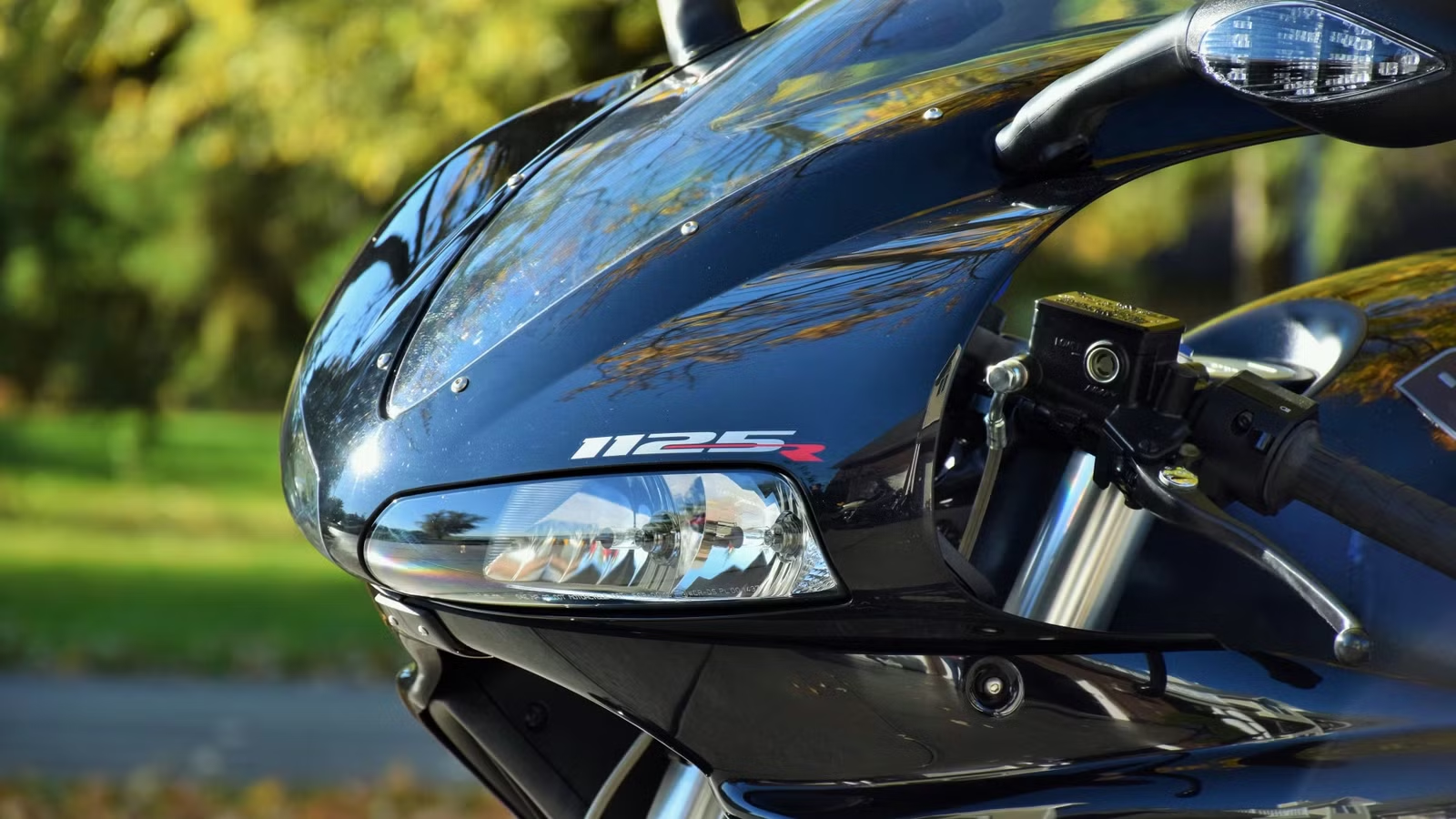
While the bikes had always been pioneering in their own way, they still had their ties to the cruiser company. Buell wanted to create a bike that could be a contender in the sportbike world, and in 2007, they released the 1125R.
The First Production Bike To Run A 10-Second Quarter Mile
It was a benchmark that manufacturers were vying to hit, but who actually hit it first?
The Barrier-Breaking Buell 1125R

Buell had already been experimenting with fast sportbikes by the mid-2000s. Its XB Series bikes, like the XB9R Firebolt and XB9S Lightning, had proved that it could make successful road bikes, and subsequent iterations pushed them further. But it had plans to be much faster and, in 2007, it released the Buell 1125R.
The bike did things a little differently. To start with, there’s the frame; far from “just” being the bit that the parts attach to, it actually housed the 5.6-gallon fuel tank, while the oil was held in the swingarm. The space the tank usually took up was replaced by an air intake. This had a few benefits; the first of which was a lower center of gravity. This made the bike more agile, which helped to improve its cornering.
|
Engine |
Power |
Torque |
Top Speed |
Weight |
|
1,124.9 cc liquid-cooled V-twin |
146 hp |
82 lb-ft |
161 mph |
375 lbs dry / 466 lbs wet |
Keeping the weight down, and in the middle of the bike, was something that Buell focused on, and fluids in the frame wasn’t the only example of it. The bike’s front brake was a massive single perimeter rotor, meaning that rather than having a tight disc in the middle of the wheel, the disc itself was actually a much larger circle almost as wide as the rim. Far from being different for the sake of being different though, it has grounds in engineering. The rotor being closer to the tire provides greater leverage, reduces the unsprung weight (no need for heavy center hubs) and improves cooling.

The mass centralization also saw the exhaust placed underneath the bike, rather than to the side, and the belt drive instead of a chain offered both improved durability and smoother power delivery. It was the bike Buell had always wanted to make but, unfortunately, it came at exactly the wrong time.
The 2007 launch for the 2008 model year meant it came at the start of the 2008 Financial Crisis, with Harley dropping Buell in 2009 to cut costs and refocus on its core lineup. This killed the bike’s run just after it had started, though it had also had a rocky launch. The bike’s styling was controversial, with the two large air intakes either side of the front suspension being labeled “lobster claws” by its detractors. There were also teething issues with early bikes, with quality control, heat, and stiff suspension all going against it. Still, for all the issues with the bike’s launch, it did have one thing on its side. And that was its speed.
Buell Breaks 150 MPH And Keeps Going

150 mph might not sound like much in today’s motorcycle market, and to be fair, it wasn’t a huge accolade for bikes in 2007, either. The Vincent Black Lightning, a British bike, had hit 150 mph in the hands of Rollie Free in 1948. Japanese and European bikes were routinely breaking 180 mph for years. The Hayabusa had effectively ended the top-speed competition in 1999. But US bikes had largely focused on power over speed, and were lagging.
The 1125R aimed to remedy that. It had 146 hp, low weight, and a goal. It achieved that goal, too, and not by a small margin. Period reports put the bike at 158 mph and 161 mph, comprehensively surpassing that 150 mph mark.
This Old Touring Motorcycle Will Destroy Modern Supercars
A decade-old touring motorcycle packs bags, sips miles, and still crushes today’s supercars from a stop or a roll. The surprise? That’s the point.
How The 1125R Stacked Up Against The Competition

|
Buell 1125R |
Honda CBR1000RR |
Suzuki GSX-R1000 |
Ducati 1098 |
|
|
Engine |
1125cc liquid-cooled 72° V-twin |
998cc liquid-cooled inline-four |
999cc liquid-cooled inline-four |
1099cc liquid-cooled L-twin |
|
Horsepower |
146 hp |
175–176 hp |
185 hp |
160 hp |
|
Torque |
82 lb-ft (Crank/Brake Torque), 75.9 lb-ft (Rear-Wheel Torque) |
85 lb-ft |
86 lb-ft |
90.4 lb-ft |
|
Top Speed |
158–161 mph |
180 mph |
180–186 mph |
173 mph |
|
Weight |
375 lbs dry / 466 lbs wet |
438 lbs wet |
379 lbs dry |
381 lbs dry |
The Buell 1125R arrived at a time when the sportbike class was dominated by absolute giants, including Japanese inline-four-powered models like the Honda CBR1000RR and Suzuki GSX-R1000, and European monsters like the Ducati 1098. Smooth, refined, and brutally fast, the Honda CBR1000RR was the benchmark all-rounder of the era and objectively the better motorcycle for most riders, but the Buell still had advantages like stronger mid-range punch, quicker steering characteristics, and distinctive chassis innovation.
The 1125R also struggled against the Suzuki GSX-R1000, which was arguably the king of outright performance at the time and known for ferocious acceleration and incredible top-end speed. Compared to the GSX-R1000, the Buell simply lacked the same explosive peak performance, but it still fought back with compact dimensions and being more distinctive and arguably more engaging at sane road speeds. The 1125R’s most direct rival was the Ducati 1098.
Buell 1125R Vs. Ducati 1098

This was a fascinating comparison because both bikes approached performance with big V-twin philosophy rather than inline-four power, and surprisingly, the Buell came closer than many expected, even though the Ducati was the more premium option. While the Ducati was a high-strung masterpiece with around 160 hp and a higher top speed than the Buell, it was a demanding bike on the street and was more race-focused than the more street-friendly 1125R. The Rotax engine also provided a thick torque curve that made the 1125R feel fast in real-world riding. The Buell also had a more agile feel and could genuinely keep pace with the Ducati and other bigger-name rivals on tight roads.
While the Ducati 1098 was faster, more polished, more stable, more exotic, and ultimately a superior sportbike, the 1125R was a serious, budget-friendly contender.that proved an American sportbike could stand in the same conversation as Ducati and other top manufacturers of the day.
10 Things Only Real Bikers Know About Buell
Buell Motorcycles not only astounds with its fantastic superbikes but also its racing track record.
Outside Of Mass Production, The American Motorcycle Has Gone Far Faster

Other US-made bikes had broken the 150 mph mark before the Buell 1125R, but these were either homologation specials like the Harley-Davidson VR1000 or insane boutique bikes like the MTT turbine series. There’s also the Lightning LS-218, which is an American-made electric bike capable of 218 mph.
Buell themselves would break 150 mph again more recently, with the Hammerhead 1190 (around 183 mph) and the Erik Buell Racing (EBR) 1190RX, which can almost hit 190 mph. But the Buell 1125R will forever go down as a “what if” of motorcycling. A high-performance, high-speed American sportbike that, while not without its issues, was cut down by factors outside its control before it hit its prime. How far it could have gone will forever remain a mystery, but the 2009 AMA Pro Racing Daytona Superbike Championship title it secured suggests it could have gone further. It just needed the chance to prove it.
Sources: Motorcycle Consumer News

Related posts
Latest Post


No Comments