
McLaren’s First SUV Is Confirmed, And Here’s What That Means For Buyers Eyeing The Urus Or Cayenne Turbo
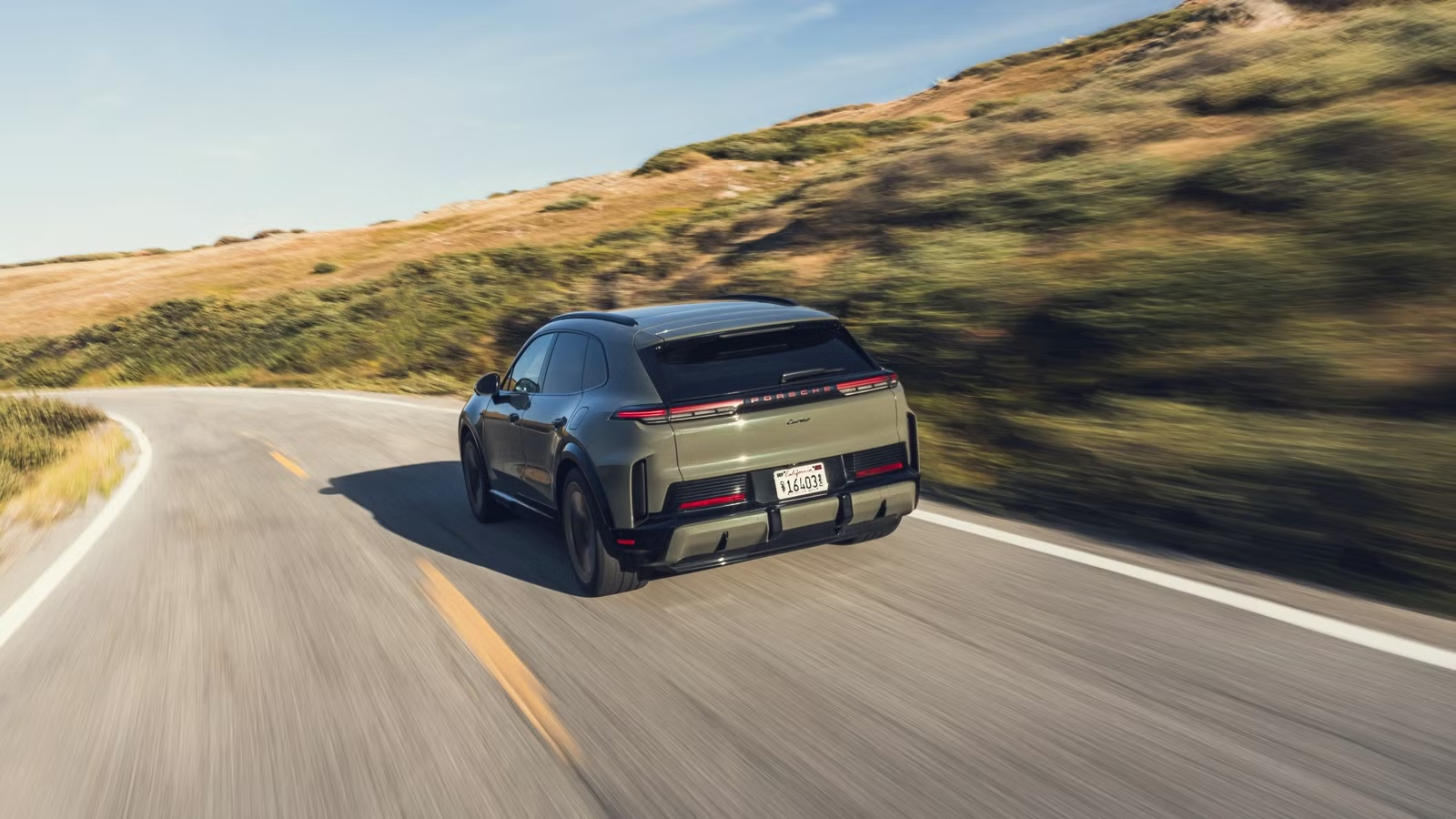
McLaren confirmed yesterday what years of rumors had been building toward: the British supercar maker is building its first SUV. Announced alongside a £500 million investment from Abu Dhabi’s L’IMAD sovereign fund, the four-door, five-seat performance SUV — codenamed P47 internally — is expected to arrive before 2030, with some reports pointing to a 2028 target. For buyers currently weighing the Lamborghini Urus or Porsche Cayenne Turbo GT Coupe, that confirmation changes the conversation.

The bigger story isn’t just that McLaren is joining the segment — it’s how. Rather than borrowing a powertrain from a partner, McLaren will develop and build its hybrid V8 engine and transmission entirely in-house, a first in the company’s history. That engineering commitment, backed by real capital and a second UK assembly facility, signals this isn’t a badge-engineering exercise. It’s a ground-up play for a slice of the most profitable corner of the luxury car market.
What McLaren Has Actually Confirmed About the P47
McLaren’s official announcement was deliberately light on specifics, but dealer briefings and reporting from Autocar and Motor1 fill in a clearer picture. The P47 will be a four-door, five-seat SUV — both firsts for the brand — with a silhouette described as similar to a more muscular Porsche Cayenne Turbo GT Coupe, complete with a large rear spoiler and diffuser. A clay model shown to dealers reportedly wore 24-inch wheels, which would be the largest ever fitted to a McLaren.

Powertrain details remain officially unconfirmed beyond the hybrid V8 direction. McLaren COO Michael Straughan told Autocar the SUV could be built around a carbon fiber tub — the same structural philosophy underpinning its supercars — though he acknowledged the engineering challenges that would involve in terms of cost, refinement, and repairability. “If we went that way, it would be the first. It would be incredibly special,” he said. No other SUV in this segment uses carbon tub construction; all current rivals rely on aluminum-intensive platforms.
In-House Powertrains Are the Real Differentiator

For most of its modern history, McLaren sourced its engines from Ricardo, the Sussex-based engineering firm that supplied the twin-turbo V8 used across the 12C, 650S, 720S, 750S, and beyond. That engine traces its roots to a Nissan Le Mans racing unit from the 1980s. Going forward, McLaren will design, develop, and manufacture its own powertrains in the UK — two new hybrid engines and associated transmissions are already in development.
This matters to performance SUV buyers because it addresses a credibility question the brand would otherwise face. The Urus uses a Volkswagen Group-derived twin-turbo V8 shared across Audi, Bentley, and Porsche products. The Cayenne Turbo GT draws on Porsche’s own engineering, but Porsche has decades of SUV development behind it. McLaren arriving with a clean-sheet hybrid V8 built in Woking — tuned, as Straughan put it, to maximize “emotion” through sound, feel, and power delivery — positions the P47 as something genuinely engineered for the badge it wears, not assembled from borrowed parts.


The Lamborghini Urus Performante starts around $250,000 and delivers 657 horsepower from its twin-turbo V8. The Porsche Cayenne Turbo GT Coupe sits near $210,000 and produces 729 horsepower. Both are proven, well-developed products with established dealer networks and known reliability records. McLaren is asking buyers to wait until roughly 2028 for a car whose final specifications, pricing, and production readiness are still being determined.
That’s a real consideration. But the calculus shifts if McLaren can deliver on its carbon tub promise and match or exceed the power figures of its rivals. CEO Nick Collins has framed the SUV explicitly as a path to Ferrari-level profit margins, which implies pricing well above the Urus — likely north of $300,000. At that level, McLaren isn’t really chasing Porsche volume; it’s targeting the buyer who wants the Purosangue but prefers a British supercar pedigree. For that buyer, the P47 adds a genuinely new option to a consideration set that has been static for several years.
The Broader McLaren Transformation Behind the SUV

The £500 million investment covers more than just the P47. McLaren plans a second UK assembly facility — location not yet confirmed, though Sheffield, where its carbon fiber plant sits, has been mentioned — and expansions at its Woking production center. The company built around 2,000 cars in 2025; the SUV is intended to drive volumes significantly higher, with Straughan pointing to rivals like Aston Martin (around 6,000 cars per year) as a reference point for where McLaren wants to go.
The announcement also comes as the Artura, McLaren’s current entry-level hybrid supercar, is reportedly being discontinued by 2028 following a troubled launch marked by quality issues and slower-than-expected sales. Its replacement, codenamed P34, is expected by late 2027 with a twin-turbo V6 hybrid targeting around 810 horsepower — a significant step up. Together, the P34 and P47 represent a near-complete reset of McLaren’s lineup, funded by sovereign capital and anchored by powertrains the company will finally own outright.
The P47 won’t reach showrooms for at least two years, and plenty can change between now and then. But McLaren has put real money behind this commitment — £500 million and 1,000-plus UK jobs by 2032 — and the in-house powertrain program gives it an engineering story that borrowed-engine rivals can’t match. If you’re shopping the Urus or Cayenne Turbo GT today, you probably shouldn’t wait. But if your timeline stretches to 2028, it’s worth keeping a spot on your shortlist.

Related posts






Latest Post


No Comments