
This Was The World’s Fastest Car Over The Quarter Mile In The ’80s
Few decades have left a deeper mark on performance car culture than the 1980s. It was an era defined by engineering ambition — turbocharged engines, exotic lightweight materials, and a relentless pursuit of speed that produced some of the fastest quarter-mile times ever recorded by production supercars. Manufacturers weren’t just chasing top speed; they were locked in a full-spectrum arms race that rewrote what a road-legal automobile could do.

While the battle for top speed and 0–60 mph acceleration raged on, manufacturers also worked on raw acceleration, traction, and power delivery. As a result, these cars were blindingly fast when running the standing quarter mile. Some used brute force with high horsepower, some employed clever advanced technologies like active suspension and all-wheel drive, while others benefited from their lightweight construction.
One car, however, rose above all the rest to claim the quarter-mile crown — posting a time so remarkable it still commands respect by modern standards. So, which production car was the fastest over the quarter mile in the ’80s? Let’s take a closer look.
The 1987 Ferrari F40 Ran The 1/4 Mile In Under 12 Seconds
Ferrari F40 Performance Specs
 59 autotech 0-60 MPH |
3.8 seconds |
|
0-100 MPH |
7.6 seconds |
|
0-140 MPH |
14 seconds |
|
1/4 Mile |
11.9 seconds at 125 MPH |
|
Top Speed |
201 MPH |
(Source: Ferrari, Mecum)
Recording a time of 11.9 seconds at 125 mph, the Ferrari F40 is the fastest production car over the standing quarter mile from the 1980s. After the F40 debuted in 1987, various outlets recorded performance numbers that had never been seen before from a road-legal car. The F40 posted a 0–60 mph time of 3.8 seconds, a 0–100 mph time of 7.6 seconds, and a 0–140 mph time of 14 seconds. With a top speed of 201 mph, the Ferrari F40 was also the fastest production car in the world at the time.
When it debuted, the F40 redefined the modern supercar concept. The lightweight machine was conceived in 1986 to celebrate Ferrari’s upcoming 40th anniversary. It would go on to be the final Ferrari supercar developed under Enzo Ferrari, who passed away on August 14, 1988.
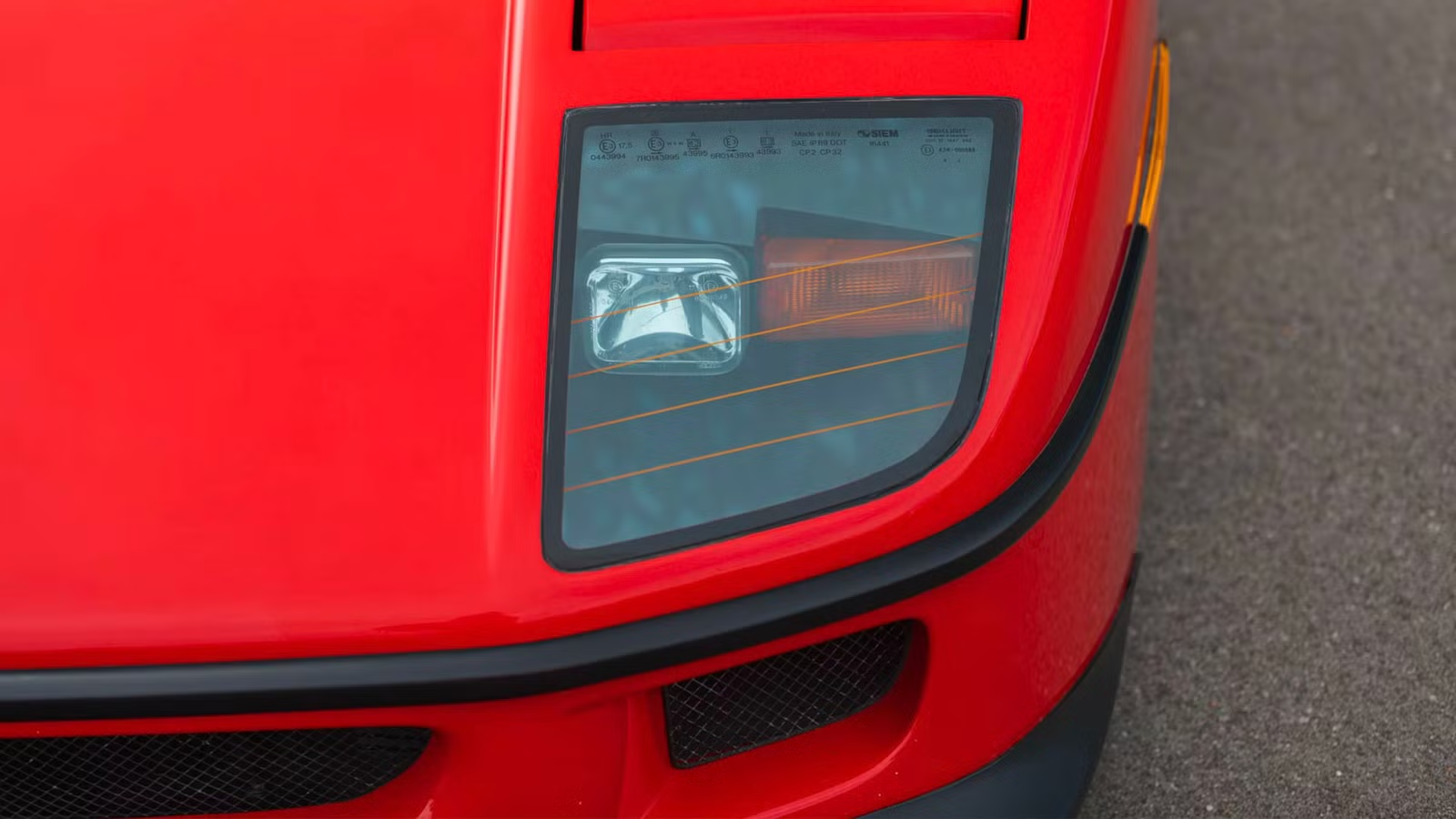
While the exterior of the Ferrari F40 was optimized for aerodynamics — with air ducts at the front and the iconic fixed rear wing — the interior was deliberately spartan. The stripped-down cabin was racecar-inspired, with no carpets, door handles, or sound insulation, all in service of saving every possible ounce of weight.
Initially, the F40 was projected for a production run of 400 units. However, overwhelming demand led Ferrari to extend production to 1,315 units, all built between 1987 and 1992.
Ferrari F40 Historic Highlights
- Last Ferrari Supercar built under Enzo Ferrari
- Fastest car in the world in the 80s with a 201 mph top speed
- Ran the standing quarter mile in 11.9 seconds at 125 mph
- 400 unit production run, extended to 1,315 units by 1992
In The 80s, The Ferrari F40 Was The World’s Fastest Car
Engine Specs
|
Displacement |
2.9-Liter |
|
Configuration |
V8 (Tipo F120A) |
|
Induction |
Twin-Turbocharged |
|
Power |
477 HP at 7,000 RPM |
|
Torque |
426 LB-FT at 4,000 RPM |
|
Transmission |
5-Speed Manual |
|
Drive |
Mid-Engine / Rear-Wheel Drive |
|
Weight |
2,765 lbs |
|
Fuel Type |
Gasoline |
(Source: Ferrari, Mecum)
Powering the iconic F40 was the legendary 2.9-liter twin-turbo Tipo F120A V8 engine. Ferrari tuned the engine to 471 hp, though for the US market it produced 477 hp at a visceral 7,000 rpm. Peak torque of 426 lb-ft arrived at 4,000 rpm. Drive went through a 5-speed manual transmission with a gated shifter, delivering satisfying tactile feedback with every shift.
The F40’s twin-turbocharged V8 featured intercoolers, a quad-cam design, and port injection, managed by a Weber-Marelli engine management system. The mid-engined, rear-wheel-drive layout makes driving the F40 a pure, unfiltered experience. The complete absence of driver aids makes it an extremely demanding car, one that rewards skilled drivers handsomely but punishes mistakes without mercy. Thanks to its lightweight construction, the F40 tips the scales at just 2,765 lbs, contributing directly to its blistering performance.
Ferrari employed independent double wishbones with coil springs and anti-roll bars for the F40’s suspension setup. Braking was handled by large Brembo ventilated discs, while Pirelli developed a special compound and tire design exclusively for the F40.
For the F40, Ferrari constructed a carbon-fiber and Kevlar-reinforced steel spaceframe chassis — materials that were exceptionally rare in a production automobile at the time. Only the Ferrari 288 GTO had previously used this type of lightweight construction. Italian coachbuilder Scaglietti was tasked with designing the body, which also used composite materials for its panels.
The Ferrari F40 Is Worth $2.4 Million Today
Ferrari F40 Current Values
|
Condition |
Value |
|
Concours Condition |
$3,450,000 |
|
Excellent Condition |
$3,100,000 |
|
Good Condition |
$2,400,000 |
|
Fair Condition |
$1,600,000 |
(Source: Hagerty)
The Ferrari F40 had a six-year production run between 1987 and 1992. Ferrari originally planned to build just 400 examples, but strong demand pushed that figure to 1,311 units over the course of production. Among these, just 213 examples were delivered to the US market.
Today, regardless of model year, the Ferrari F40 is one of the most valuable cars on the planet. According to Hagerty’s valuation tool, a fair-condition F40 is worth an eye-watering $1,600,000. On average, good-condition examples sell for around $2,400,000. Well-maintained, low-mileage cars are valued at approximately $3,100,000, and pristine, Concours-worthy examples can reach $3,450,000.
Over recent years, Classic.com data shows used Ferrari F40s selling for an average of around $2.4 million, consistent with Hagerty’s figures. The lowest recorded sale for an F40 since 2020 is $1.1 million, while the highest recorded sale reached $3.9 million at auction in 2022.
Porsche 959 Was Second Fastest Over The Quarter Mile

Engine Specs
|
Displacement |
2.85-Liter |
|
Configuration |
Flat-6 (Type 965) |
|
Induction |
Twin-Turbocharged |
|
Power |
444 HP at 6,500 RPM |
|
Torque |
369 LB-FT at 4,500 RPM |
|
Transmission |
6-Speed Manual |
|
Drive |
Rear-Engine / All-Wheel Drive |
|
0-60 MPH |
3.6 Seconds |
|
0-100 MPH |
7.9 Seconds |
|
1/4 Mile |
12 Seconds |
|
Top Speed |
197 MPH |
(Source: Porsche, Mecum)
In the late 1980s and early 1990s, the F40 had worthy rivals in the Porsche 959, the Lamborghini Diablo, and the McLaren F1. Recording a quarter-mile time of 12 seconds flat, the Porsche 959 was the second-fastest production car over the standing quarter mile, just behind the F40.
The F40 was more powerful and considerably lighter than the twin-turbo 2.8-liter flat-six-powered Porsche 959. Even so, the 959 was one of the most technically sophisticated machines of its era, offering active suspension, all-wheel drive, and a suite of driver aids that were genuinely groundbreaking for the time.
The F40 was lighter, quicker to accelerate, and had a higher top speed. The Porsche 959’s all-wheel-drive system, however, delivered superior traction and stability — particularly in wet conditions. The 959 also offered a far more civilized interior, complete with air conditioning and leather seats.
With only 292 examples of the 959 ever produced, it is significantly rarer than the F40. Despite that scarcity, the Ferrari commands higher values on the market; the Porsche 959 is worth around $1.7 million on average.
Sources: Ferrari, Porsche, Mecum Auctions, Hagerty

Related posts

Latest Post


No Comments