
Only 16 Survive: The 454 Big-Block GMC Muscle-Car History Forgot
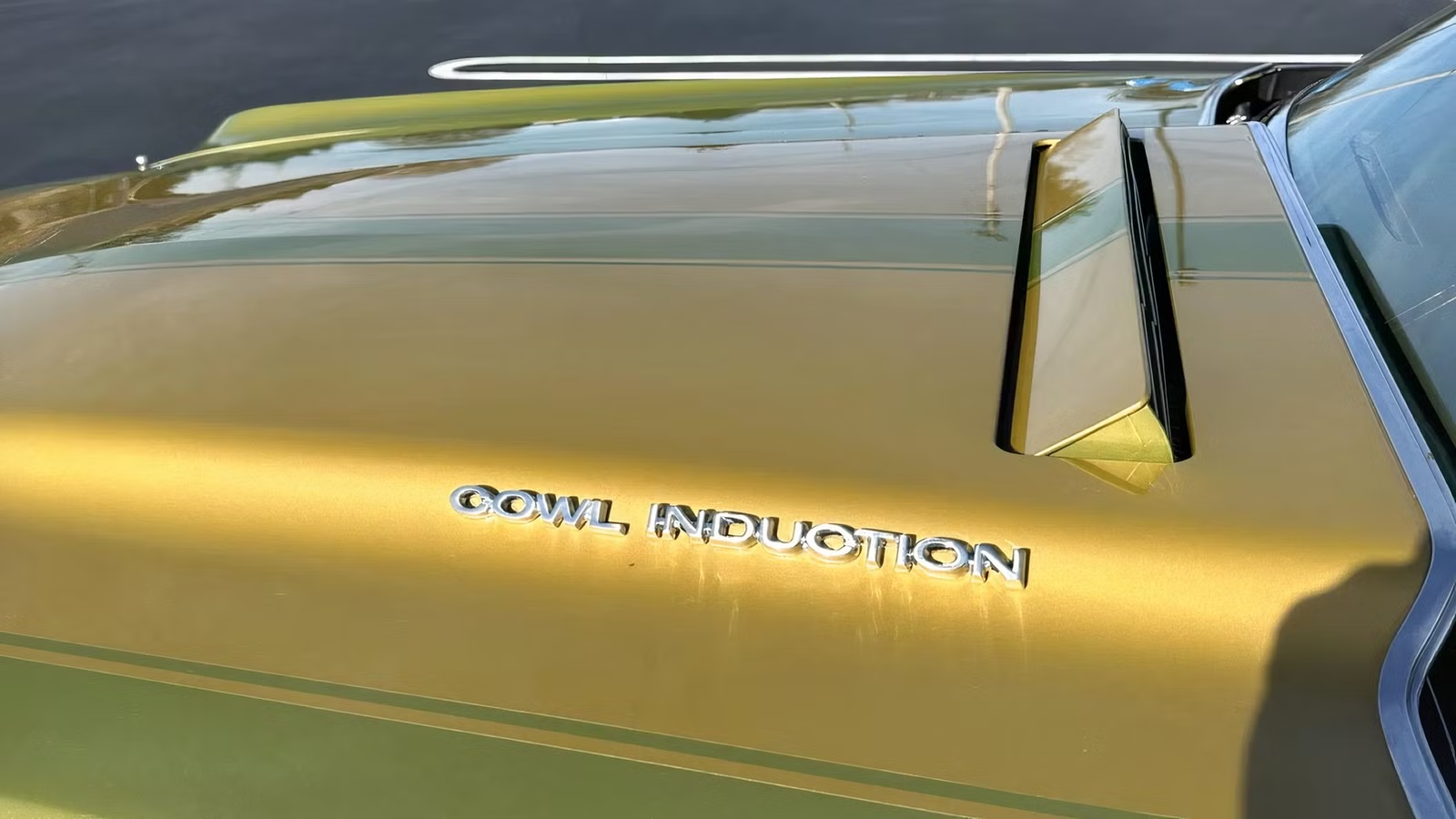
Twenty-five. Think about that number for a moment. In the context of global automotive production, where assembly lines churn out millions of vehicles every year, twenty-five cars isn’t even counted as a production run. This number is lower than that of exclusive ultra-rare modern hypercars like the Bugatti Centodieci or the Pagani Utopia. Yet over five decades ago, General Motors accidentally created a street legend so scarce that only about sixteen people on Earth are estimated to own one today. This vehicle came from a brand better known for hauling gravel than for burning rubber.
Big Block Muscle Cars Were Coming To An End
1971 marked the beginning of the end of the original golden era of American muscle. For nearly a decade, Detroit had been locked in a displacement war, stuffing larger and more aggressive engines into mid-size family cars. But by 1971, this golden era was crashing down under the combined weight of impending federal emissions legislation and skyrocketing insurance premiums that made owning a big, powerful, high-compression V8 expensive for young drivers who were the core demographic for these cars.
American automakers had to make their engines capable of running on low-octane unleaded gasoline, forcing an industry-wide reduction in compression ratios and power. The party was almost over, and Detroit knew it. But none of these companies were going to go out without making a statement, which led to the making of some of the most refined, high-displacement heavy hitters the automotive world had ever seen.
Some Of The Best Muscle Cars Came Out Of The ’70s

Before the restrictive emissions laws and mandatory use of catalytic converters took full effect in the mid-70s, the early 1970s produced an extraordinary batch of muscle cars that can only be described as pure mechanical greatness. Vehicles like the 1970–1971 Chevelle SS 454, the Hemi Cuda, the Pontiac GTO Judge, and the Plymouth Road Runner represented the absolute peak of iron-block dominance. These cars didn’t just move; they dominated the drag strips and streets, leaving a trail of smoke and melted rubber everywhere they went. It was at this peak period that GMC quietly created a vehicle no one expected.

GMC Wasn’t Supposed To Be The Interesting Brand

In 1971, the GMC division of General Motors had a crystal-clear identity: it was the utilitarian workhorse. Chevrolet was GM’s mass-market, high-volume brand that catered to families, street racers, and boulevard cruisers alike. GMC, by stark contrast, was where farmers, contractors, and fleet managers bought heavy-duty pickup trucks, commercial vans, and medium-duty haulers. GMC didn’t build sleek coupes; it didn’t participate in NASCAR or Trans-Am, and it certainly wasn’t in the business of selling tire-shredding performance cars to twenty-something-year-old street racers.
The idea of a performance-focused GMC vehicle was an absolute contradiction to the brand’s identity. But Detroit in the early 1970s was driven by dealer demands and badge-engineering economics. This led brands like GM to use the same platform, or even the entire vehicle, across their sub-brands by simply swapping the badge. GMC truck dealers wanted a car-based pickup utility vehicle in their showrooms so they could compete directly with Chevrolet dealers selling the wildly popular El Camino. This led to the creation of a new type of GMC truck.
They Kind Of Made A Big Block Muscle Car

This gave birth to the 1971 GMC Sprint. Built alongside the Chevrolet El Camino on GM’s legendary A-body intermediate platform, the Sprint was fundamentally identical to its Chevrolet twin under the skin but with its distinct GMC styling. It fulfilled its core duty as a stylish, car-like truck designed to carry light loads on weekdays and tow a boat on weekends. To the casual observer, GMC had simply launched a rebadged El Camino to keep its commercial truck dealers satisfied and maximize profits. But behind closed doors, GM had bigger plans for this truck. GMC wasn’t just building a utility truck; they also had plans to build a heavy-hitting big-block muscle car with a pickup bed.
The Sprint SP Was GMC’s Forgotten Big-Block Weapon

GMC introduced its top-tier performance option code (RPO) YE7, better known as the Sprint SP. Opting for the SP package transformed the utility truck into an aggressive street machine. The package included a heavy-duty suspension, a round-gauge instrument cluster, dark-finished grille accents, special SP badging, and 15-inch 5-spoke rally wheels borrowed directly from the Chevelle SS, complete with unique GMC-branded center caps.
While the Sprint SP could be ordered with a modest 350 cubic-inch small-block V8 or a 402 cubic-inch big-block, one option stood head and shoulders above the rest. Ticking this option took the Sprint SP from a quirky utility truck into an absolute terror on the road and drag strip.
The LS5 454 Was The Real Story

The crown jewel of the 1971 Sprint line was the optional LS5 454 cubic-inch (7.4-liter) big-block V8. This massive powerplant was one of the biggest displacement engines ever fitted to a road car. Built with a heavy cast-iron block and cast-iron cylinder heads, the overhead-valve (OHV) V8 was fed by a massive Rochester Quadrajet four-barrel carburetor. In an era when emission mandates were forcing compression ratios down to 8.5:1 across General Motors, the LS5 454 still managed to punch out a staggering 365 horsepower and an astonishing 465 lb-ft of torque. It sent power to the rear wheels via a three-speed automatic, the only transmission available for this vehicle.
That lower compression ratio mattered immensely in 1971. While peak horsepower dropped compared to the previous year’s legendary high-compression LS6, the LS5 lost virtually none of its low-end grunt, and that torque figure was the reason why. This was not a delicate, high-revving, overhead-cam exotic engine that needed to be screamed to 7,000 RPM to find power. That torque came in at 3,200 RPM — it was a giant-displacement, low-RPM torque machine. The moment you tapped the accelerator pedal, the LS5 delivered a wave of instant, low-end rotational force capable of breaking those wide rear tires loose at virtually any speed.
The Sprint SP 454 Was Fast Even Against Dedicated Muscle Cars

Having such a powerful engine also meant the Sprint SP would definitely keep up with some of the most powerful muscle cars of that era. But because it carried an open bed in the back, skeptics often dismissed the Sprint SP as a commercial truck trying to play dress-up. That was a big mistake. Straight off the showroom floor, an LS5-equipped Sprint SP was capable of running a 0–60 mph time of around 6.5 seconds and quarter-mile times in the low-14-second range. These figures put it in direct competition with dedicated period muscle cars like the Dodge Challenger R/T, Ford Mustang Mach 1, and Pontiac GTO. In fact, if your vehicle wasn’t packing an engine that big, you were likely not beating this truck in a race.
It Looked Like A Pickup Truck Until It Didn’t

The Sprint SP looking like a small pickup truck was its greatest advantage. It had a deceptively modest silhouette with clean lines, a bed, and the GMC badge on the front grille. It looked like a vehicle meant to deliver farm supplies until the driver smashed the throttle, the V8 roared, and it was gone. Underneath that utilitarian exterior lay GM’s proven A-body car chassis, the same high-performance architecture underpinning the Chevelle SS.
With a rear-wheel-drive layout, heavy-duty front and rear sway bars, power front disc brakes, and a robust 12-bolt rear axle, the Sprint SP possessed all the mechanical upgrades of a top-tier muscle car. But the Sprint SP 454 is a unique and fascinating vehicle that occupies a highly desirable middle ground in American automotive history: part fire-breathing muscle car, part practical pickup truck, and part personal-luxury coupe.
Sprint SP 454 Is Rarer Than The Cars That Became Legends

When muscle car enthusiasts gather to debate the rarest vehicles of the classic muscle car era, the conversation usually turns to legendary holy grail cars like the 1971 Plymouth Hemi Cuda convertible (11 units built), the 1970 Chevelle SS 454 LS6 (roughly 4,475 built), or the 1969 Hurst/Olds. Yet, the 1971 GMC Sprint SP 454 quietly sits among the rarest production muscle vehicles ever assembled by General Motors. The numbers speak for themselves.
While Chevrolet pumped out over 41,000 El Caminos in 1971, total GMC Sprint production across all trim levels was just 5,536 units. Narrowing that down to the high-performance SP trim, the number plunges to just 249 vehicles. Finally, the ultimate Sprint SP equipped with the factory LS5 454 V8 accounts for only about 25 factory examples that were ever built. More than five decades have passed, so when we account for accidents, rust, and engine swaps, only around 16–17 authentic 1971 GMC Sprint SP 454s survive today. It is difficult to give an accurate valuation of these cars today, since so few were made and almost none have come up for sale. Hagerty puts good driver-condition cars at around $25,000, while a 2025 sale from Bring A Trailer came in at $16,454, although this has 98,000 miles.
Why The GMC Sprint SP 454 Still Matters

For decades, the automotive market overlooked the Sprint SP 454 for obvious reasons. The GMC badge, long associated with commercial fleets, caused car collectors to bypass it in favor of Chevrolet’s equally quirky El Camino. GMC’s ultimate muscle car was hiding in plain sight behind a truck nameplate, and almost no one knew about it.
However, the collector landscape has shifted dramatically in recent years. As popular muscle icons become a regular sight at auctions, serious collectors are hunting for documented, ultra-low-production unicorns that tell a unique story. The badge that once caused the Sprint SP 454 to be forgotten has now become its greatest asset. Today, a verified, matching-numbers 1971 GMC Sprint SP 454 represents the ultimate combination for collectors: undeniable big-block American muscle, extreme low-production rarity, and a fascinating chapter of GM history when a commercial truck brand secretly built a street-shredding monster.
Sources: General Motors, GMC, Chevrolet, Bring A Trailer, Hagerty.

Related posts



Latest Post


No Comments