
The Luxury SUV Where 53% Of Buyers Accept A First-Year Fault Just To Skip The RAV4
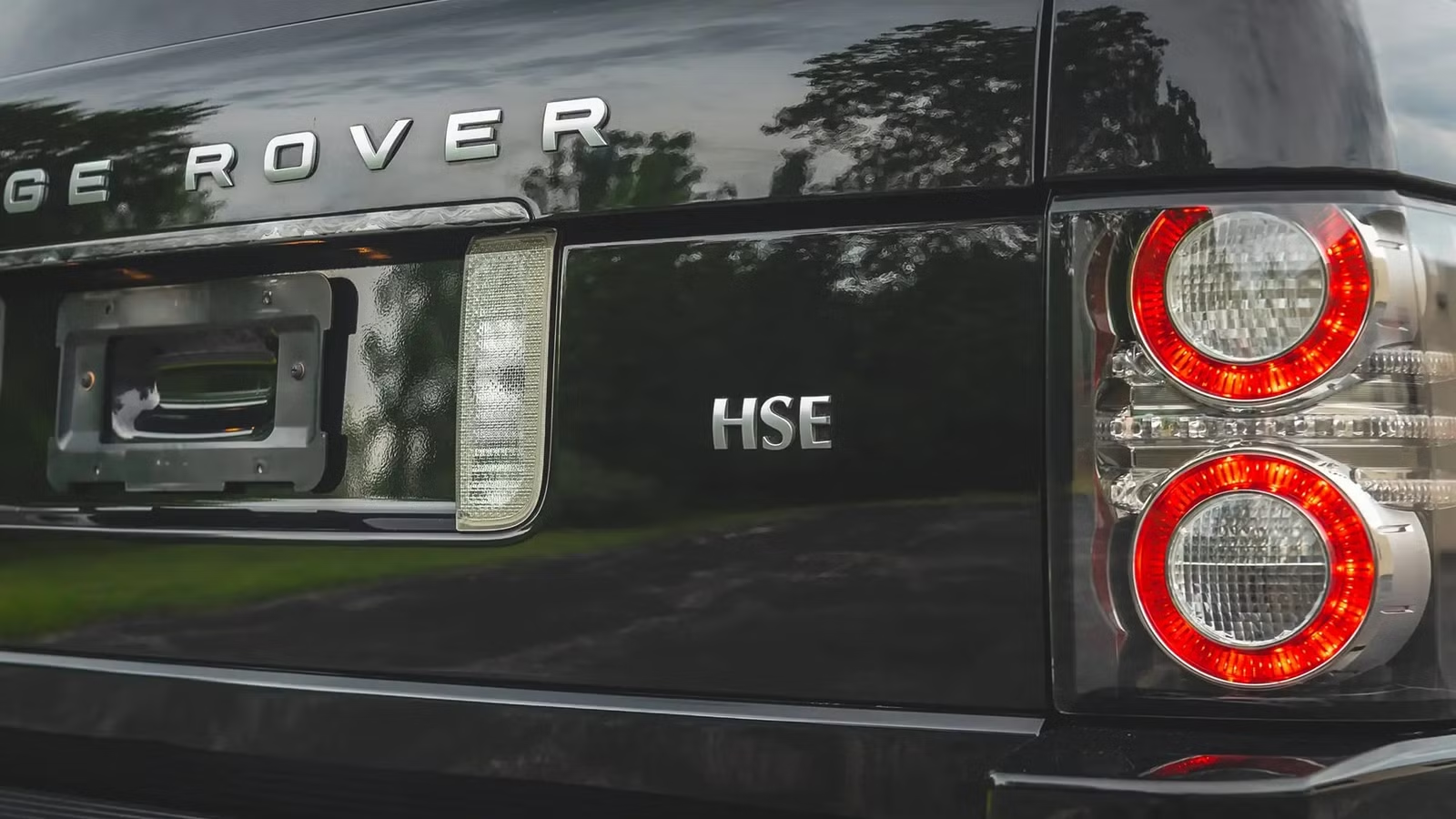
For most car buyers, shopping for a family crossover is a pragmatic exercise. It’s head over heart, so you compare cargo volume, the fuel economy figures, and cross-reference reliability ratings to find the best daily driver. If you follow that logical formula to its natural conclusion, you’ll likely end up with a Japanese hybrid.

It starts every morning, costs virtually nothing to maintain, and can easily last twenty years. Yet every day, some buyers reject that sensible choice, opting instead for a luxury SUV with a known history of unexpected breakdowns and frequent repair shop visits, to avoid driving a mundane SUV that feels like an appliance.
The $100k Paradox: Buying A 53% First-Year Fault Rate
In the modern SUV market, the gap between a pragmatic mass-market crossover and a high-end luxury hauler reflects opposing manufacturing philosophies. The mainstream segment treats the crossover like an appliance. Vehicles like the Toyota RAV4 Hybrid are engineered around zero-defect manufacturing standards, simplified powertrain options, and low-stress electrical networks designed to withstand even a decade of neglect. They deliver seamless commuter transport, but here’s the catch: they do so without evoking an ounce of emotion or prestige.

JaguarLand Rover approaches its Range Rover SUVs through a different lens, sitting at the opposite end of the spectrum. Vehicles like the Range Rover are designed to offer a combination of opulent cabin architecture, commanding road presence, and supreme all-terrain capability. Achieving that vast dynamic range requires cramming the chassis with intricate mechanical systems, active hydraulic suppressors, and dense sensor arrays.
Where Japanese engineers see secondary features as potential failure points to be eliminated, British luxury designers see high-tech features as necessary to maintain exclusivity. This dynamic creates a bizarre marketplace anomaly where buyers willingly spend upwards of six figures on a vehicle fully aware of its brand’s historical reliability flaws.
The Paper Trail That Proves Convenience Isn’t The Point

A large body of government data and corporate financial disclosures supports the reputation for fragility among luxury British SUVs. Regulatory filings with the National Highway Traffic Safety Administration document thousands of owner complaints across various Land Rover models. These official reports center on three distinct issues: electrical bus communication errors, sudden air suspension level and compressor drops, and early-life engine management or cooling faults.
Corporate filings reveal that JLR, as a brand, absorbed a 105 million pounds ($139 million) year-over-year increase in quarterly warranty provisions, driving total warranty reserves to the highest they’ve been in the last fifteen years. Because their cars use high-tech modular components and specialized mechanical assemblies, they can’t be repaired on the bench; they must be replaced and recoded to the vehicle’s specific identification number, which increases costs.
Why Modern Luxury Electronics Keep Failing

These electronic vulnerabilities are directly tied to the complexity and density of network architecture. Modern luxury vehicles operate like high-speed computers on wheels, utilizing over eighty individual Electronic Control Units to coordinate secondary vehicle functions. Systems like 48-volt active anti-roll bars, motorized door latches, multi-zone climate blowers, and air-suspension leveling valves constantly flood the central controller area network with data traffic.
A minor voltage fluctuation from an idling battery or a fractional signal delay across a wire can trigger a cascade of warning lights, risking a powertrain limp mode. In a basic commuter crossover, there are far fewer sensors and actuators, so these vehicles do not have as many functions capable of generating ghost faults in the first place.
53% vs. 99.2%:The Unfathomable Statistical Gulf

Historical reliability surveys have made the statistical gulf between mainstream transport and luxury SUVs undeniable. Landmark survey metrics published jointly by What Car and Warranty Direct have historically ranked Land Rover last among thirty-two major global vehicle manufacturers, recording a 53 percent first-year fault rate across legacy surveyed vehicles. Over half of all new owners experienced an unscheduled mechanical or electrical issue within their first twelve months of driving.
In contrast, the Toyota RAV4 Plug-in Hybrid recorded a 99.2 percent reliability rating, with its conventional hybrid sibling tracking closely at 98.9 percent. Even non-hybrid competitors like the gas-powered Mazda CX-5 consistently score above 93 percent. Historically, choosing the luxury badge meant accepting a significantly higher probability of experiencing an early-life breakdown.
Furthermore, this gap reflects two opposing engineering approaches. Japanese platforms prioritize long-term durability by standardizing mechanical layouts and rigorously testing components over extended development cycles. Meanwhile, luxury automakers push the envelope with the latest technology available on the market, sacrificing long-term simplicity for cutting-edge cabin features and maximum performance.
What $150,000 Actually Buys Under the Skin

Rather than buying a simple option, buyers are willing to pay six figures for luxury vehicles designed to conquer environments no standard crossover will ever see. High-end Land Rover models use the Modular Longitudinal Architecture (MLA Flex), an aluminum-intensive chassis that provides a 50 percent increase in torsional rigidity over traditional platforms.
Powertrains like the P550e plug-in hybrid integrate a 3.0-liter turbocharged inline-six with a 160 kW electric motor built into an eight-speed automatic transmission. With a floor-mounted 38.2 kWh battery, it produces 542 horsepower and 590 lb-ft of torque, launching the heavy vehicle to 60 mph in under 5 seconds. Dynamic Response Pro, a 48-volt active anti-roll system, can apply over 1,000 lb-ft of torque to allow maximum wheel articulation with 35.4 inches of water wading depth.
Over-The-Air Healing: The Truth About Modern JLR Reliability

Modern luxury reliability requires distinguishing between traditional legacy vehicle platforms and current production architectures. That infamous 53 percent failure figure comes from historical survey data on older platforms like the L322 Range Rover, Freelander 2, and early L405 models, which used fragile physical wiring looms and early-generation infotainment networks.
Modern MLA-Flex platform vehicles, including the current L460 Range Rover, L461 Range Rover Sport, and the Defender, run JLR’s advanced Electronic Vehicle Architecture. Under EVA 2.0, up to eighty-five individual modules receive remote Software-Over-The-Air updates via the cloud network. On older vehicle architectures, a minor infotainment lockup, battery management calibration error, or sensor sync delay required a dealership visit.
On current-generation vehicles, a large portion of these soft electronic glitches are resolved via background over-the-air fixes. However, while software patches can silently cure a frozen touchscreen or recalibrate a module overnight, they cannot fix a leaking air-suspension bladder, a hydraulic leak, or physical engine mechanical wear. Software cures the ghost gremlins, but mechanical complexity still requires physical shop time when hardware fails.
Why Status And Capability Will Always Win

The market reality remains that most Range Rover and Defender drivers will never push their expensive cars through deep mud or high-speed mountain passes. Yet physical presence is enough. It projects status and uncompromised capability at the valet stand in a way no highly efficient, hyper-reliable hybrid crossover ever could.
As long as Japanese manufacturers focus on delivering bulletproof efficiency and maintenance-free utility, they will dominate the top of every reliability leaderboard. And as long as Land Rover manufactures ultra-complex, dynamic SUVs, buyers will gladly accept the risk of a service bay visit to avoid driving an everyday appliance.
Source: Range Rover, WhatCar, AutoReliabilityIndex, Bring a Trailer, National Highway Traffic Safety Administration

Related posts


Latest Post



No Comments