
KTM’s Most Complete Adventure Bike Isn’t the Biggest One
The adventure motorcycle segment is prone to a specific kind of logic: the idea that more displacement inevitably leads to more capability. It’s a seductive trap where massive fuel tanks, triple-digit output, and exhaustive equipment lists dominate the spec sheet, yet size is rarely a substitute for poise. In reality, a motorcycle’s utility often begins to erode once a trail turns technical and steep. KTM’s current catalog is a perfect case study, stretching from the entry-level 390s to the continent-crushing 1390 Super Adventure. However, the strongest argument for a bike that genuinely does it all lives in the space between those two extremes.
KTM’s Adventure Lineup Spans From Entry-Level To Flagship

KTM doesn’t build one adventure bike for the American market — it builds three, and each one is chasing a different kind of rider. The entry point is the 390 Adventure, a 399cc single that starts at $6,499 for the X, going up to $7,699 for the more off-road-focused R trim, putting up 45 horsepower and 29 pound-feet of torque. It’s light, cheap to insure, and forgiving enough for someone who’s never dropped a bike on gravel. Nobody’s buying it to cross a continent in comfort, though.
At the opposite extreme is the 2026 KTM 1390 Super Adventure R, KTM’s newly revised flagship. The number that gets thrown around most is 173 horsepower—up from 160 on the outgoing 1290—paired with 107 pound-feet of torque from a 1,350cc V-twin running KTM’s new Camshift variable valve timing. It carries an eight-inch vertical TFT touchscreen, optional Front Radar for adaptive cruise control, and a stiffened tubular steel frame built to handle everything that extra power throws at it. All of that arrives for $21,649, before a rider adds a single accessory. However, a more meaningful solution lies in the middle.
Why Riders Are Trading Liter-Twins For Bikes They Can Actually Pick Up

This isn’t just a KTM story. Across the U.S. market, the 800–900 cc adventure class has quietly become the segment everyone wants a piece of — Ducati’s DesertX, Yamaha’s Ténéré 700, Aprilia’s Tuareg 660. Riders who spent a decade chasing liter-plus V-twins are increasingly deciding that agility and manageable weight matter more on an actual trail than bragging rights at a gas station. Manufacturers have noticed the shift too, which is why nearly every major brand now fields a middleweight ADV. A bike you can pick up alone after a low-speed tip-over is worth more than a spec sheet most owners will never fully explore.

The KTM 890 Adventure R Is Where That Balance Actually Lives
At $16,299, The 890 R Undercuts The Flagship By Over $4,500 — Without The Tradeoffs You’d Expect

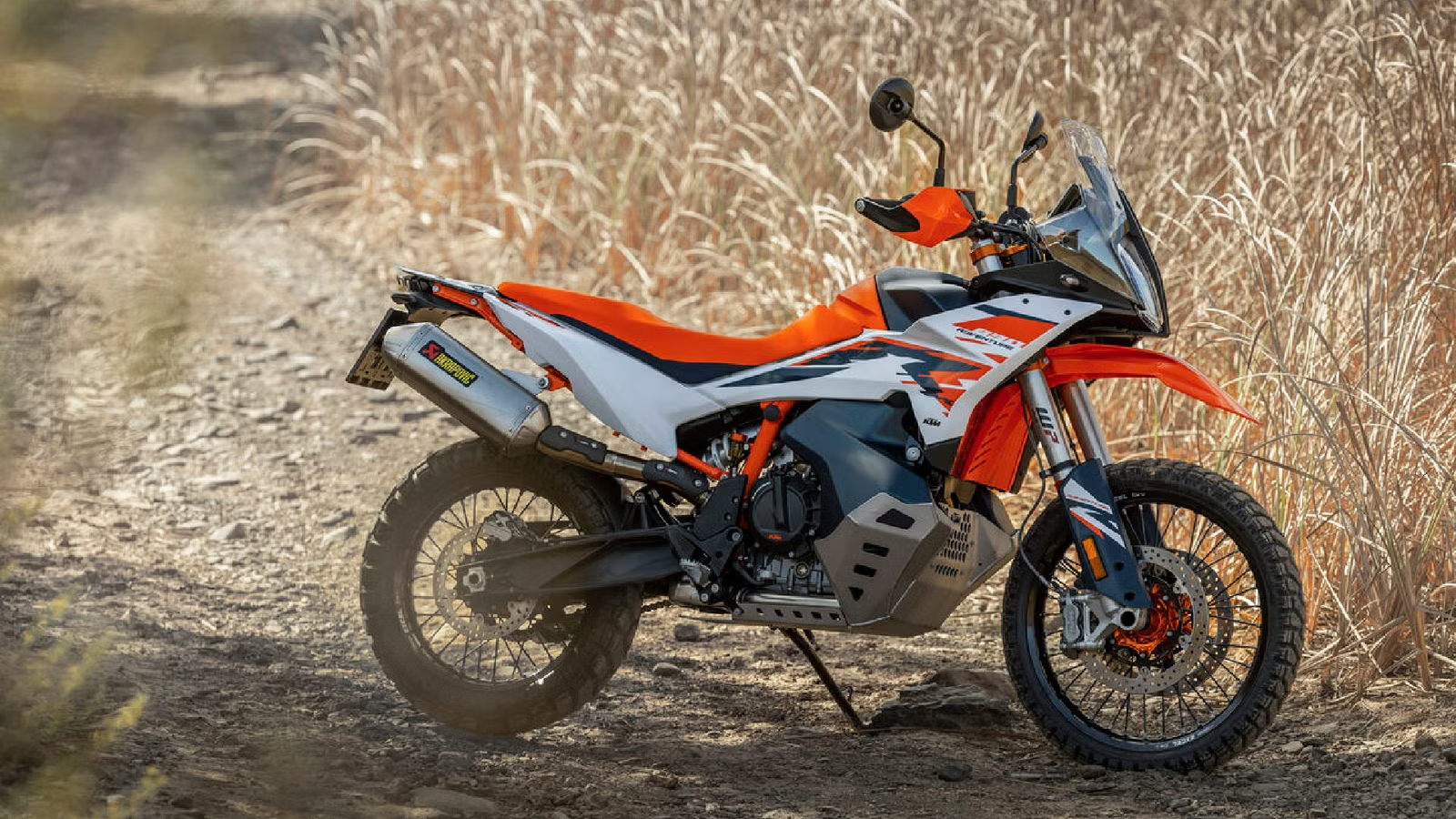
That’s the gap the KTM 890 Adventure R was built to close. It’s KTM’s middleweight, off-road-focused adventure bike, sold in a single, dual-tone, orange and white colorway, and it comes standard with Mitas Enduro Trail tires — a 90/90-21 up front, 150/70-18 out back — that signal exactly where KTM expects this bike to spend its life.
The 890 Adventure R starts at $16,299, plus roughly $800 for destination, which lands most buyers around $17,099 out the door. That’s more than $4,500 less than the 1390 Super Adventure R’s $21,649 sticker, which isn’t a small gap when you’re financing a motorcycle. Compared to the base 890 Adventure, the R trim adds longer suspension travel, a 21-inch front wheel in place of the standard model’s smaller hoop, and a noticeably more aggressive off-road stance overall. But the price gap only matters if the 890’s engine can actually back it up on the trail — and that’s where the parallel-twin’s unusual character becomes the real story.
A 103-HP Parallel-Twin Tuned For The Trail

Under the tank sits an 889cc liquid-cooled parallel-twin with a 285-degree crank, DOHC, and four valves per cylinder — the same basic architecture KTM has been refining since the 790 Adventure debuted. It’s rated at 103 horsepower and 73.8 pound-feet of torque, run through a Bosch ride-by-wire throttle and a six-speed gearbox, with a bidirectional quick-shifter available as an option.
On paper, that’s a modest number next to the 1390’s 173 horsepower and 107 pound-feet, but in practice, it’s plenty. The 285-degree crank gives the twin an uneven, lumpy firing order that behaves more like a V-twin than a typical parallel-twin, which means better low-end traction on loose surfaces without the peaky, top-heavy power delivery a bigger engine can bring. The 890’s power is tuned for the speeds a rider actually hits on a trail, not the ones they’d hit merging onto an interstate, and that distinction matters more than a dyno chart suggests.
How The 889cc Twin Compares To The 1390’s V-Twin

The 1390 Super Adventure R’s 1,350cc V-twin isn’t just bigger on paper; it claims nearly 70 more horsepower and over 30 additional pound-feet of torque over the 890. However, that extra output in the 1390 arrives bundled with more weight sitting higher in the chassis and less forgiving low-speed manners once the pavement ends. Riders who’ve spent time on both bikes tend to agree on one thing: the 890’s parallel-twin is simply easier to meter through a rocky switchback, even if the 1390 would win every straight-line argument.
WP Suspension And A Steel Trellis Frame Built To Handle The Trails The 1390 Can’t

The 890 Adventure R runs a chromium-molybdenum steel trellis frame that uses the engine as a stressed member, a layout that keeps the package compact without sacrificing rigidity. Suspension comes from WP — a 48mm XPLOR upside-down fork up front and an XPLOR mono-shock out back, both delivering 9.4 inches of travel. Ground clearance sits at 10.35 inches, and the 63.7-degree steering head angle is set up specifically for off-road stability rather than sport-bike quickness. Spoked wheels with tubeless aluminum rims round things out: 21 inches up front, and 18 inches out back.
Weight Is The 890’s Biggest Advantage

Weight is where the 890 Adventure R quietly wins the argument. It comes in at 441 pounds dry and 474 pounds fully fueled — figures that would be respectable even on a bike with a smaller engine. Set that against the 1390 Super Adventure R’s bigger tank, bigger engine, and heavier electronics stack, and the middleweight’s advantage becomes obvious the moment the pavement runs out. Less mass at low speed on loose or technical terrain translates directly into rider confidence, and confidence is what actually gets a bike through a rutted trail, not a horsepower number nobody’s using below 20 mph.
Adjustable Ergonomics And Electronics Give The 890 A Dual Identity
A Tall Seat, Five-Gallon Tank, And Four-Year Warranty That Make The 890 A Serious Touring Option

At 34.64 inches, the seat height is tall enough that shorter riders will want to look into KTM’s lowering kits or an accessory seat before committing. The payoff is a 5.28-gallon tank, large enough for realistic multi-day range between fuel stops, and an adjustable windscreen mounted on forged-aluminum brackets that stays planted at highway speeds instead of buzzing in the wind.
KTM’s PowerParts catalog also lists heated rider and passenger seats for anyone planning to ride in cooler months. KTM backs the 2026 model with a premium manufacturer’s warranty of up to four years, a meaningful upgrade for anyone weighing this as a long-term, ride-it-everywhere purchase rather than a weekend toy.
Electronics That Prioritize Dirt

The electronics package follows the same philosophy. A 6D Inertial Measurement Unit feeds cornering ABS and motorcycle traction control, letting the bike read lean angle and adjust braking and slip accordingly. An Offroad ABS mode reduces front-wheel intervention and switches off rear ABS entirely, letting riders back the rear end into corners the way a dirt bike would demand. Multiple ride modes — Street, Off-road, and Rally on equipped models — adjust throttle response to match the terrain underneath.
The five-inch TFT dash is noticeably smaller than the 1390’s eight-inch touchscreen, but that’s arguably a feature rather than a compromise: a simpler display is easier to read with gloves on and mud across the switchgear, and it still pairs with the KTMconnect app over Bluetooth for turn-by-turn navigation, music, and incoming calls. To sum up, the KTM 890 Adventure R strikes a perfect balance between avoiding the budget constraints or bulk of the 1390 and sacrificing the long-haul comfort the 390 does. As a result, it ends up being the most complete adventure bike in KTM’s portfolio.
Source: KTM

Related posts
Latest Post


No Comments