
The SUV That Beat Sports Cars Before Super SUVs Were a Thing
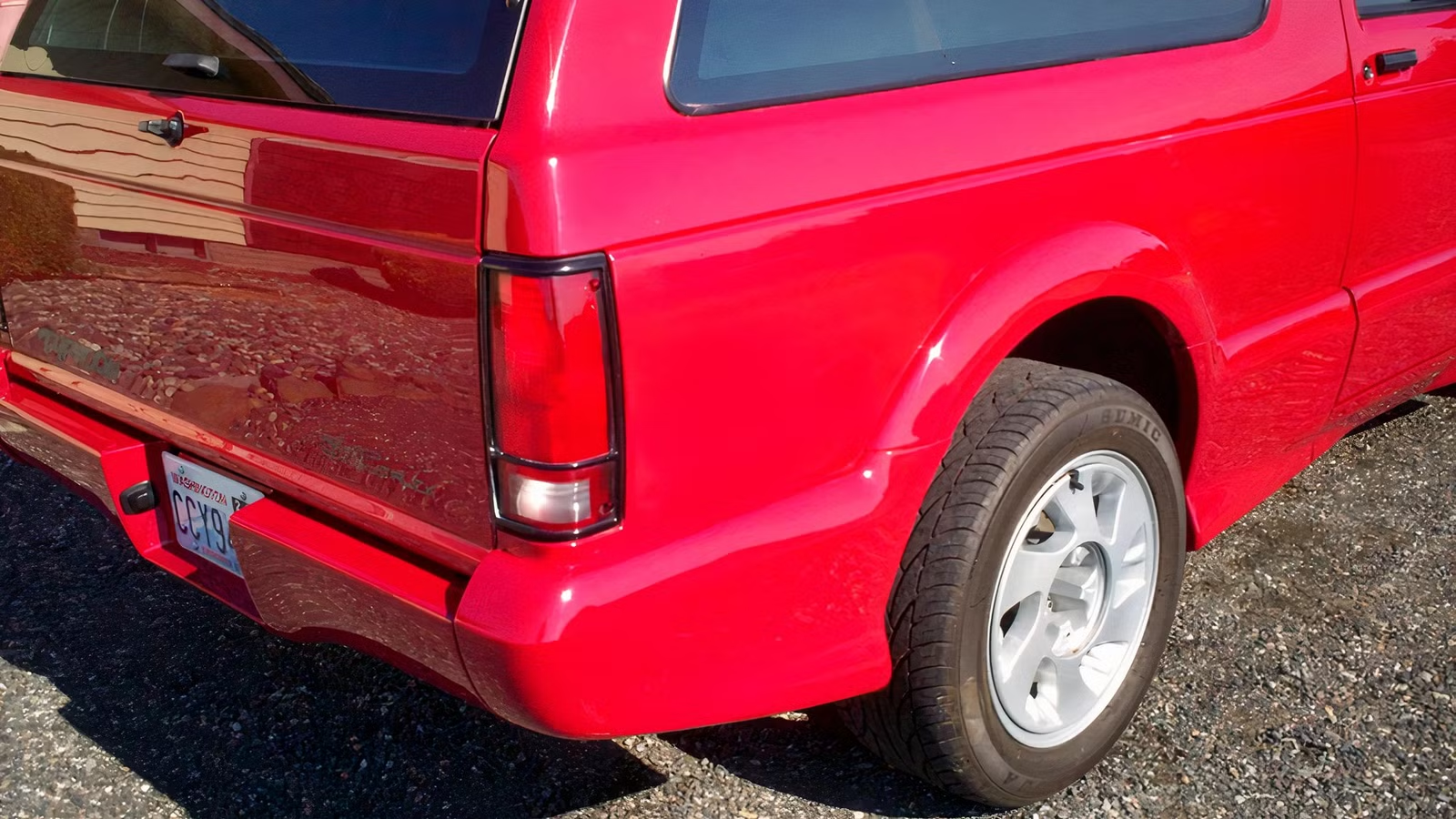
Thirty-five years ago, a two-door SUV from GMC was embarrassing sports cars at the dragstrip. Not a tuner special, not a one-off concept — a production vehicle you could walk into a dealership and buy. The 1992 GMC Typhoon hit 60 mph in 5.3 seconds, a number that wouldn’t be matched by a mainstream luxury SUV until the BMW X5 4.6is arrived more than a decade later. It did it with a turbocharged V6, a permanent all-wheel-drive system, and a platform borrowed from a compact Jimmy. No one in Stuttgart or Munich was paying attention.

The Typhoon’s story is one of genuine automotive audacity that somehow slipped through the cracks of collective memory. While Porsche, BMW, and Mercedes-Benz get credited with inventing the performance SUV — a category that now generates billions in annual revenue — an American truck brand quietly built the template first. This is the story of how GMC got there, why it worked, and why almost nobody remembers it.
The Syclone Laid the Groundwork Nobody Expected
The Typhoon didn’t appear from nowhere. Its origin traces back to a Buick test mule — of all things — built on the bones of a Chevrolet S-10 and powered by a 3.8-liter turbocharged V6 pulled from the Grand National production line. Buick was facing the end of the G-body platform that had given it the legendary GNX, and engineers were looking for ways to keep turbocharged performance alive somewhere in the GM portfolio. Chevrolet passed on the concept, protective of its own 454 SS muscle truck project. GMC took the idea and ran with it.

What emerged in 1991 was the Syclone, and it was genuinely shocking. GMC’s engineers swapped the 3.8-liter Buick unit for the more current 4.3-liter LB4 V6 already in production for the Sonoma. Mated to a Mitsubishi TD06-17G turbocharger, the engine was further developed with an L98 throttle body borrowed from the Corvette, a Garrett intercooler, and internals built to handle boost. Output landed at 280 horsepower and 350 lb-ft of torque — numbers that would have been remarkable in any car of the era, let alone a compact pickup.
To manage that power on a lightweight truck platform, GMC fitted a Borg-Warner transfer case splitting torque 35/65 front-to-rear, paired with a four-speed automatic. The result was a 0-60 time of 4.3 seconds and a quarter-mile pass in 13.4 seconds at 98 mph. Car and Driver put it on their September 1991 cover and pitted it against a Ferrari 348. The Syclone won — and it had room for a gun rack.
How the Syclone Became the Typhoon

The Syclone proved the concept worked. What it didn’t prove was that customers would buy it. Only 2,995 examples were produced for its single model year, all finished in black, with a handful of Marlboro-liveried targa-roof specials rounding out the run. The $25,000 price tag — steep for a compact truck in 1991 — put off some buyers, but the bigger issue was practicality. The Syclone’s lowered suspension made towing and hauling a liability concern, and GM restricted both. You had a truck that couldn’t do truck things.
GMC’s answer was to take the same mechanical package and drop it into the S-15 Jimmy body. The Jimmy shared its frame with the Sonoma, but offered a proper two-door SUV profile — more interior room, a rear seat, and a shape that read as a family vehicle rather than a performance statement. The Syclone’s drivetrain transferred over nearly wholesale, with an upgraded transfer case accommodating the heavier platform. The new vehicle was named the Typhoon, and GMC hoped the added practicality would open the door to buyers who had admired the Syclone from a distance.
The extra weight of the Jimmy body cost the Typhoon roughly a second off the Syclone’s 0-60 time, settling at 5.3 seconds. In the context of 1992, that was still extraordinary — faster than a Porsche 911 Carrera of the same era, and quicker than virtually any SUV that would follow for the next ten years.
The Technical Package That Made It Work

The Typhoon’s performance credentials rested on a combination of components that, taken individually, weren’t exotic — but assembled together, they created something genuinely special for the era. The 4.3-liter LB4 V6 was a familiar GM workhorse, but the turbo treatment transformed its character entirely. The Mitsubishi TD06-17G turbocharger fed boost through the Garrett intercooler, keeping intake temperatures in check and allowing the engine to sustain its output reliably. The Corvette-sourced throttle body was a detail that spoke to how seriously the engineers took the breathing side of the equation.
The permanent all-wheel-drive system was the other half of the equation. The viscous center coupling and limited-slip rear differential meant the Typhoon could deploy its 350 lb-ft of torque without the wheelspin drama that would have made a rear-drive version unmanageable. The suspension was tuned specifically for the Typhoon — not the stock Jimmy setup with minor tweaks, but a purpose-built configuration aimed at keeping the SUV composed during hard acceleration and through corners. For a vehicle that weighed considerably more than the Syclone, the handling balance was a genuine achievement.
The development partnership behind all of this was Production Automotive Services, or PAS — the same outfit that had co-developed the Turbo Trans Am with GM. PAS handled the engineering integration work on both the Syclone and the Typhoon, and their experience with boosted GM platforms showed in the final product. The Typhoon didn’t feel like a truck that had been given a turbo and declared finished. It felt like a coherent performance vehicle.
What It Was Actually Like To Drive

Numbers tell part of the story. The driving experience tells the rest. The Typhoon’s turbocharged V6 delivered its torque in a way that felt nothing like the naturally aspirated V8s that dominated American performance at the time. Boost built quickly, and when the AWD system hooked up, the acceleration was linear and surprisingly composed for a vehicle with the Typhoon’s ride height and center of gravity. There was no drama at the rear wheels, no squirming under hard throttle — just forward motion, sustained and serious.
The suspension tuning deserves credit here. GMC and PAS didn’t simply lower the Jimmy and call it a performance vehicle. The Typhoon rode on a setup calibrated to minimize body roll and maintain steering response in a way that the standard Jimmy, or any other SUV of the period, simply couldn’t match. It wasn’t a sports car — the physics of its roofline and mass saw to that — but it was genuinely capable in ways that surprised drivers who expected a truck with pretensions.
The four-speed automatic was the one concession that purists might have wished away. There was no manual option, and the transmission’s calibration was tuned for smooth, quick shifts rather than driver engagement. But in the context of what the Typhoon was trying to accomplish — accessible, repeatable performance that any buyer could exploit — the automatic made sense. It was part of what made the 5.3-second 0-60 time available to everyone who sat in the driver’s seat, not just experienced performance drivers.
Sales Reality and Why the Typhoon Disappeared

The Typhoon sold in modest numbers across its 1992 and 1993 model years, with total production reaching 4,697 units. Combined with the Syclone’s 2,995 examples, the entire SyTy program accounted for roughly 7,500 vehicles — a small run by any measure, though not unusual for a performance-focused variant built on a mainstream platform. The market simply wasn’t ready for what GMC was offering.
Part of the problem was positioning. The Typhoon occupied an awkward space in the early-1990s automotive landscape. It was too expensive and too compromised for buyers who wanted a practical family SUV, and too truck-like in its origins for buyers who wanted a performance car. The concept of a fast SUV as a desirable object in its own right — something people would pay a premium for specifically because it was fast — hadn’t yet taken hold in the American market. That idea would take another decade to mature.
GMC retired the Typhoon after 1993, and with it went the turbocharged AWD formula that had produced two genuinely remarkable vehicles. The platform moved on, the S-15 Jimmy continued in standard form, and the performance SUV concept went dormant in America. It would be European brands — with larger marketing budgets, stronger luxury positioning, and a receptive early-2000s market — that would eventually make the category mainstream.
The Legacy Question: Who Gets Credit for Inventing the Performance SUV?
When automotive historians trace the performance SUV lineage, the conversation usually starts around 2002 or 2003. The BMW X5 4.6is, the Mercedes-Benz ML55 AMG, the Porsche Cayenne Turbo — these are the vehicles that established the template in the public consciousness, and their descendants now dominate the upper end of the luxury market. The Cayenne Turbo, in particular, is regularly cited as the car that proved a performance SUV could be taken seriously by driving enthusiasts.
The Typhoon predates all of them by a decade or more, and its performance credentials were legitimate by any standard. A 5.3-second 0-60 time in 1992, from a production vehicle built on a compact truck platform, using a turbocharged V6 and purpose-developed AWD — that’s not a footnote. That’s the founding document of a genre. The fact that it came from GMC rather than Porsche, and that it sold in modest numbers rather than reshaping a market, doesn’t diminish what it accomplished technically.
The credit gap is partly a function of survival. With fewer than 5,000 Typhoons ever built, and decades of road use, attrition, and neglect taking their toll, examples in good condition are genuinely scarce. Collector values have climbed — clean Syclones have reached $60,000, with Typhoons trailing only slightly — but the vehicles themselves aren’t visible enough to anchor the cultural memory the way a Cayenne or an X5 can. You can see those cars on any upscale street in America. A Typhoon requires knowing where to look.
There’s also the matter of marketing. European performance brands built their SUV launches into cultural events, with press programs, motorsport tie-ins, and the full weight of decades of performance heritage behind them. GMC in 1992 was a truck brand trying something audacious on a limited budget. The Typhoon didn’t get a world-premiere reveal at a major auto show. It got built, sold, and quietly discontinued. The story never got told loudly enough to stick.
The performance SUV category is now worth more than any single brand can quantify. Every Cayenne GTS, every AMG GLE 63, every BMW X5 M sold today exists in a market the GMC Typhoon helped prove was possible. That’s a legacy worth acknowledging — even if the badge on the hood says GMC instead of something with a Stuttgart crest.
The Typhoon didn’t fail. It finished too early, in a market that hadn’t yet figured out what to do with it. The European brands that followed got the timing right and the credit that came with it. But the engineering logic — turbocharged six-cylinder, permanent AWD, truck-based platform, sports-car performance — was American, and it was first. That’s not a small thing, even if it took 35 years for anyone to say it clearly.

Related posts

Latest Post


No Comments