
The American V8 Engine That Can Easily Outlive The Car Around It
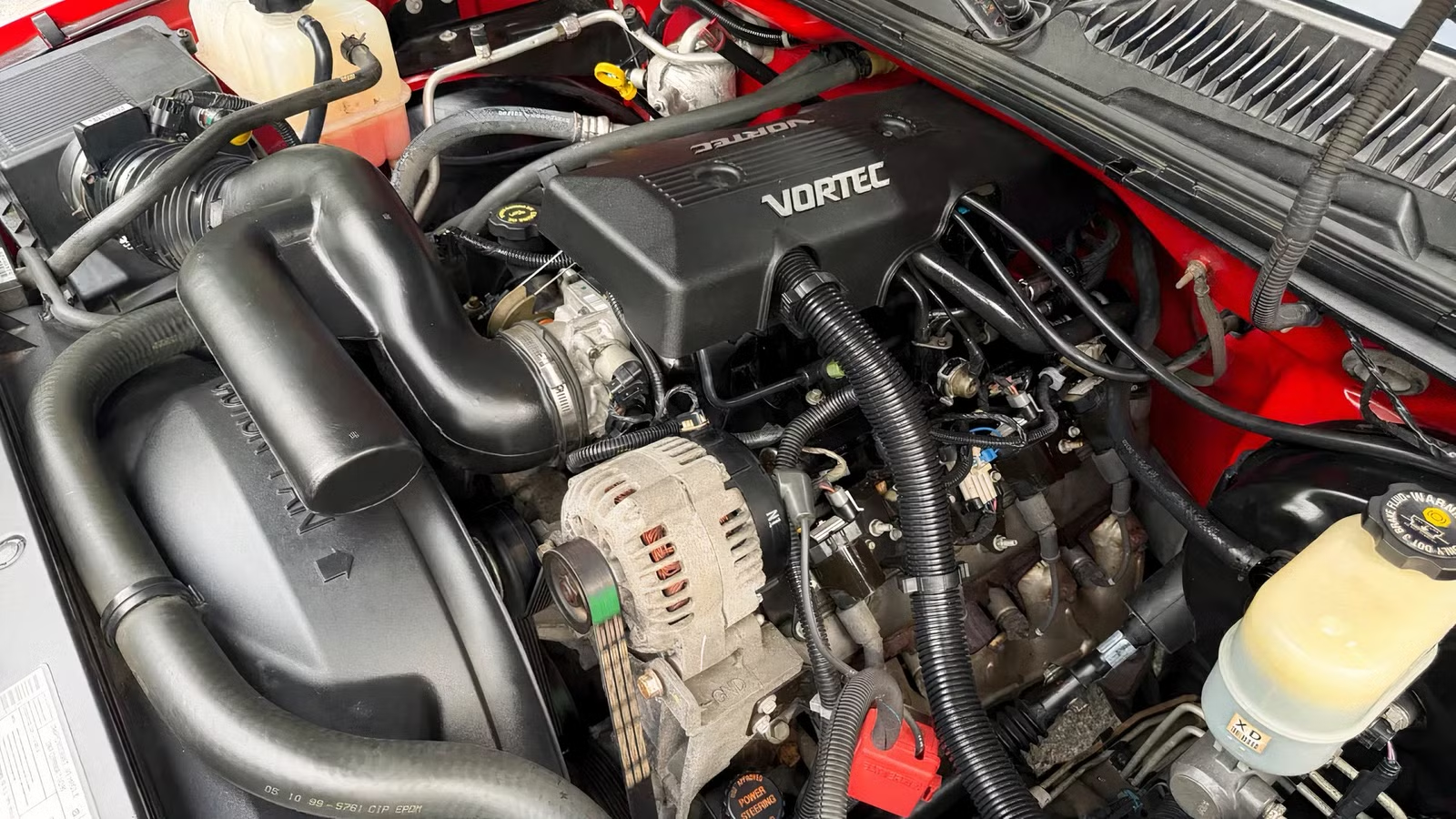
There is something about an old American V8 engine that is hard to dislike. Big displacement, plenty of torque, and usually a design that isn’t trying to be clever for the sake of it. Some of these engines are fitted to everything from family SUVs to pickup trucks, and some are nearly unkillable.

There are American V8s out there with enough life left in them to outlast the vehicle they were originally bolted onto. The body might rust, the interior may fall apart, the suspension may have seen better days, and the paint may have flaked away, but some engines will just keep going. This General Motors V8 is one of them.
Some Engines Keep Going Long After The Rest Gives Up
There is a big difference between an engine that lasts a long time and one that can genuinely shrug off serious mileage. Plenty of modern engines can cover 150,000 or 200,000 miles with the right care, but a few have earned reputations for going a lot further without becoming a constant source of problems.

Toyota is renowned for dependability, and engines like the 2UZ-FE have become a byword for longevity. This 4.7-liter V8 was used in the Land Cruiser, GX 470, Tundra, and Sequoia, giving it a lot of real-world testing when it was first used, and to this day as miles rack up high. Horsepower isn’t huge, and you can’t pick up a massive amount of speed with them, but they are conservatively tuned, and built with layers of overbuilt components that mean nothing has to work near their limits.
High Mileage Means Little When The Powertrain Was Built To Last

There is no universal mileage when an engine suddenly becomes too old to bother with, but some give up quicker than others. A big part of why the 2UZ-FE V8 does have a lot of high-mileage examples out there is because of what it doesn’t have. There is no turbocharger adding extra heat and pressure, no direct injection system to complicate things, and no massive output. It produces power in a fairly relaxed way, which is exactly what you want when the goal is to keep doing the same thing for hundreds of thousands of miles.
They aren’t indestructible; there are timing belt and water pump issues, and neglected examples can develop problems. However, the underlying engine has enough mechanical margin that regular servicing can go a remarkably long way. A proven track record and low-stress design make engines like the Toyota V8 one of the finest high-mileage contenders.
The 5.3-Liter LM7 Vortec V8 Became A GM Workhorse

It is not just a Japanese trait, though, and General Motors’ 5.3-liter LM7 Vortec 5300 V8 has become the American V8 that can last a lifetime. It has a big displacement, it is naturally aspirated, it is relatively simple, and it is made of tough materials.
It debuted in 1999 alongside the GMT800 truck platform and replaced the 350 small-block V8. The LM7 Vortec only saw original service until 2007, but today, these engines are still going.
Millions Of Trucks And SUVs Were Built Around The Proven Vortec 5300 V8

The LM7 ended up in a huge number of GM trucks and SUVs. You can find it under the hood of the Chevrolet Silverado and GMC Sierra from 1999 through 2007, as well as the Tahoe, Suburban, Yukon, and Yukon XL. It also powered the Chevy Avalanche between 2002 and 2006, and the Chevrolet Express and GMC Savana vans, so this was an engine that spent years doing everything from family-hauling to proper work.
That widespread use matters when you’re talking about longevity. The same 5.3-liter V8 was being used across vehicles with very different jobs, giving GM millions of miles of real-world experience with it. Because of that, parts are plentiful, mechanics know how the engine works, and its common problems are hardly a mystery. It is one of the most widely produced small-block V8s ever, and that kind of history makes keeping one a lot easier.
Simple Pushrod Design And Overbuilt

The LM7 is about as old-school as modern V8s get. It is a 90-degree OHV V8 with a single camshaft in the block, two valves per cylinder, hydraulic roller lifters, pushrods, port fuel injection, and rocker arms. The block is cast iron, the heads are aluminum, and the 3.78-inch bore and 3.62-inch stroke keep piston speeds fairly sensible. Maximum stock horsepower is 295, and maximum stock torque is 335 pound-feet at around 4,000 rpm, so GM was not exactly extracting huge numbers from it or asking too much of it considering its displacement.
There are different versions within the 5.3-liter family too. The L59 is the fuel-flex version, while the L33 gets an aluminum block and higher compression for more power. The LM7 itself doesn’t have Active Fuel Management, which appears in later engines, and that matters for reliability because there is simply less to go wrong. The LM7’s basic valvetrain and bottom end aren’t exotic, but they are strong, understressed, and easy to work on, which is exactly what you want from an engine that spends its life in heavy vehicles.
The LM7 Can Keep Running When The Vehicle Around It Can’t

Off-roading, towing, hauling, and calmly chugging along at highway speeds, the LM7 Vortec 5300 V8 is made for serious work. Equipped in the GMC Yukon XL, you can tow up to 8,000 pounds with it; in the Tahoe, up to 7,700 pounds; and in the Silverado, up to 9,200 pounds.
Of some of the longest-lasting vehicles, iSeeCars says the Suburban, the Yukon XL, the Tahoe, and the Yukon all make the top 20 vehicles with the longest potential lifespan. The Yukon has a potential lifespan of 238,956 miles; the Tahoe, 250,338 miles; the Yukon XL, 252,360 miles; and the Suburban, 265,732 miles. These are potential lifespans, though, not maximum lifespans.
400,000-Mile Examples Show What It Is Capable Of

There are plenty of examples of owners claiming to have put LM7-equipped models through 200,000 miles without breaking a sweat, but there are some exceptionally high-mileage legends out there that make 200,000 miles look like running-in numbers. One 2001 Silverado 1500 racked up 446,000 miles with the factory-installed bottom end fitted, another owner claims to have put 435,000 miles on their Silverado, and plenty of owners have claimed to have put over 500,000 miles on their LM7 models with just simple maintenance.
Then there is the 703,605-mile Chevrolet Avalanche. According to The High Mile Club, this 2002 Avalanche achieved this massive feat with the original engine, spark plugs, and wires. The owner used the truck for long trips between Maryland and Georgia, and it was kept on a strict 3,000-mile oil change schedule for as long as the owner had it.
A Lot Can Retire A Truck Or SUV Before This V8 Will

With GMT800 trucks and SUVs, the LM7 V8 is often not the component you have to worry about. The 1999–2006 Silverado and Sierra can develop rust around the cab corners, rocker panels, and frame, while 2000–2006 Tahoes, Yukons, and Suburbans can suffer from worn suspension and steering components after years of abuse. Four-wheel-drive models also bring transfer case and front-end wear into the equation. RepairPal says that a transfer case replacement in a Suburban typically costs between $3,244 and $3,542.
That is a lot of money when something like a 2006 Suburban has an average used price of between $5,800 and $6,200. Some GMT800 trucks and SUVs are also known for instrument-cluster failures, with dead gauges and warning lights becoming more common with age, while things like window regulators can just quit working. Generally speaking, everything around the engine is much more prone to failing than the engine is.
This 5.3-Liter V8 Is One Of GM’s Greatest Long-Term Workhorses

The LM7 Vortec 5300 V8 is not a mythical engine that never breaks. Intake manifold gaskets can leak, knock sensors fail, fuel pumps eventually give up, and piston slap is not unheard of on higher-mileage examples. The difference is that these are generally manageable problems rather than evidence of a fundamentally fragile engine. Even oil consumption, which will likely become a lot more noticeable with age, does not mean the bottom end is finished. For an engine that has spent decades pulling heavy trucks and SUVs, it does have a very good record.
SUVs and trucks with the LM7 V8 regularly last past 250,000 miles with proper maintenance. GM built millions of them, gave them modest output, and put it into everything made for a busy life. There are newer, more powerful V8s, but few have the same combination of simple mechanics, enormous parts availability, and a huge amount of proof behind them. GMT800-gen models may eventually become too old and expensive to keep around, but the 5.3-liter V8 under the hood has already proved it can stick around for much longer.
Sources: General Motors, Bring A Trailer, The High Mile Club, RepairPal, iSeeCars.

Related posts

Latest Post


No Comments