
The Mustang V8 So Reliable It Powered Police Cars For Decades
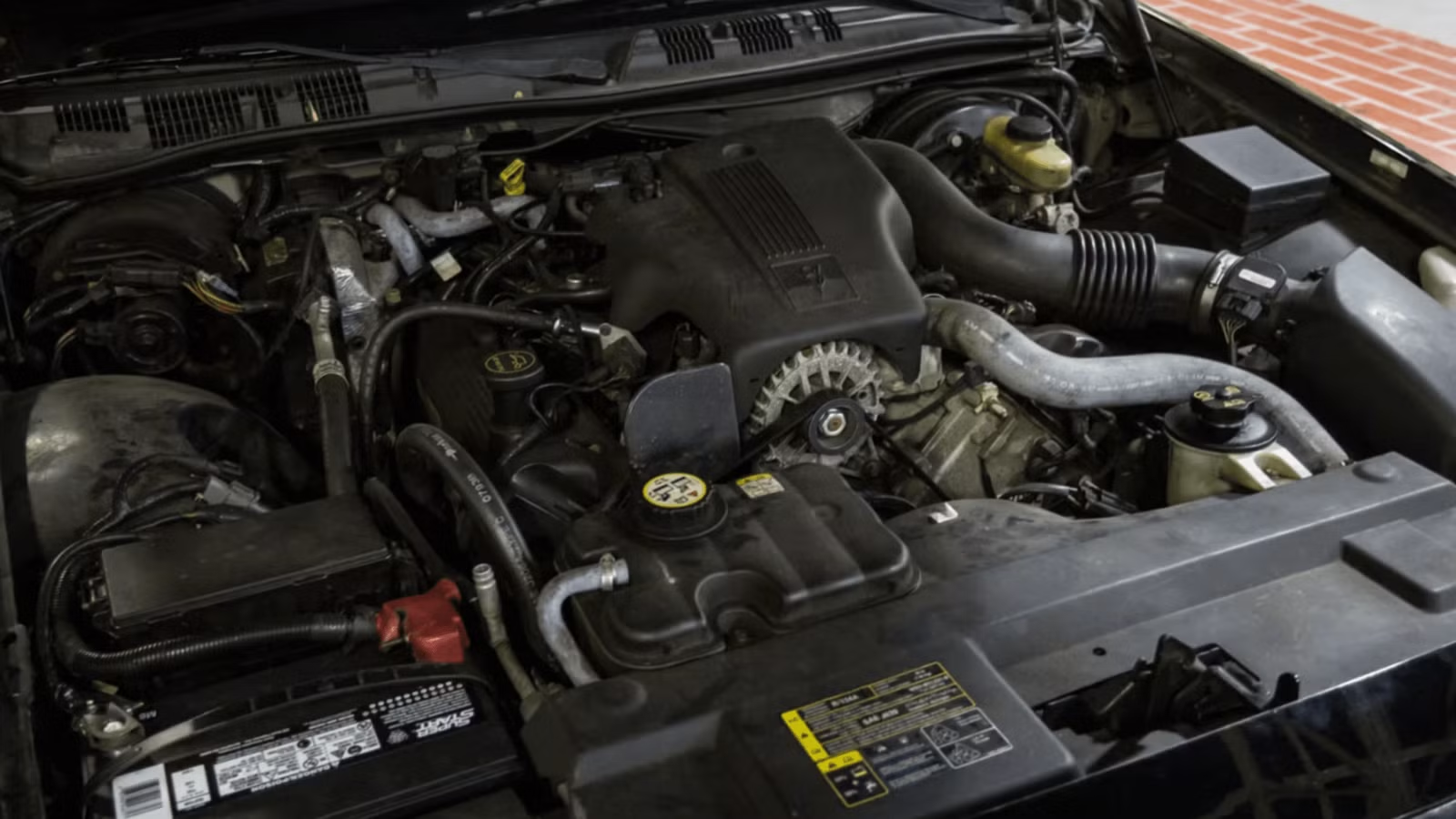
Engines evolve in a way that would make Charles Darwin himself feel proud. Engineers optimize what they can, omit the unnecessary, and do away with the superfluous. But even by those standards, what Ford managed to do by replacing its ubiquitous classic small block V8 was less of an evolution and more of a downright revolution. So much so, in fact, that police departments across North America, and even a few other places worldwide, still mourn not driving it every single day as they once did for 30 years. In an era of twin-turbo hybrid V6s in every department, this big old V8 is sorely missed. But first, a brief history lesson.
The 5.0 Windsor Motor: Ford’s Bread and Butter for Decades

The earliest days of Ford V8s in the era of the Flathead, through the post-war years of the Y-block, and on to the first 302-cubic inch, 5.0-liter small blocks, spanned over half a century of development, hardship, and brand-wide dependability that helped define FoMoCo through its rise to superstardom. The 302 earned a legendary reputation as an endlessly adaptable platform through the latter part of those years, appearing in everything from cargo vans to pickup trucks, and family cruisers, but also muscle cars, pony cars, and Le Mans winning race cars.
Like any decent Lego set, the 5.0 Windsor block could be easily broken down, mixed and matched, and swapped out to fill a number of different roles. With an iron block, pushrods, and a simple-as-can-be single-cam layout, you could throw together a 5.0 Windsor build in a three-day weekend with a set of basic tools and a couple of your buddies. It was sturdy, dependable, and so remarkably good at not breaking that Ford didn’t take it out of production for almost 40 years. While that made it a darling child on the consumer side of things, it also made the Windsor tailor-made for police work.

In police fleets across America, the Windsor 5.0 powered hundreds of thousands of Ford LTD Crown Victorias, but also Fox-body SSP Mustang interceptors that formed the backbone of thousands of highway patrols and beat cop daily drivers. It could survive abuse that would’ve obliterated other engines, day in and day out for a decade or more at a time with just basic maintenance. Still, by the time the ‘90s rolled around, it was clear a change was needed under the hood of America’s police cars. Thankfully, what they got was exactly what they needed.

Why Cop Motors Need to Be a Cut Above

Before we move on, it’s important to remember why the engines in police cars can’t just be built to the standards of your daily commuter.In truth, police cars often spend just as much, if not more, time idling on a curbor median running a suite of police computers and other electronics, with the AC running at full blast, all day, every day, for years on end. They also need to be able to blast at 6,000 rpm or more doing 120 mph or higher in the event of a high-speed pursuit.
Believe it or not, running for hours and hours at low-rpm idles will do just as much damage, if not more, as hitting the rev limiter constantly down an open highway. It starves valvetrains of oil pressure, cooks the engine bay in stagnant heat that movement would mitigate, and carbons up the valves in a real hurry. There’s a reason every police department in America runs, at most, two or three different police cruisers at any given time. Put simply, everything else would blow up in a year doing all of that, and probably even less than a year. Suffice it to say, this put Ford in a tough position when the time came to finally put the 5.0 Windsor motor to bed.

Not only would its replacement need to do everything it could do, and just as well, but it needed to comply with modern emissions restrictions, conform to rapidly digitizing, computer-controlled engine management, and do so without giving up any of the simplicity or ease of maintenance that made Ford products so desirable to law enforcement. This was no easy feat, as the two requirements are traditionally equal and opposite to each other. Yet, that’s exactly what Ford managed to do in 1991.
The 4.6-Liter Modular V8: The Ultimate Cop Engine

4.6 liters, two valves per cylinder, an overhead cam, and a cast iron engine block. Who’d have guessed that was that winning formula in making the cop motor of the future back in the early ‘90s? Honestly, it doesn’t sound too dissimilar to the old 5.0 Windsor. But where its follow-up, the 4.6-liter Modular V8, differentiates itself is in the architecture. Gone are the thin-wall block castings that defined the old 5.0. In its place were thick, deep-skirt iron block walls that stretched below the crankshaft centerline for extra toughness.
Add a cross-bolted six-bolt main bearing cap with four vertical and two horizontal bolts, plus two-bolt main caps, and you have an engine that could take abuse day in and day out as if it were nothing at all. A single-overhead camshaft running hydraulic roller rocker arms with a one-to-one bore to stroke ratio meant piston speeds stayed relatively low, even well up in the rev range. At idle speeds, it also cuts down on cylinder wall friction, cutting back on the level of wear and tear the block experiences on a daily basis. The 4.6 Modular V8 made its civilian debut under the hood of the 1991 Lincoln Town Car, and eventually found its way to the SN95 Mustang GT in 1996.

And yet, perhaps its most important application came in 1992, with the introduction of the Ford Crown Victoria Police Interceptor. Ford manufactured no fewer than one and a half million Crown Vics over two decades, all running the lauded Panther platform underneath, with tens of thousands of them devoted to serving law enforcement. Of course, many ultimately became municipal utility vehicles and taxi cabs as well, only proving how versatile these motors were. On top of that, the Modular V8 was a stalwart of the pre-Coyote era of the Ford Mustang GT through the Gen-IV SN95, as well as the New Edge years that saw the Mustang become an icon once again. Granted, it never made all that much power. The Crown Vic never made more than 250 horsepower, and those Mustangs struggled to crack 300 at the best of times. Still, in terms of toughness, there really was none better.
Setting the Foundation for the Coyote

These days, Coyote V8s are all the rage. Mustangs use them, F-150 trucks use them, and every restomodder who doesn’t want to use an LS or HEMI uses them out of habit. Strictly speaking, the 5.0 Coyote could never have existed at all if not for the architectural lessons of the modular motor that came before it. Of course, the Coyote’s deep-skirt block and overhead-cam layout came directly from lessons learned in the Modular years.
Even its 100 mm bore spacing came directly from the original Modular architecture introduced almost 40 years ago. In terms of longevity, that’s nothing short of amazing. Clearly, what some people call archaic, we call downright durable. So far as police departments are concerned, Ford engines will keep serving with them for as long as FoMoCo is still around.
Source: Ford

Related posts





Latest Post


No Comments