
How Ford’s Modular 4.6 Outlasted Every V8 In Its Class
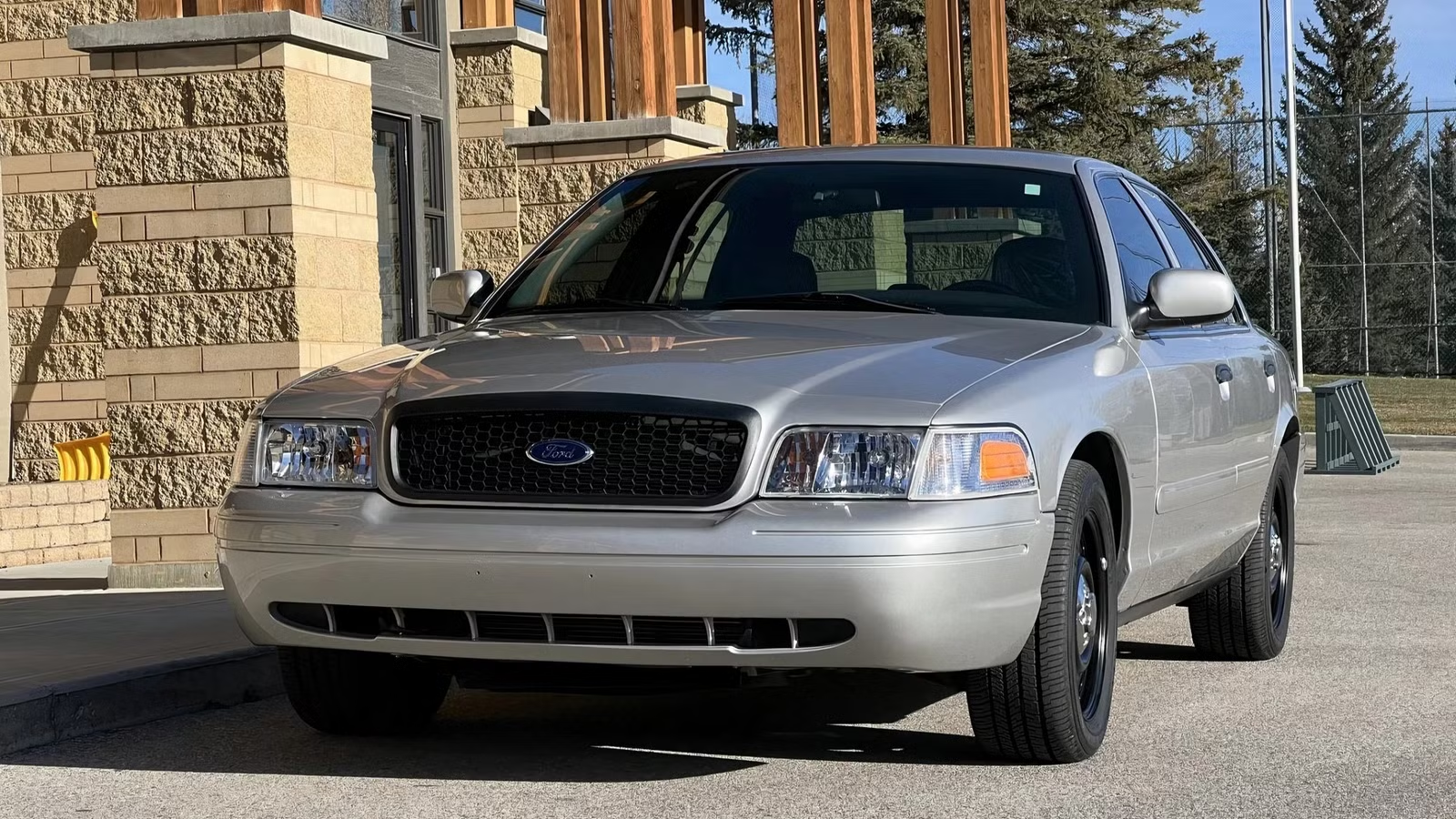
Ford’s 4.6-liter Modular V8 entered the Mustang with just 215 horsepower, spent years being mocked by Chevrolet and Mopar loyalists, and never completely escaped its reputation for being short on muscle. Yet while more powerful V8s won the spec-sheet argument, this supposedly disappointing engine was quietly surviving taxi shifts, police patrols, construction sites, and neglectful owners. “Outlasted every V8” may be impossible to prove universally, but few engines from its era built a stronger case under genuinely brutal working conditions.
Crown Victoria Fleets Gave The 4.6 Its Strongest Longevity Proof
Taxi Duty Pushed Crown Vics Beyond 500,000 Miles

A privately owned car reaching 200,000 miles is impressive. A New York City taxi that has exceeded 500,000 miles while spending its life in traffic is an entirely different kind of evidence.
By November 2023, New York’s final two Crown Victoria taxis had covered more than one million miles combined. One had approximately 550,000 miles, while the other had accumulated roughly 491,000 miles. These weren’t pampered collector cars cruising to weekend shows. They endured stop-and-go driving, long idle periods, multiple drivers, potholes, and near-constant operation.
That environment made the Crown Victoria’s 4.6-liter, two-valve single-overhead-cam V8 prove itself in ways no laboratory durability test could fully replicate. Taxi operators didn’t care that it produced less power than an LS or Hemi. They cared that it started every morning, remained easy to repair, and stayed on the road long enough to earn money.
Police Service Added Wear The Odometer Couldn’t Show


Police Crown Victorias faced a different version of the same abuse. Officers spent hours idling with lights, radios, computers, and climate controls running before accelerating hard into traffic. Those stationary engine hours never appeared on the odometer.
Many Police Interceptors were retired with around 100,000 to 150,000 road miles, but that number rarely told the entire story. Some then began second careers as taxis, security vehicles, or inexpensive civilian transportation.
Heavy-duty cooling and electrical systems helped these cars survive, but Ford didn’t install an exotic engine. The basic long block remained closely related to the 4.6 found in ordinary Crown Victorias, Grand Marquis, and Town Cars. That severe-duty record became the engine’s strongest answer to anyone who dismissed it as merely underpowered.
The Engine Ford Was Mocked For Building Weak Became Difficult To Kill
Modest Output Helped Keep Mechanical Stress Under Control

The conflict started in 1996, when Ford replaced the Mustang GT’s beloved 5.0-liter pushrod V8 with an overhead-cam 4.6 producing 215 horsepower and 285 pound-feet of torque. The new engine was smoother and more modern, but it didn’t provide the performance leap enthusiasts expected.
Ford improved the formula over time. The 1999 Mustang GT’s Performance Improved version reached 260 horsepower, while the three-valve engine introduced for 2005 produced 300 horsepower. Even so, the regular Modular never had to chase extreme specific output.
Conservative tuning, port fuel injection, a sturdy bottom end, and chain-driven camshafts allowed most versions to work comfortably below their mechanical limits. The same small bore that restricted valve size and helped create the engine’s weak reputation also discouraged Ford from extracting excessive low-speed torque from everyday variants.
Low output doesn’t automatically create reliability, but it certainly reduces the stress carried by millions of work-focused 4.6-liter engines.
Mustang GT And F-150 Owners Repeated The Fleet Result

Crown Victoria taxis supplied the best large-scale evidence, but the engine’s durability wasn’t limited to one sedan. Owner reports include 4.6-liter F-150s that have passed 250,000 miles, with several documented examples reaching 300,000 miles or more.
One 1999 F-150 featured by F-150 Online reached 300,000 miles while reportedly avoiding internal engine repairs. Another one-owner 2006 truck passed 300,000 miles and was later reported at approximately 340,000 miles. High-mileage Mustang communities contain similar 250,000-mile examples, although those should be treated as owner reports rather than controlled reliability studies. At those mileages, alternators, ignition coils, plugs, sensors, transmissions, and suspension components may all require attention. The important distinction is that many owners reached those numbers without opening the engine’s basic long block.
For a used buyer, that doesn’t make maintenance history optional. It means a properly serviced 4.6 shouldn’t automatically be rejected just because the odometer begins at 200,000 miles or more.
SOHC Simplicity Was The Sweet Spot, But DOHC Engines Were Durable Too
Two-Valve Engines Built The Fleet Reputation

The most convincing durability case belongs to the two-valve single-overhead-cam, or SOHC, engine. It used one camshaft in each cylinder head, giving it two camshafts and 16 valves overall.
This was the version that powered Panther-platform fleet cars and many F-150s. Its cylinder heads were relatively simple, its output was conservative, and parts sharing was extensive. Most components remain readily available because Ford produced the engine in enormous numbers.
The later three-valve SOHC version added variable camshaft timing and substantially more power, but it also introduced cam-phaser concerns and two-piece spark plugs that could break during removal. Those complications don’t make every three-valve unreliable, but the two-valve remains the safer choice when longevity and repair simplicity matter most.
Four-Valve Engines Added Breathing And Power

Ford’s four-valve dual-overhead-cam, or DOHC, versions used two camshafts per cylinder bank and 32 valves. They appeared in vehicles including the Lincoln Mark VIII, Mustang Cobra, Mach 1, Mercury Marauder, and Lincoln Aviator.
The design improved airflow dramatically. A 1996 Mustang Cobra produced 305 horsepower, compared to 215 for the GT, while the supercharged 2003–2004 Cobra produced 390 horsepower. These engines retained much of the Modular family’s underlying strength, but they never accumulated the same enormous fleet sample as the two-valve. Many also lived in performance cars that were driven harder and modified more frequently.
The DOHC 4.6 can be extremely durable, but the ordinary SOHC version earned the family’s reputation for longevity through repetition, simplicity, and severe service.
The LS 5.3 And 5.7 Hemi Keep The Comparison Honest
Chevrolet’s 5.3 Is A Longevity Peer, Not A Defeated Rival

Declaring the Ford unquestionably tougher than every Chevrolet 5.3 would trade evidence for brand loyalty. Early LS-based 5.3-liter truck engines also have extensive owner histories beyond 250,000 and even 300,000 miles. The Chevrolet combines a compact pushrod layout with strong parts availability, proven bottom-end strength, and better torque potential. Early versions without Active Fuel Management are especially respected by owners and mechanics.
The Ford’s advantage is narrower. Its Crown Victoria record provides unusually visible evidence from taxi and police use, while the Panther platform created a deep supply of inexpensive replacement parts and salvage engines.
That makes the 4.6 a legitimate longevity peer, not an undisputed champion. Either engine can last a very long time with proper maintenance, and either can become expensive when neglected.
The Hemi Added Muscle Along With Costlier Risks

Chrysler’s 5.7-liter Hemi answered the performance question more convincingly. It offered stronger output and acceleration while still producing credible 200,000- and 300,000-mile owner examples.
However, owners also encounter broken exhaust-manifold bolts and potentially expensive camshaft and lifter wear. Later versions added Multi-Displacement System cylinder deactivation, bringing another layer of oil-dependent complexity.
The Ford has its own weaknesses, but failed ignition coils and leaking intake manifolds are generally easier to understand and price than internal cam-and-lifter damage. The Hemi’s greater power doesn’t automatically make it less durable; it simply presents a different risk-and-reward calculation.
If performance comes first, the Hemi has the clearer appeal. If predictable repairs and fleet-proven longevity matter more, the 4.6 remains difficult to dismiss.
Most 4.6 Problems Are Repairable—But Oil Neglect Can End The Engine
Intake Manifolds And Ignition Coils Usually Don’t Scare Mechanics

Early two-valve engines used a composite intake manifold that could crack around its coolant crossover. The problem affected specified 1996–2002 Ford, Lincoln, and Mercury vehicles and eventually resulted in class-action litigation and extended coverage, not a universal safety recall. Ford’s revised design added an aluminum front coolant crossover. Replacement manifolds, coils, gaskets, sensors, and valvetrain components remain widely available.
More serious warning signs include persistent timing-chain noise, low oil pressure, metal in the oil, severe overheating, or pronounced cam-phaser noise in a three-valve engine. Those problems deserve more concern than a single misfire caused by a failed coil. The engine’s tremendous production volume still works in your favor. Mechanics know it, parts stores support it, and salvage yards remain full of potential donors.
Correct Oil Matters More Than The Bulletproof Reputation
Ford specified SAE 5W-20 oil meeting its applicable standard for later Crown Victoria models. That detail matters because the Modular is an overhead-cam engine that must pump oil into both cylinder heads to properly lubricate several engine parts.
Using an unsuitable viscosity, especially in cold conditions, can delay oil delivery, while extended change intervals and sludge can restrict the relatively small passages feeding the heads. One fill of a different oil won’t automatically destroy a 4.6, but chronic use of the wrong lubricant or running the oil low can turn valvetrain noise into expensive damage. When shopping, listen to a cold start, check for timing noise, inspect beneath the oil cap for sludge, and prioritize service records over a freshly detailed engine bay.
The Ford Modular 4.6-liter V8 engine didn’t win its reputation with horsepower. It earned it by surviving work that would have worn out the rest of the vehicle, remaining affordable to repair, and giving owners fewer reasons to fear a six-digit odometer reading. The Chevrolet 5.3 deserves equal respect, and the Hemi delivers considerably more muscle. Still, if you’re considering a maintained Crown Victoria, Town Car, Grand Marquis, Mustang GT, or F-150, Ford’s former underdog may be the old V8 you’re least afraid to buy.
Sources: Ford, CarSurvey, F-150 Online

Related posts




Latest Post


No Comments