
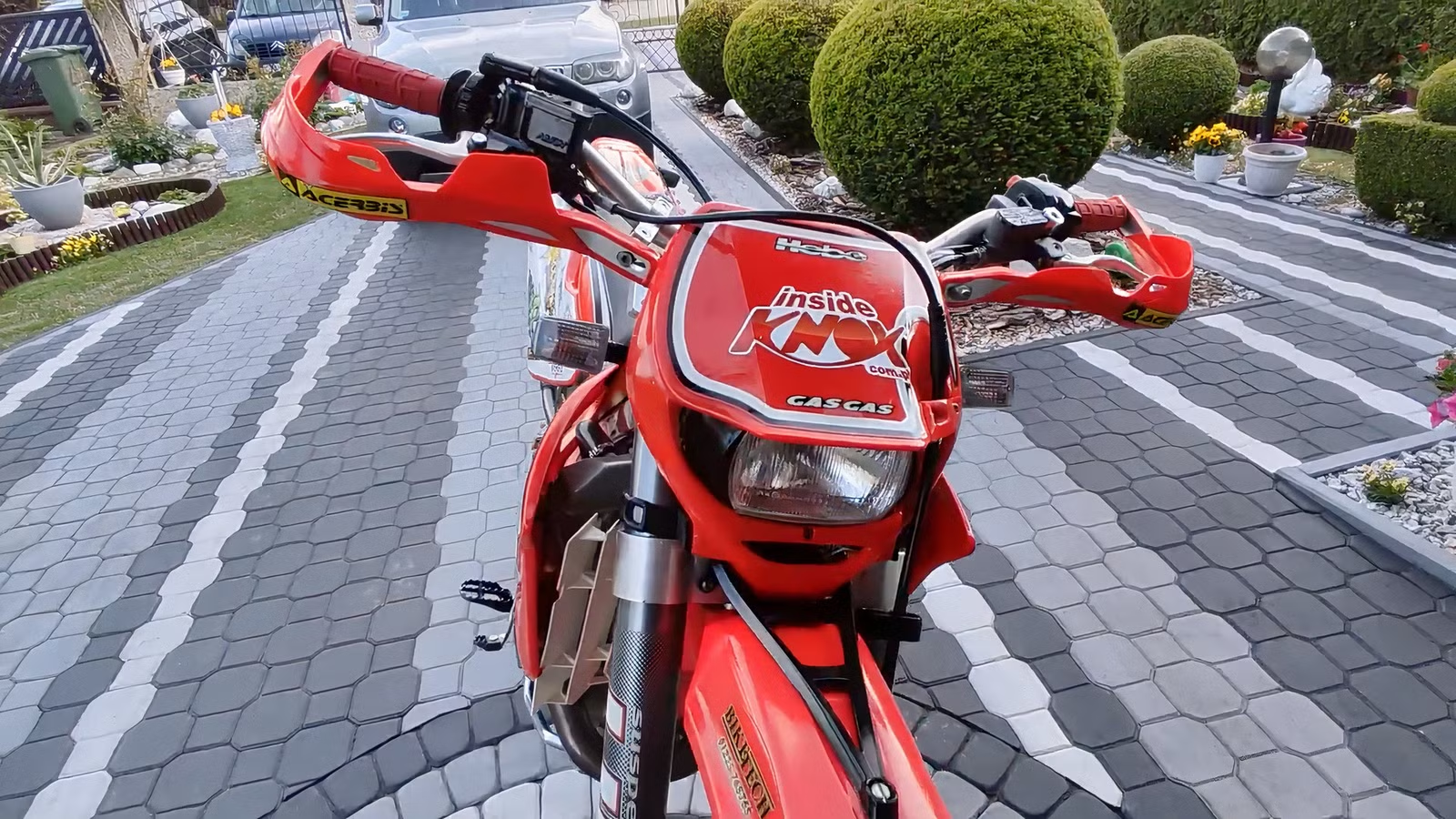
GasGas EC 400 FSE: The First Successful EFI Enduro Bike
Broadly speaking, motorcycles haven’t been as quick to embrace new technologies as their four-wheeled counterparts. And this wasn’t the result of manufacturers’ complacency in most cases, instead stemming from very practical reasons like weight management, smaller budgets for R&D or riders’ general affinity for simpler analog machines. So whereas features such as ABS and EFI have long been adopted at a large scale in the car world by the turn of the century, most two-wheelers still lacked that sort of tech. Today, we’ll be focusing more specifically on fuel injection and the first successful attempt at implementing it in the enduro segment.
Motorcycles Gained EFI Technology Much Later Than Cars

Whereas Chrysler had multiple models kitted with electronic fuel injection as far back as 1958, the first fuel-injected production bike was still more than two decades away at the time. Kawasaki finally broke the ice in 1980 with the Z1000H, but it took much longer for EFI to become truly commonplace in the motorcycle realm. Widespread adoption only took place during the 2000s, and the use of carburetors still persisted on dirt bikes to a much greater degree than their road-going relatives. Enduro riders preferred carbs for their simplicity, ease of maintenance or repairs and snappy throttle response, as well as the peace of mind afforded by knowing they could fix almost anything that went wrong with just a basic toolkit. With this in mind, the added complexity of EFI systems wasn’t all that appealing out there on the trails.
Cannondale Pioneered Fuel Injection On Dirt Bikes, And It Was A Disaster

Cannondale is famous for its top-notch bicycles, but what you may not know is that it also produced motorcrossers once upon a time. Its stint on the dirt bike scene was short-lived, though, and things went so catastrophically wrong that the company filed for Chapter 11 bankruptcy in 2003. Because even though the MX400 — Cannondale’s first motorcycle — was very ambitious, it was also plagued by delays and reliability issues which ultimately sealed its fate. The bike came out in 2001 filled with technologies that were cutting-edge at the time, such as a cassette-type gearbox, electric start and, of course, electronic fuel injection. It all sounded very exciting, for sure, yet the practical limitations of packing so much novelty into the MX400 became a brutal wake-up call for Cannondale.

Simply put, the bike was a complete flop — poorly designed, notoriously unreliable and sluggish compared to what other established manufacturers were offering back then. This blunder ended up costing Cannondale around $80 million in total, while the company’s stock price on Nasdaq plummeted by 83% before it was delisted. The whole thing was a mess, and even subsequent models like the X440 couldn’t remedy the damage inflicted. But, funny enough, a small manufacturer from Spain managed to succeed where Cannondale had failed, cleanly integrating EFI into a four-stroke dirt bike in 2002. Enter GasGas, founded less than two decades prior in ‘85 and specializing solely in the off-road segment. Now, GasGas wasn’t trying to reinvent the wheel like Cannondale, only looking to make a solid dirt bike that just so happened to be fuel-injected.
The GasGas EC 400 FSE Proved An EFI Dirt Bike Could Work

Just one year after the MX400’s debut, GasGas came up with the EC 400 FSE. As reported by buyers and the press, the bike did just about everything as well as you’d expect it to without being too impressive at anything in particular. That’s still a heck of a lot better than what Cannondale brought to the table, though, and the Spanish brand also did a much better job with its fuel injection system. Some folks claimed they could hardly sense the difference between it and conventional carbs, praising the FSE’s brisk throttle response, overall performance and dependable nature. Let’s take a closer look at the technical side of things for a better understanding of what GasGas had to offer.

The EC 400 FSE featured a four-stroke single with liquid cooling, dual overhead cams and a displacement of 399cc. Its EFI setup came courtesy of Magneti Marelli, while the engine’s power output was rated at 47 hp and about 32 lb-ft of torque. Interestingly enough, the thumper’s bore and stroke were identical to those of the popular Suzuki DR-Z400 dual-sport, measuring 90 and 62.6 millimeters (3.54 and 2.46 inches), respectively. Power reached the rear wheel by way of a six-speed transmission and a hydraulically-actuated clutch. One thing noted about the gearbox in a period Cycle World test is that its gear ratios were a little too close, so first didn’t feel low enough while sixth should’ve been higher. But, all things considered, the powertrain certainly did the trick.
As far as the chassis was concerned, the FSE used a chromoly perimeter-style frame perched on high-grade WP suspension, though one could also opt for Ohlins hardware in exchange for some extra dough. The brakes were pretty standard for a dirt bike in the early 2000s, mated to a 21-inch rim at the front and an 18-incher at the other end. In terms of weight, the motorcycle tipped the scales at approximately 270 pounds without fluids, right in line with other machines in its class. Pricing started at $6,795 for the base model, while that sweet Ohlins suspension would’ve set you back an additional 500 bucks. So, the EC 400 FSE didn’t just do its job way better than the MX400, but it was also slightly cheaper even when bought with the top-shelf suspension package.
No Gimmicks, Just Stuff That Actually Worked

It’s remarkable how a small-scale Spanish manufacturer managed to solve the whole fuel injection conundrum, while a company with Cannondale’s resources couldn’t pull it off. But it all makes sense when you think about it, because GasGas wasn’t out to create something flashy or generate much hype through promotional material filled with buzz words. Instead, it focused on integrating just one piece of fresh tech and did it right, otherwise sticking to the tried-and-true enduro formula that’s been proven to work over the years. What’s more, Cannondale was a new player in the dirt bike game, whereas GasGas had an established reputation in its niche and far more experience to rely on. So, while the MX400 became a cautionary tale, the EC 400 FSE found its footing and continued to evolve as time went on.
Engine capacity grew to 449cc in 2003 and the model became the EC 450 FSE, with more upgrades awaiting it further down the road. The FSE was around until 2007, then it made way for the improved EC 450 FSR to continue where it left off. By then, EFI was starting to gain some serious ground on the dirt bike scene, as companies like Suzuki, KTM, and Honda all started to implement it on various models in their lineups. And that finally brings us to the EC 400 FSE’s legacy, which paved the way for everyone else as the 2000s were drawing to a close. This seems like the perfect note to end on today, so let us emphasize the bike’s far-reaching influence before we wrap things up here.
A Major Technological Milestone We Tend To Overlook

Although the FSE’s achievement is largely forgotten by the motorcycling community nowadays, its legacy made its presence felt throughout the entire enduro segment. GasGas demonstrated how fuel injection could be effectively used on four-stroke dirt bikes, while also highlighting that Cannondale’s botched attempt was a matter of poor execution rather than technological incompatibility. Were it not for the EC 400 FSE making that crystal-clear, other manufacturers might’ve kept EFI at arm’s length and stuck with old-school carbs for many more years. As such, the FSE might just be one of the most criminally underrated motorcycles in history, not getting anywhere near as much recognition as it should.
Sources: Cycle World, Motocross Action Magazine, Transmoto, MotoParts, YouTube

Related posts



Latest Post


No Comments