
The Ford Pickup That Welded Its Body To A Flexing Frame And Jammed Its Own Doors
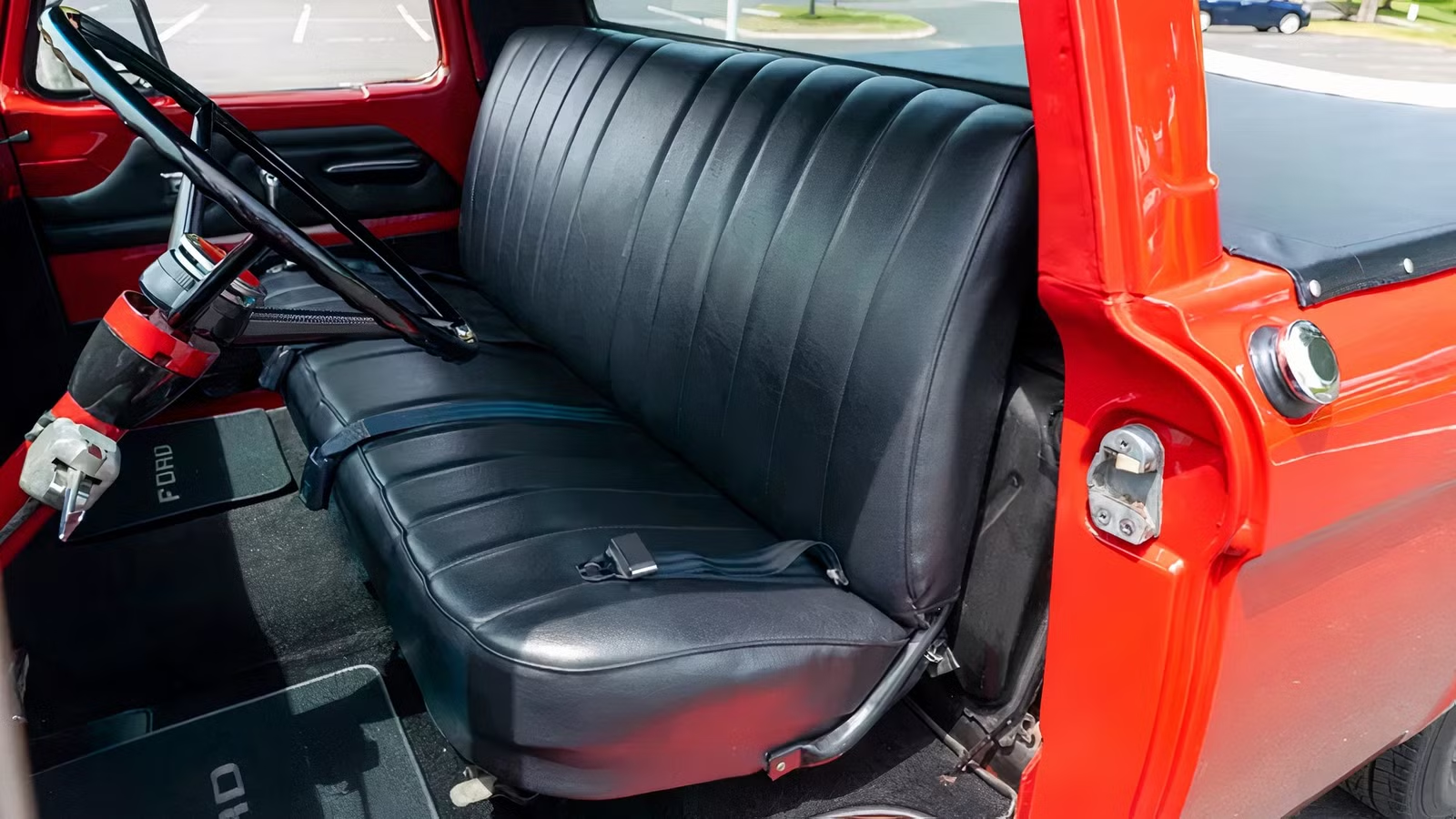
The pickup truck is a type of vehicle you wouldn’t expect to see a lot of experimentation on. It’s a very utilitarian product, for people who value practicality above all else. But that hasn’t stopped some people from trying. But, Ford learned the hard way why beds should stay seperate from cabins when they tried to meld them together.
By The 1960s, The Pickup Truck As We Know It Was Coming Together

The full-size pickup truck is a concept that we’re all familiar with. It’s got a standard format, and even a standard look. But, in the early days of these trucks, that wasn’t exactly the case. A lot of trial and error was done in the early days, and it took until the 1960s for things to get really standardized. Even then, there were some quirky experiments that happened. What we’re going to talk about here is one of those, and how it relates to one of Ford‘s most beloved pickups.
Ford Decided To Do Something Radical With Its F-100

Up until the start of the 1960s, the Ford F-100 had been a fairly run-of-the-mill pickup truck. The 1957-1960 version had introduced some new features, but it still looked very much like a regular 1950s American vehicle. That changed a little bit, though, when the 1961-1966 version showed up. Not only did this have a very different look to welcome in the 1960s, but Ford also decided to conduct one of its most controversial engineering experiments with it. While it looked into the future to how some pickup trucks would turn out, this new design quickly became notorious for how many problems it caused for its owners.

The Fourth-Generation Ford F-100’s Integrated Bed Is A Quirky, Short-Lived Engineering Experiment

Like many other pickup trucks of its day, the fourth-generation Ford F-100 (sold from 1961–1966) had a single-cab, rear-wheel-drive version for light utility use. In the past, these trucks had always had a separate bed that wasn’t joined to the body. This was a part of pickup trucks having a traditional body-on-frame construction, and nobody had really thought to change it. It worked, after all.
Ford, however, thought differently. Ford’s engineers worked out that if the truck bed was welded to the cab to integrate it into the rest of the body, there could be some serious advantages. The truck’s load capacity could be increased by 16%, it could be constructed more cheaply (thanks to fewer components needing fewer stampings, fewer welds, and being easier to paint), and it would have a sleeker, more car-like appearance. The last of those three aspects is something that people already saw in the Ford Ranchero, which was based on a car platform and sold alongside the F-100 at the time. While Ford tried to market it as being some kind of a unibody, this truck was only that in appearance. Underneath, it still had the same ladder-frame chassis as the other F-100 variants, which kept the old separate bed body style.
People Found Out Quickly That These Trucks Had Problems

The integrated bed F-100s did look great, and they did have more space in the bed thanks to Ford’s engineering experiment. But, it was only a matter of time before things started going wrong. Because it was still a ladder-frame truck with body-on-frame construction, its chassis retained all those ladder-frame characteristics. This included flexing under heavy loads. While this wasn’t that much of a problem in trucks where the bed was separate, in these integrated bed ones it caused an engineering disaster. The flexing caused the entire body to twist, and that twisting would put pressure on the doors. This caused the doors to get stuck, leaving owners unable to open them. There were also stories of doors flying open due to the flex, but it’s now believed that these were just urban legends.
Ford Started Offering A Solution For People Who Weren’t Happy
As you’ll have gathered, Ford had a serious problem on its hands with these trucks. The slick-looking integrated bed had been a total failure, and a solution was needed fast. What Ford decided to do was get rid of the new bed entirely and simply attach the bed from the old generation to the rear-wheel-drive, single-cab models instead. This created a truck that eliminated all those engineering problems, but with a bed that looked completely out of place on the truck it was fitted to. Enthusiasts started calling this version the “wrongbed”, and the name has stuck to this day.
The wrongbed trucks were introduced in 1962, only a year after the fourth-generation F-100 debuted. They immediately began outselling the integrated-bed trucks, even though it was clear that the wrongbed was a near cut-and-shut solution done on the cheap. The integrated bed pickups ended up being discontinued after 1963, due to customers wanting the much less problematic wrongbeds instead. A proper, matching bed eventually ended up getting made for these trucks in 1964, but the wrongbed configuration persisted on some variants for longer.
The Integrated Bed Experiment Was A Warning To Future Pickup Truck Engineers

The F-100’s integrated-bed failure would certainly have been a massive embarrassment for Ford. But, automakers everywhere learned a good lesson from it regarding building full-size, body-on-frame pickup trucks. The experiment of creating a unibody-style construction on top of a traditional ladder-frame chassis was never attempted again, and even to this day, full-size trucks have separate beds.
While the integrated bed has disappeared for good on full-size trucks, you can still see it on compact and mid-size unibody trucks. The Ford Maverick, Honda Ridgeline and Hyundai Santa Cruz all have integrated truck beds, and because they’ve got a unibody construction they don’t suffer from any flex issues. So, in that sense, Ford’s integrated bed truck did predict the future. It just didn’t get the engineering right.
Sources: Ford

Related posts






Latest Post


No Comments