
The Engine That Helped Turn This Motorcycle Into A Long-Term Favorite
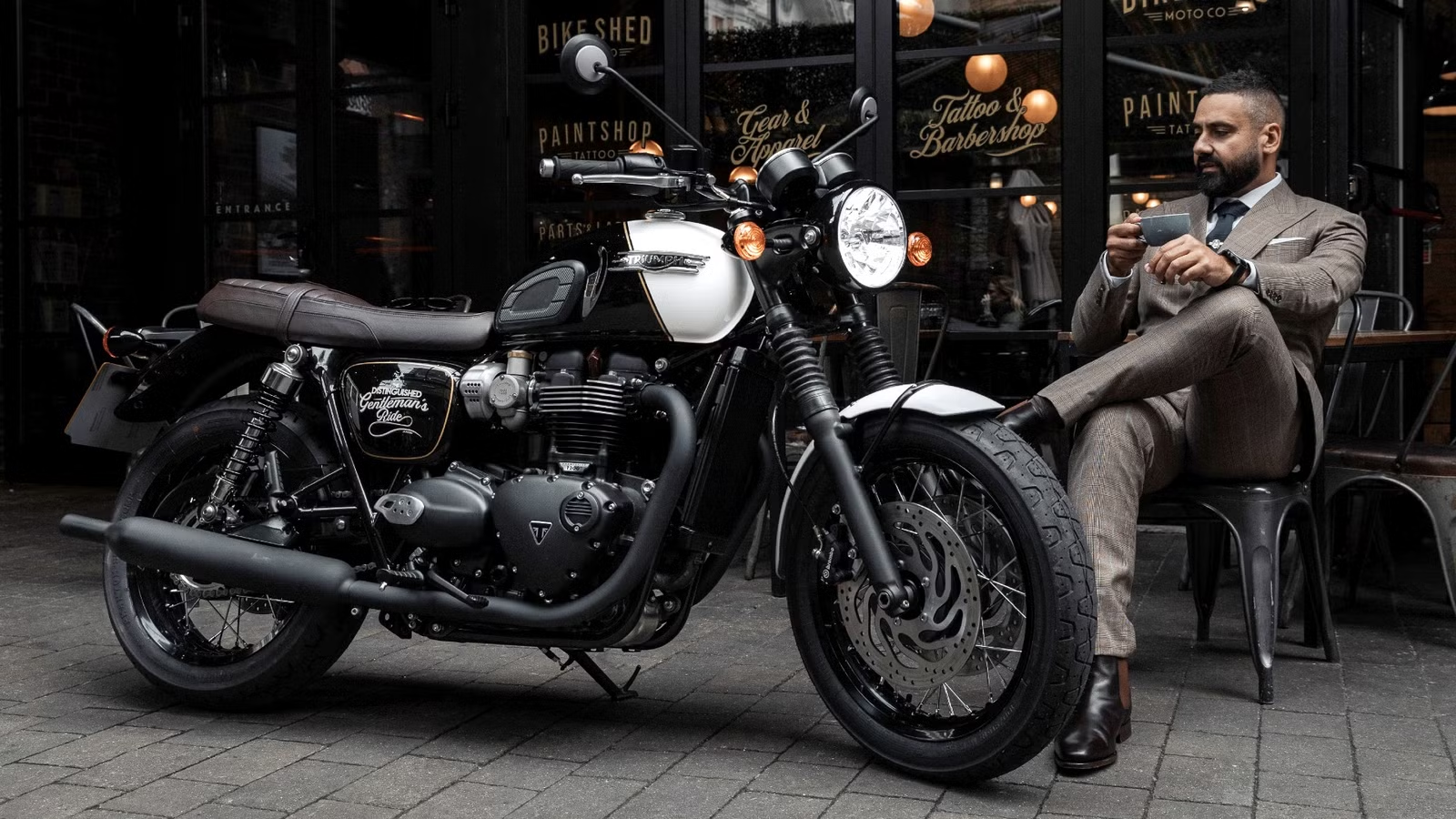
The Triumph Bonneville motorcycles ran on an 865cc air-cooled parallel-twin from 2001 to 2016, a design that carried over with only minor updates for most of that run. Its 360-degree crank gave it a busier, buzzier character, and for the most part, it managed to evoke the emotions of the classic British parallel-twins. But Triumph knew an overhaul was needed as this engine’s linear power delivery lacked the low-end punch that the modern rider was demanding. By 2012, Triumph had started a full redesign of the lineup.

New Euro 4 emissions rules that would be implemented for 2016 forced the issue further, requiring both emissions compliance and a formal durability test, with ABS becoming standard equipment across the board. So, Triumph went ahead and built a completely new 1200cc bottom end, keeping the classic look through a flush-fitting radiator and cosmetic cooling fins. This engine, as it later turned out, would be tuned differently depending on which bike it went into.
How Using One Bottom End To Power An Entire Lineup Made Sense
Redesigning an engine from scratch is not cheap, and no manufacturer can absorb that cost for a single motorcycle if it can help it. Triumph built one new 1200cc bottom end and then derived a new 900cc version from it when it retired the old air-cooled twin. With two engines, Triumph could now utilize modern electronic tuning to give each version a unique character so they could be placed across the entire Bonneville family of bikes. With economies of scale at play, this was a much better move than building bespoke engines for every model.
The 1200cc unit ended up in the classic-styled bikes, the smaller 900cc version in the more accessible roadsters, and each size got at least two distinct states of tune depending on the character that a specific model needed. The beauty of this mechanism also came from more in-depth engineering.

Triumph could’ve gone ahead with a simple ECU configuration and called it a day. Instead, each version of the Bonneville gets its own specific state of tune, its own cam profile, compression ratio, and fine-tuning of its performance. And it’s this attention to detail that gives every bike in Triumph’s modern lineup its own unique character. One such bike stands out the most and is cherished by its owners, who end up keeping it for years.
The T120 Name Carries 60 Years Of Salt Flats History Into Every Ride
How A Land Speed Record From 1955 Gave This Bike Its Name — And Its Purpose

That cost-sharing strategy pays off most directly on the Bonneville T120, and the nameplate carries a similar weight of history behind it. Back in 1959, Triumph named its new parallel-twin after the Bonneville Salt Flats in Utah, where a Triumph-powered streamliner had set a land speed record a few years earlier.
The ‘120’ badge came from the streamliner’s top speed, but that badge disappeared for four decades before finally being revived in 2016. And it was a fitting bike to adorn it, as it was attached to the first liquid-cooled Bonneville and the debut of the 1200cc High Torque parallel-twin. But what exactly makes that 1200cc engine so different from its siblings — and why does it inspire the kind of loyalty that keeps T120s in garages for a decade?
Inside The 1200cc High Torque Twin: Why Less Power Means More Character

Triumph’s own name for this tune is the High Torque. The liquid-cooled, 1200cc, parallel-twin makes 79 horsepower at 6,550 rpm and 77.4 pound-feet of torque at 3,500 rpm, ample for a bike built for everyday roads and riding.
This compares to the Speed Twin and Thruxton, which use the same 97.6mm bore and 80mm stroke but get a higher compression ratio and a state of tune that pushes peak power to 104 horsepower. The T120 gives up roughly a quarter of that peak number in exchange for torque that peaks 750 rpm earlier, and that’s exactly what Triumph was aiming for with the bike.
A Lower State Of Tune Means More Durability With All The Feels

The T120’s relaxed state of tune comes from a restrained 10.0:1 compression ratio and a lower operating range putting less strain on the pistons and valve gear. An engine that spends its life at lower loads simply has less to wear out over time. However, the reason why this engine on the T120 is dearer to its owners is its character.
Where the old engine had both pistons moving in lockstep, the new architecture offsets them with the 270-degree crank, shifting the exhaust note to be more akin to that of a V-twin. Throttle inputs are translated to a thumpy, pulsating buildup of revs felt through the seat and bars as much as through the pipes. And this character is further aided by the low-end torque, which helps the bike gather speed quickly without needing downshifts. It’s the kind of engine that feels eager in city traffic and unbothered on longer rides.

Triumph offers a 10,000-mile service interval and a two-year, unlimited-mileage warranty. These numbers hint at the fact that the engine won’t need much attention every few thousand miles. The T120 also isn’t new territory for Triumph’s dealer network or parts bins anymore, after more than a decade of its existence.
Bonnie’s Simplicity Extends Beyond The Engine Bay

The Bonneville T120’s uncomplicated engine extends to the rest of the bike too, with its simple overall design and classy lines. Triumph pairs the engine with a six-speed gearbox and a torque-assist clutch to lighten lever pull. The electronics package stays just as unfussy, with two riding modes, Road and Rain, that adjust throttle response and traction control. A single button press toggles the modes, plus ABS and cruise control are equipped as standard.

The instruments follow the same logic. Instead of one large touchscreen doing everything, the T120 keeps a pair of period-correct analog dials, speedo and tach, with a small multi-function screen tucked into each one for readouts and a USB-C port hidden underneath. It’s a dashboard that will look exactly as good in another ten years as it does today.
The Kawasaki Z900RS And BMW R 12 nineT Offer More Power — But At A Cost
How The T120 Beats Its Closest Rivals on Value and Long-Term Usability

The $12,899 Kawasaki Z900RS costs nearly the same as the $12,895 T120 in jet black base form, but is built around a completely different engine philosophy. It hits old UJM nostalgia with a screaming 948cc inline-four, the very opposite of the T120 and its low-end torque. It is well-equipped though, with cruise control and an IMU-based traction system as standard, and is sportier than the T120.
But if you’re looking for an equally classy alternative that hits vintage vibes with its styling and panache, the BMW R 12 nineT is the right fit. It sits well above the T120 as well as the Z900RS’ price tag, at $17,245, but it justifies it with the same underlying draw of a unique character. Most of that can be attributed to its 1170cc air-cooled boxer twin making 109 horsepower and 85 lb-ft of torque. It’s also backed by modern electronics underneath the vintage attire, with three riding modes and a shaft-driven rear wheel.

Between all three, however, the T120 is the one that pairs genuine long-term ease with its simplicity and an engine that has had enough of a history of reliability to last you for years to come. Its unhindered, almost laid-back performance from the 1200cc parallel-twin is a major reason why its owners simply refuse to look at another option.
Source: Triumph

Related posts






Latest Post


No Comments