
The Real Reason Dodge’s Scat Pack Exists Traces Back to 1957
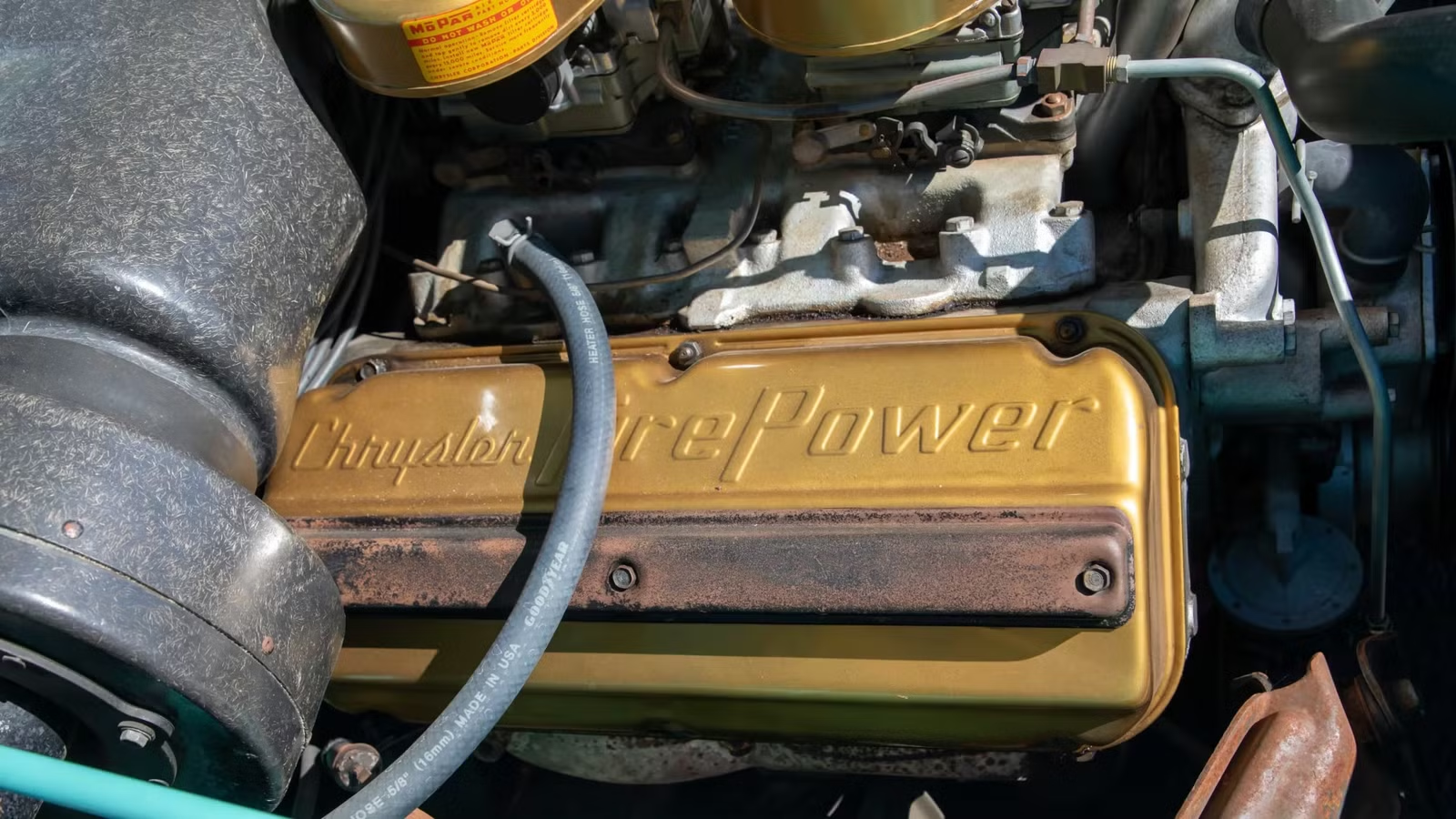
You wouldn’t initially think of the 1950s as being a prime era of American cars. But, it was a very important time in the American auto industry. This was the start of the development of many of the great qualities of those classic muscle cars. This includes the engines. One engine in particular that popped up out of Detroit during this time has gained a reputation of being one of the best.
The 1950s Was The Dawn Of The Powerful American V8

Many people may highlight the ’60s and ’70s as the golden age of super-powerful Muscle Cars. But, the groundwork for that was already being laid as far back as the ’50s. The malaise of the post-World War II era was starting to lift, and automakers were hitting breakthroughs on how to get more out of their engines. The V8 format had already existed for a while, and had powered some successful luxury cars before the 1950s. But, during this decade, that V8 power that was previously only available for the rich and famous started filtering down into cars that more ordinary people could afford. Plus, these V8s were becoming more powerful than ever.
Chrysler Was At The Forefront Of Developing These New, Powerful Engines

Out of the American automakers who were pushing the boundaries of V8 performance, Chrysler made themselves really stand out. A lot of that was down to one particular engine it developed during this period. It introduced some engineering that was revolutionary for car engines at the time. It also became a cornerstone of a uniquely American part of car culture, and set the stage for the Mopar performance monsters of the ’60s and ’70s.

The Chrysler 392 Hemi Started Mopar’s Journey Towards High-Performance Dominance

If there’s any engine that can be singled out as Chrysler’s most important, there’s probably a very good case to be made for the 392 Hemi. This 392 cubic inch V8 can be considered as the first proper high-performance V8 to be developed by Mopar. That high performance comes from an innovation that hadn’t been seen in car engines before this time – the hemispherical combustion chamber. This new combustion chamber design allowed for bigger intake and exhaust valves, meaning that the engine had better airflow. It also allowed the engine to have bigger valves, and a central spark plug for a faster and more even burn during combustion.
All of that added up to serious performance. The 392 Hemi produced anywhere between 325-390 horsepower, depending on what car it was put in. Its peak torque was also anywhere from 420-435 lb-ft. Those torque figures made the 392 Hemi the torquiest engine you could get on any production car in the 1950s!
It Can Trace Its Origins Back To An Engine Designed For A Fighter Plane
A fascinating part of the 392 Hemi’s backstory that almost nobody ever seems to mention is that the hemispherical combustion chamber originally came from an aircraft engine. That engine was the XIV-2220, a massive V16 that was intended for the top tier of American piston-engined fighter planes. Chrysler began developing this engine during the 1940s, right in the middle of World War II where the need to outstrip the Axis powers in military technology was high. Just like in the car engines that came later, the prime reason for the aircraft engine having the hemispherical combustion chamber was for maximum performance.
While the XIV-2220 was actually tested in a modified P-47 Thunderbolt fighter plane, by the time it was developed enough to get to that stage times had moved on. The first test flight happened on 26 July 1945, right at the end of World War II and the start of the jet age. The idea of developing a new engine for piston-engined fighters would have seemed like a waste of time, when they could put all that money and time into developing new jet fighters. So, it never entered production, and its only legacy is Chrysler adopting the hemispherical combustion chamber for the 392 Hemi some years later.
It Powered Several Of The Top Chrysler And Imperial Models – Including One That’s Incredibly Rare and Desirable

A big part of the 392 Hemi’s enthusiast appeal is that it powered several of the most expensive and desirable Chrysler and Imperial models of the ’50s and ’60s. The Chrysler 300C, 300D and New Yorker all got the 392 Hemi engine, as did the Imperial Crown, Custom and LeBaron. The Chrysler 300D is by far the most special out of all of them, as it’s the rarest and most desirable now. It was genuinely one of the world’s most powerful production cars in the 1950s, producing that maximum output of 390 horsepower and 435 lb-ft of torque.
It Was Also Put Into An Ultra-Exclusive French Grand Tourer
The 392 Hemi may be an all-American engine. But, that doesn’t mean that its use was restricted to American cars. There was actually one super-exclusive European grand tourer that had the 392 Hemi as an engine option! That was the Facel Vega FV2, a stylish French coupe that was considered to be one of the best luxury cars in the world. It was produced in extremely limited numbers (some variants even had less than 50 examples produced overall), and had a litany of famous owners that included Edward Ashley, Ava Gardner, Tony Curtis and Sir Stirling Moss.
The 392 Hemi Became A Centerpiece Of Hot Rod And Drag Racing Culture

With how much of a revelation it must have been for its day in terms of performance, it’s no surprise that the 392 Hemi ended up becoming a centerpiece of America’s tuning culture. Plenty of hot rods have ended up having the 392 Hemi fitted inside them, and those engines typically get tuned to crazy levels. Many hot rod builders to this day actually still prefer these old 392 Hemi engines over more modern small-block units from Chevrolet or Ford! It’s not surprising why that is. These engines have a strong bottom end, making them incredibly reliable for competition use. Combine that with various upgrades you can easily get to bump up the power and modernize them, and you can get a situation where you have the best of the old and the new.
It Set The Stage For The Monstrous 426 Hemi

Perhaps one of the biggest legacies the 392 Hemi has had is that it paved the way for the development of Mopar’s most legendary muscle car engine. That’s the homologation special 426 Hemi, which took the hemispherical combustion chamber V8 design to its absolute extreme. The hemispherical combustion chamber’s effect on a V8 engine’s performance made it perfect for use in NASCAR. NASCAR’s super speedways require lots of power high up in the rev range, and that’s something the hemispherical combustion chamber lent itself to.
The 392 Hemi Name Re-Appeared On An Engine Intended For Modern Muscle Cars And Muscle Trucks

Thanks to its status as a legendary tuner engine and the strength of the Hemi brand, it’s not that surprising that Mopar found a way to bring the 392 Hemi name back for the modern day. The modern 392 Hemi shares nothing with the classic 392, but it does promise great power and performance like the original engine did. It’s a similar size to the classic 392 Hemi (6.4 liters), but produces much more power at 410-485 horsepower and 475 lb-ft of torque. This engine can be found the Chrysler 300C Final Edition from 2023, as well as multiple modern Dodges (several variants of the Charger and Challenger), a couple of Jeeps (the Grand Cherokee SRT and Wrangler Rubicon 392) and the Ram 2500 and 3500 HD. In the Ram trucks, they’re tuned more for heavy-duty work than outright performance, and so they fall around the bottom end of the modern 392’s power band.
Sources: Chrysler, Dodge, Facel Vega, Jeep, Ram

Related posts



Latest Post


No Comments