
This Japanese Adventure Bike Refuses To Die, Break, Or Become Boring
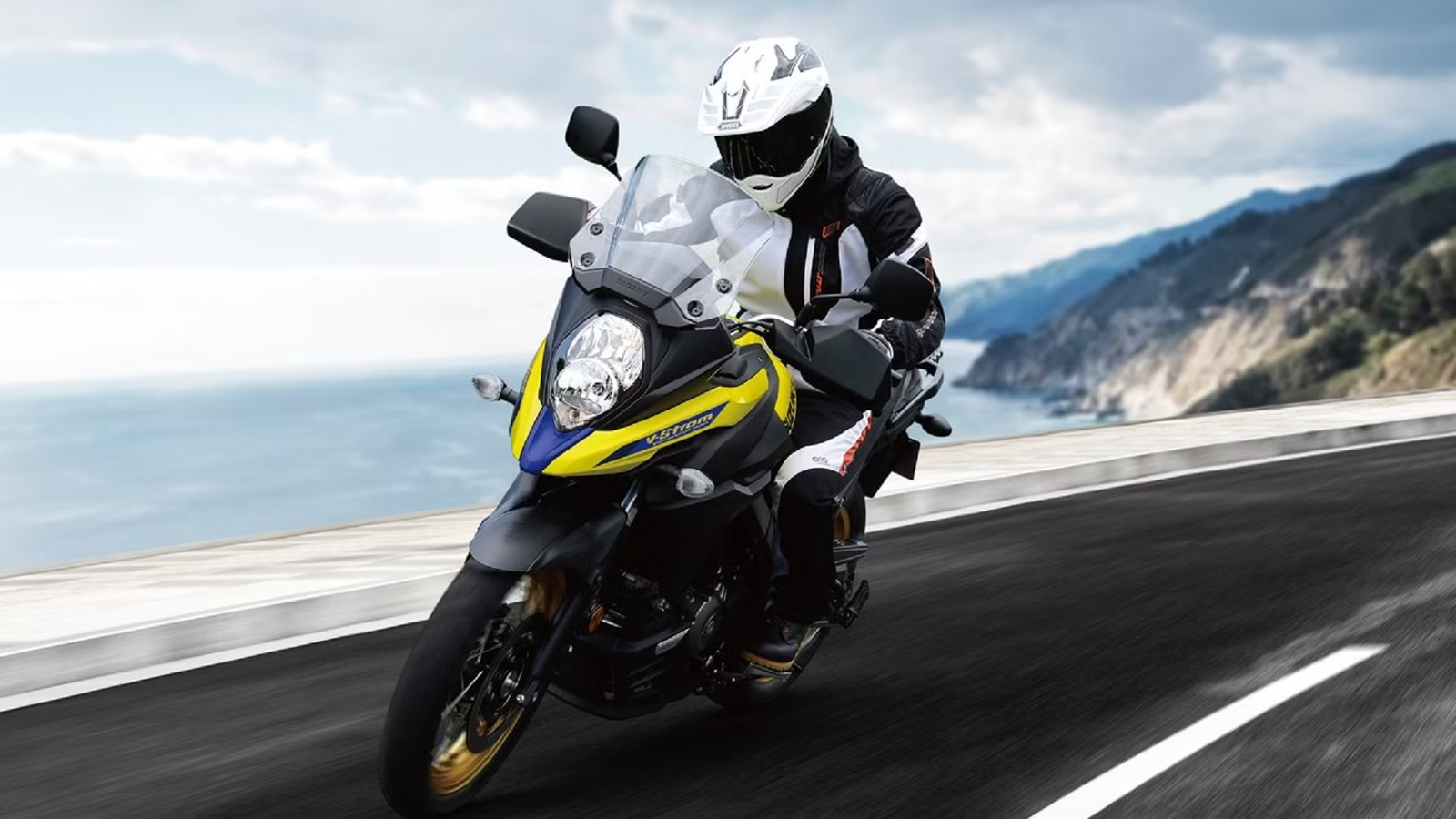
Adventure bikes have spent the past two decades getting faster, taller, smarter, and far more serious about dirt. Horsepower climbed, screens grew brighter, electronics learned to measure lean angle, and suspension started looking ready for a rally stage. One stubborn Japanese middleweight kept following a much simpler plan, though – it offered enough power, enough comfort, enough dirt-road ability, and very little drama.
Adventure Bikes Got Faster, Smarter, And Much More Complicated

The modern middleweight adventure bike barely resembles the class that existed 20 years ago. Engine sizes have crept toward 900cc, and 100-plus horsepower no longer sounds unusual. The BMW F 900 GS, for example, makes a claimed 105 horsepower from 895cc, while Triumph’s current Tiger 900 produces 106.5 horsepower from its 888cc triple. The dirt-focused end of the category has also grown much more serious, with 21-inch front wheels, long-travel adjustable suspension, stronger brakes, and chassis geometry built for riders who genuinely intend to leave the pavement.
Electronics have moved just as quickly. Modern adventure bikes can offer several ride modes, cornering ABS, lean-sensitive traction control, quickshifters, cruise control, large TFT screens, and settings dedicated to loose surfaces. KTM’s 890 Adventure R, for example, uses a six-axis IMU to help manage traction control and ABS while also carrying fully adjustable WP suspension with 9.4 inches of travel at both ends. Triumph’s Tiger 900 Rally Pro adds six ride modes, cornering ABS, premium brakes, and long-travel Showa suspension. A middleweight ADV can now carry a technology list that once belonged on a flagship superbike.

All of that progress comes with choices. More hardware usually means more cost, while extra electronics add systems for an owner to understand and, eventually, maintain. Greater off-road focus can bring tall seats, dirt-biased tires, or suspension settings that matter more on a rocky climb than during a 400-mile highway day. Triple-digit horsepower also sounds exciting until most of the motorcycle’s life consists of commuting, sweeping back roads, and running errands with luggage attached.

Longevity Matters More When The Motorcycle Actually Gets Used

Reliability means something different on an adventure-tourer than it does on a motorcycle that spends most weekends under a cover. These bikes collect ugly miles – they start on cold mornings, crawl through traffic, sit at highway speeds for hours, carry passengers and luggage, get soaked in rain, and occasionally get bounced down a gravel road because a GPS app had an interesting sense of humor. A useful adventure bike needs to tolerate ordinary neglect as well as extraordinary trips.
Adventure-bike reliability also depends on how much stress the design carries in the first place. High compression, extra heat, complicated electronics, semi-active suspension, and tightly packaged bodywork can all improve performance, but they also give owners more systems to inspect, service, and eventually repair. Off-road riding adds another layer of punishment through dust, water crossings, vibration, hard impacts, and frequent low-speed heat. That does not make modern adventure bikes unreliable by default, but it simply means durability comes from more than a strong engine.
The Suzuki V-Strom 650 Combined Durability With Character

One motorcycle in the adventure segment has always been against the tide, and that motorcycle is the Suzuki V-Strom 650. The company launched the larger V-Strom 1000 in 2002, then added the smaller DL650 for the 2004 model year. The idea was simple: package the V-Strom family’s touring comfort into a lighter, cheaper machine that could reach more riders. Its engine came from the same family as the much-loved SV650 motor.
The heart of the whole story is a 645cc, liquid-cooled, 90-degree V-twin. That layout gives the V-Strom something many practical motorcycles struggle to create: personality without demanding attention. It pulls cleanly through the low and middle part of the rev range, which matters when slipping through traffic or hauling luggage out of a slow corner. Yet it does not sign off the moment the road gets interesting. The engine will rev, and there is enough urgency higher in the tach to make a mountain road worth taking twice. Power was rated at around 67 horsepower and 43 pound-feet of torque at the rear wheel on later models. Those numbers hardly threaten a modern 900cc ADV, but they explain why the bike rarely feels overwhelmed by normal riding. It has enough motor to work hard without constantly feeling like it is working hard.

Suzuki also resisted the temptation to throw away the recipe every few years. For 2012, the V-Strom received a major redesign with new bodywork, reduced weight, improved fuel economy, and changes aimed at stronger low- and midrange response. The manufacturer said the redesign cut six kilograms while improving comfort and street manners. For 2015, the V-Strom 650XT brought more visual and practical adventure flavor through wire-spoke wheels, hand guards, and extra protection. Those wire wheels still accepted tubeless tires, a small detail that matters quite a lot to someone staring at a puncture hundreds of miles from home. Then came the 2017 update, which added two-level traction control, Low RPM Assist, and Suzuki Easy Start while keeping the same basic 645cc V-twin architecture. Evolution kept winning over reinvention.
That long development curve eventually became part of the appeal. Suzuki still offered the V-Strom 650 in the United States for the 2025 model year, more than two decades after its American debut. The late-model specification reads almost like a rejection of the arms race around it: 645cc V-twin, six-speed gearbox, 19-inch front and 17-inch rear wheels, a 5.3-gallon fuel tank, 32.9-inch seat height, and a 470-pound curb weight for the base model. Suzuki asked $9,299 before destination charges. There was traction control and ABS, but no giant tablet mounted above the handlebars and no menu maze required before leaving a gas station.
It Is Fun Because It Never Tries To Be A Hardcore ADV
One statistic may explain the V-Strom 650 better than any horsepower figure. Before the 2012 redesign, Suzuki researched how owners actually used previous V-Stroms. According to Cycle World, 97 percent reportedly never left pavement. Suzuki could have treated that number as a failure of the adventure-bike concept, but instead, its engineers paid attention to the customers. The 2012 redesign concentrated heavily on road performance, comfort, efficiency, and handling rather than transforming the 650 into a miniature rally bike. That decision looked conservative at a time when the ADV market was becoming increasingly obsessed with dirt credentials. In hindsight, it looks unusually clear-eyed.
The hardware reflects that mission. A 19-inch front wheel sits between the quick steering of a 17-inch street setup and the obstacle-clearing advantage of a 21-inch dirt wheel. The telescopic fork and conventional rear shock have enough travel and compliance for broken pavement, potholes, and gravel, but they do not pretend to be competition enduro parts. Ground clearance on a late V-Strom 650 sits at 6.7 inches, another hint that boulder gardens were never the main assignment. The upright riding position gives a rider wide-bar leverage and good visibility while leaving enough room to stay comfortable for long stretches. Even the XT’s extra equipment moves the bike toward dirt roads rather than hard enduro terrain.

That compromise is where the fun lives. On a sweeping back road, the V-twin gives corners a pulse without launching the speedometer into courtroom territory. On tight mountain pavement, the broad power delivery lets the rider concentrate on lines rather than electronics settings. In traffic, the upright stance and easy low-speed response make gaps less tiring. On a long trip, the fairing, large tank, relaxed ergonomics, and luggage options turn the same machine into a simple tourer.
The V-Strom 650’s Greatest Strength Is That Nothing Quite Replaces It

Suzuki itself eventually developed a much newer answer to the middleweight question. The V-Strom 800 uses a 776cc parallel twin, ride-by-wire throttle, selectable power modes, a quickshifter, and a more modern electronics package. The dirt-focused 800DE pushes farther with a 21-inch front wheel, extra ground clearance, and electronics designed around loose surfaces. Those motorcycles show exactly how far Suzuki’s adventure range moved after the 650 arrived. They are stronger, newer tools, yet they also underline what made the old 650 unusual. Even Suzuki’s newer road-oriented V-Strom 800 weighs a claimed 492 pounds, 22 pounds more than the 2025 base 650, despite the expectation that an old platform should be the heavy one.
The V-Strom 650 has flaws, and hiding them would miss the point. A 470-pound motorcycle is hardly featherweight, and the basic fork, two-piston front brake calipers, and modest ground clearance look plain beside premium rivals. Riders who want to attack rocky climbs, deep sand, or fast dirt will find much better tools. Riders who want radar cruise control, semi-active suspension, a huge color display, an up-and-down quickshifter, or an IMU-managed safety net will also need to shop elsewhere. The V-Strom was built to a price, and parts of it never tried very hard to hide that fact.
Those limits helped create the motorcycle’s staying power. The V-Strom 650 refuses to die because Suzuki spent decades refining a proven engine instead of treating every model cycle as a clean sheet. It refuses to break its owners’ trust because its mechanical package remains conventional, well understood, and backed by years of real mileage. And it refuses to become boring because the V-twin still has a beat, the chassis still likes a good road, and the whole motorcycle asks very little before joining almost any kind of ride. Faster adventure bikes exist, sure, and so do lighter ones, not to mention better dirt bikes or more luxurious tourers. Finding one motorcycle that combines the 650’s character, simplicity, comfort, range, price, and long record of use, however, remains much harder. That may be the old Suzuki’s best trick: after more than 20 years, the sensible choice can still be the interesting one.
Source: Suzuki, CycleWorld

Related posts

Latest Post


No Comments