
A 948cc V4 Cruiser Is Coming For Harley’s Throne — And It’s Cheaper
Cruiser motorcycles have spent decades teaching riders that displacement, low-rpm torque, and a big V-twin are basically inseparable. Even manufacturers without a century of American cruiser history usually follow some version of that formula. Benda has decided not to bother. Its newest flagship uses four cylinders, spins to 9,000rpm, and reaches peak torque at an engine speed where a traditional Harley-Davidson is already very much in another gear.
Cruiser Engines Usually Follow A Very Particular Formula

There are good reasons the V-twin became the default cruiser engine. The layout can be relatively narrow; it produces the kind of low-speed pulse riders associate with the category, and its appearance naturally becomes part of the motorcycle’s styling. More importantly, decades of American motorcycle culture have made the exposed V-twin almost inseparable from what a cruiser is supposed to look, sound, and behave like. Harley-Davidson has turned those qualities into an entire brand identity.
Nothing about those numbers suggests Harley is interested in chasing superbike-style revs. The Fat Boy’s appeal comes from doing almost the opposite. Its engine makes a huge amount of torque without needing much rpm, while its long, low chassis and huge 160-section front and 240-section rear tires emphasize stability and presence. You don’t need to wring its neck to reach the part of the engine that matters. Peak torque arrives before plenty of four-cylinder motorcycles have even started getting interesting.
The Harley Fat Boy Defined Multiple Generations Of Cruisers


Few motorcycles have done more to establish the modern image of a heavyweight cruiser than the Harley-Davidson Fat Boy. Since arriving at the start of the 1990s, its combination of a low stance, wide tires, solid-looking wheels, and a big exposed V-twin has become instantly recognizable. Plenty of cruisers have evolved technologically since then, but the basic Fat Boy formula has remained remarkably consistent because its mechanical layout is inseparable from the identity Harley spent decades building around it.

The current Fat Boy takes that familiar approach and gives it considerably more muscle. Its Milwaukee-Eight 117 Custom displaces 1,923cc and produces 103 horsepower at 4,800rpm, but horsepower isn’t really the number that defines it. The engine makes 126 pound-feet of torque at just 3,000rpm, giving riders a huge amount of thrust without needing to chase the upper reaches of the tachometer. Combined with its long wheelbase, low seat, and 694-pound running weight, the entire motorcycle is built around effortless low-rpm performance and physical presence.
That’s where the next challenger becomes interesting. Rather than shrinking the traditional Fat Boy formula and trying to reproduce the same character for less money, it takes almost the opposite mechanical approach. Its engine has half the displacement, twice the cylinders, and develops its strongest output thousands of rpm higher. Yamaha’s VMAX and Ducati’s Diavel V4 have already shown that cruiser-like proportions can coexist with high-revving multi-cylinder performance, and this new machine applies a similar philosophy at a potentially much more accessible price.
The Benda Dark Flag 950 Challenges The Traditional Cruiser Formula

That motorcycle is the Benda Dark Flag 950, and the difference between its numbers and the Fat Boy’s is more revealing than a simple horsepower comparison. Harley’s 1,923cc twin delivers maximum torque at 3,000rpm. The Benda doesn’t reach its own peak until 8,000rpm. That’s a 5,000rpm gap between the points where the two engines are theoretically doing their strongest work, despite both motorcycles sitting broadly within the cruiser category.
Without riding the Dark Flag, it’d be premature to declare exactly how that difference translates from the spec sheet to the road. The numbers nevertheless suggest two very different approaches. The Harley should reward short shifts and letting its huge torque curve do the work. Benda’s V4 appears designed to encourage the rider to use considerably more rpm, with much of its performance concentrated higher in the rev range rather than available just above idle.
It’s Still Unmistakably A Cruiser

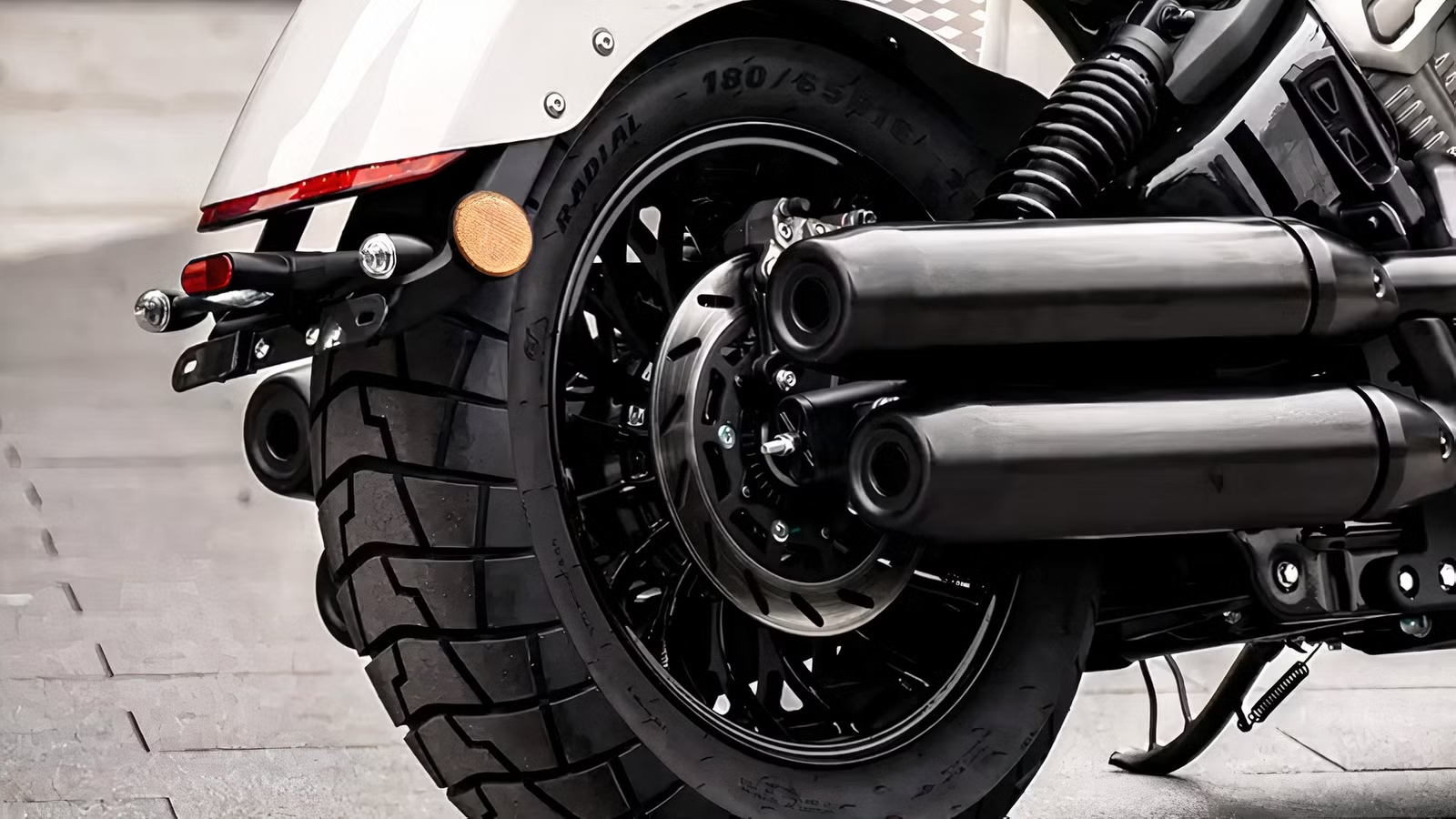
The rest of the Dark Flag is surprisingly conventional by comparison. Power goes through a six-speed gearbox, multi-plate oil-bath anti-hopping clutch, and belt final drive. The chassis uses a steel tubular frame and steel swingarm, with a 41mm inverted fork and twin hydraulic rear shocks providing 118mm and 50mm of travel, respectively. Benda lists a 1,590mm wheelbase, 690mm seat height, and a curb weight of about 534 pounds.
That means it’s roughly 160 pounds lighter than the Fat Boy while still keeping the proportions buyers expect from a cruiser. It rolls on 16-inch wheels with a 130/90 front and 180/65 rear tire, while braking comes from dual 320mm front discs with radial four-piston Brembo calipers and a 260mm rear disc with a two-piston Brembo. Bosch dual-channel ABS and traction control are included, and Benda says both systems can be switched off independently.
The Dark Flag Follows The Muscle Cruiser Philosophy More Closely

This is where the Dark Flag makes more sense alongside motorcycles like the VMAX and Diavel than next to traditional laid-back cruisers. The connection isn’t about copying either motorcycle. It’s the underlying idea that cruiser proportions and ergonomics don’t have to dictate a low-revving engine. Yamaha explored that decades ago, Ducati continues doing it today, and Benda is now trying to package the same broad philosophy into a motorcycle positioned much farther down the price ladder.
Benda claims the Dark Flag can accelerate from 0 to 62 miles per hour in 3.8 seconds. That’s quick enough to move the V4 beyond novelty status and into legitimate muscle-cruiser territory. The company also claims a top speed of around 112 miles per hour. Neither figure makes it a Diavel rival on outright performance, but they do reinforce the idea that the extra cylinders aren’t there purely to make the brochure more interesting.
There are practical touches here, too. Electronic throttle control enables cruise control, while Benda’s Idle Shutdown Technology can deactivate cylinders while idling or under light loads, potentially helping manage fuel consumption and heat from the tightly packaged V4. There’s also a 3.6-inch TFT instrument display, ABS, traction control, USB and USB-C connectivity, and a 16-liter, or roughly 4.2-gallon, fuel tank. Benda quotes fuel consumption at 5.6 liters per 100km, equivalent to about 42mpg U.S.
Undercutting Harley Could Be The Easy Part

All of that would be interesting even before price entered the conversation, but price is where Benda’s strategy becomes especially difficult to ignore. The 2026 Harley-Davidson Fat Boy starts at $22,599 before destination charges and options. That buys one of the most recognizable cruisers in production, backed by Harley’s enormous dealer network, aftermarket ecosystem, brand recognition, and decades of accumulated loyalty. Benda isn’t competing with a specification sheet alone.
There’s currently no verified US MSRP for the Dark Flag 950, so any claim that it’ll cost a particular amount less than the Harley would be speculation. That said, Europe does provide some useful context. Benda France currently lists the Dark Flag 950 at €10,990 (around $12,729 USD) including VAT, although its release date is still marked as TBD. That price can’t simply be converted into dollars and presented as an American MSRP, but it makes Benda’s intended positioning pretty difficult to miss.

More importantly, price isn’t the most interesting thing about this motorcycle. Cheap cruisers aren’t new, and Chinese manufacturers have spent years competing by offering familiar layouts for less money. The Dark Flag 950 is more ambitious because its 948cc V4 asks whether a cruiser needs to behave anything like the V-twins that defined the category. If Benda eventually brings it to the U.S. at anything close to its European positioning, undercutting the Fat Boy could simply be the headline. The genuinely unusual part is how differently it’s trying to get down the road.
Source: Benda Motorcycles

Related posts

Latest Post


No Comments