
Honda Produced An Accord That Was Almost As Powerful As A Civic Type R
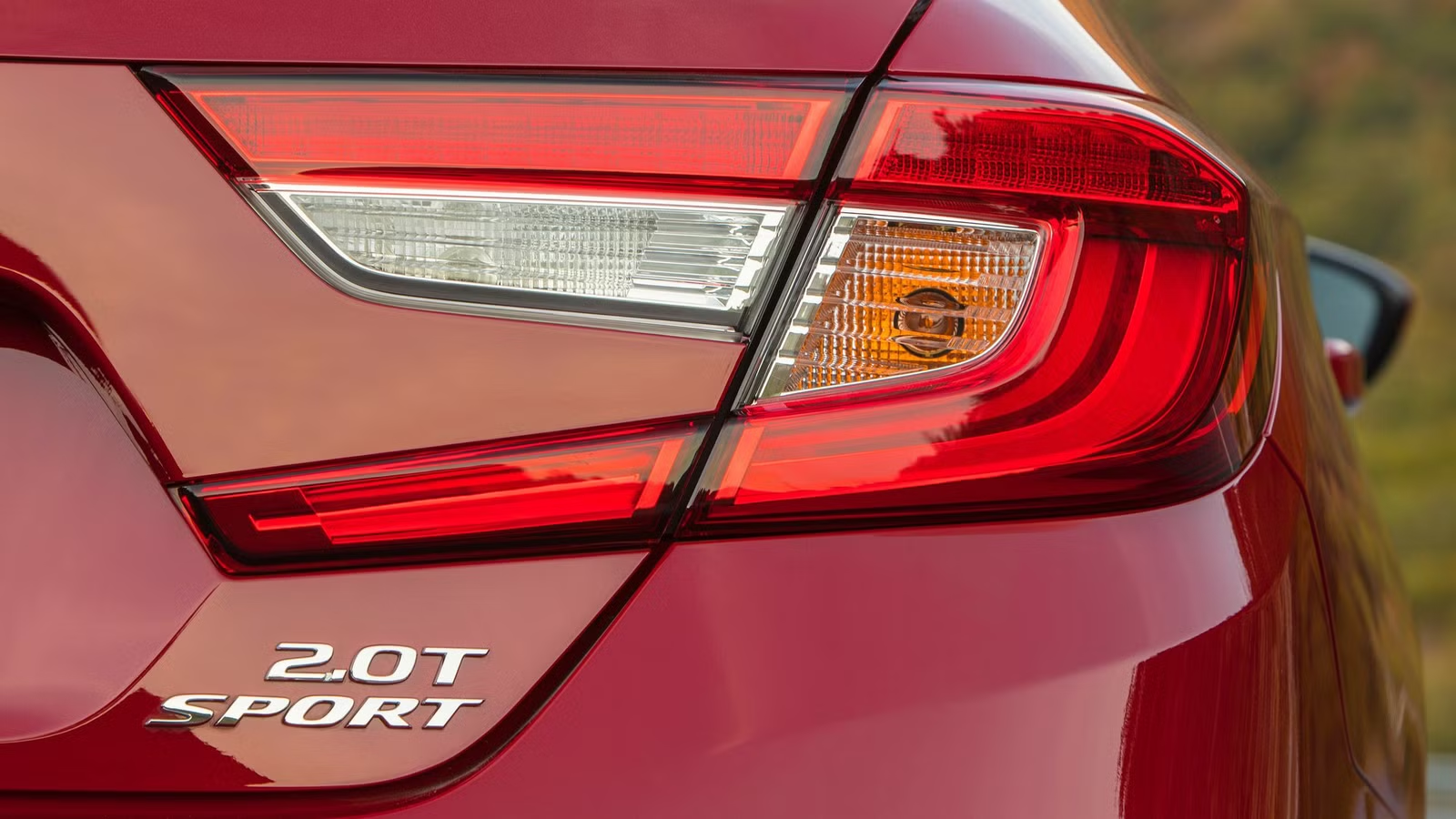
Over at Honda, the Civic Type R has long kept its place as the manufacturer’s halo model and performance icon, but when it comes to comfort, cruising, and offering a practical family sedan experience, it is the Accord that has filled in that spot. Yet between 2018 and 2022, Honda quietly sold a turbocharged version of the Accord with a power output closely rivaling that of the Type R. Challenging one of Honda’s most celebrated sports cars, this Accord pretty much flew under the radar. Packing a turbocharged four-cylinder engine with the option of a six-speed manual transmission and offering an unexpectedly engaging driving experience without sacrificing its daily driver traits, this is perhaps one of the most underrated performance sedans Honda has ever built.
This Honda Accord Shares Its DNA With The Civic Type R

During a short four-year span between 2018 and 2022, Honda sold the Accord 2.0T, a sportier trim of the family-oriented sedan. Though the 2.0T trim looked almost identical to the standard Accord, it hid the K20C4 under its hood: a 2.0-liter turbocharged four-cylinder engine that shared its core architecture with the FK8 Civic Type R’s K20C1. This shared DNA comes from both K20C4 and K20C1 belonging to Honda’s K-series engines.
Both use the same 2.0-liter turbocharged inline-four architecture, with lightweight aluminum-alloy blocks to reduce overall weight, and share the same 86.0-mm bore, 85.9-mm stroke, and compression ratio of 9.8:1. Each engine received different tuning, but the performance gap between the two is surprisingly narrow. The Accord 2.0T produces 252 horsepower and 273 lb-ft of torque, while the Civic Type R produces 306 hp and 295 lb-ft of torque, making it a difference of just 54 hp and 22 lb-ft of torque.
Despite identifying as a comfortable family sedan, the 2.0T is pretty quick and accelerates from 0 to 60 mph in about 5.5 seconds. As for transmission, the Accord came with a 10-speed automatic as standard to make the most of the engine’s broad torque curve. But for those who prefer a more engaging driving experience, Honda also offered an optional six-speed manual gearbox for the Sport 2.0T trim, which was unfortunately dropped by the manufacturer after 2020.

Main Differences Between The Honda Accord And The Civic Type R

While both engines share the same DNA, both cars have been engineered to serve different purposes and some of the major differences between the Accord 2.0T’s K20C4 and the Type R’s K20C1 come down to hardware. On one hand, the Type R’s K20C1 uses a larger turbocharger for top-end power. As a performance-oriented sports car, the Type R also features a limited-slip differential and a dual-axis front strut suspension to help reduce torque steer. The firmer suspension setup is combined with a stiffer, track-focused chassis for the Type R to deliver its signature sharp and responsive hot hatch performance.
On the other hand, the K20C4 uses a smaller turbo that spools more quickly in order to deliver low-end and mid-range torque suited to the Accord’s daily driving purposes. The 2.0T engine also gets balance shafts for a more refined ride. Unlike the Type R, the 2.0T does not get a limited-slip differential but rather an open front differential, MacPherson struts up front, and a multi-link rear setup, for a quieter and more comfortable ride.
The weight difference between the Accord 2.0T and the Civic Type R is also noticeable. As a larger, midsize sedan, the manual Accord weighs 3,298 pounds (3,377 pounds for the 10-speed automatic) or about 170 to 250 pounds more than the Civic Type R’s 3,121-pound curb weight. Though less agile than the hot hatch, the Accord 2.0T still proves that nearly the same powertrain can deliver impressive speed without compromising on practicality.
The Accord 2.0T’s Appeal Is Its Versatility

With a large wing and prominent air intakes, the Type R fully showcases its hot hatch credentials with an aggressive and aerodynamic look to complete the performance-oriented K20C1 engine. By comparison, the Accord 2.0T looks much tamer and very much embraces its family sedan styling, for a genuine sleeper appeal. The Accord 2.0T was primarily available in two trims: Touring 2.0T and Sport 2.0T (and a third, more luxurious EX-L trim discontinued after 2020). Though visually almost indistinguishable from one another, the Sport 2.0T gets a body-colored decklid spoiler, chrome exhaust finishers, and an optional six-speed manual gearbox discontinued for models produced after 2020.
Despite sharing the same core engine architecture, differences in driving experience are apparent behind the wheel. The Accord’s softer suspension tuning and longer wheelbase make it a more comfortable highway cruiser, handling uneven roads and long distances with ease. Inside, the family sedan offers a quieter and more spacious cabin than the Type R. The rear seats come with generous legroom, and the trunk space is larger than the Type R’s, making it the ideal family-duty car. What makes the Accord 2.0T stand out is its ability to deliver all these convenient features without ever feeling dull. With the 2.0T, Honda managed to offer a compelling sleeper car that feels genuinely quick and fun, especially with the six-speed manual version that retains much of the driver engagement enthusiasts appreciate in the Civic Type R.
Why The Accord 2.0T Became The Enthusiast’s Choice

When Honda launched the Accord 2.0T in 2018, the sedan quickly earned a reputation as one of the most attractive sleeper sedans on the market. Starting at $30,310, the 2.0T offered a slightly more reasonable price point than the FK8 Civic Type R’s MSRP of $35,595. For those who were looking to strike the right balance between practicality, space and performance, the Accord 2.0T became an appealing alternative to the Civic Type R. The Accord offered more value, as the lower price tag still gave buyers access to a turbocharged K-Series engine closely related to the Type R’s and a six-speed manual transmission, while also providing a quieter cabin, more passenger room, a larger trunk, and sleeper styling as an added bonus. For enthusiasts looking for a car that could comfortably handle the daily commute yet still deliver an engaging driving experience on demand, the Accord offered a good balance between the two.
But what also keeps adding to the Accord 2.0T’s appeal is its tuning potential. With the K20C4’s strong foundation and its shared architecture with the Type R’s K20C1, simple tweaks such as tuning the ECU or upgrading the intercooler and exhaust unlock more power. A simple stage 1 tune can easily yield around 290-hp at the crank, and further modifications can push the output well past the 300-hp mark. With such modifications, Accord 2.0T owners have been able to match or even surpass the Civic Type R’s factory power output, all while enjoying the Accord’s daily driver perks, namely comfort and practicality.
Why Honda Killed The Accord 2.0T

Honda eventually did put an end to the Accord 2.0T’s production with the arrival of the 11th-generation Accord for the 2023 model year. For the new generation, Honda shifted the model’s focus away from performance and toward efficiency, leaving behind the turbocharged performance variant to make space for the hybrid powertrain as the centerpiece of the new lineup.
As Honda had previously been aiming to fully electrify its future lineup (a goal that the manufacturer recalibrated earlier this year), it discontinued the 2.0-liter turbocharged engine along with what was one of the rare manual family sedans available in North America.
With DNA shared with the Civic Type R and a performance that came remarkably close to Honda’s flagship hot hatch without sacrificing comfort or refinement, the Accord quietly marked the end of a unique chapter in Honda’s history. As Honda continues to prioritize hybridization while phasing out its manual trims, it is difficult to imagine Honda building another Accord that blends practicality, affordability, and near-Type R performance in quite the same way.
Sources: Honda

Related posts





Latest Post


No Comments