
Toyota’s Quad-Cam 4.0L V8 Handles 800 HP On Stock Internals
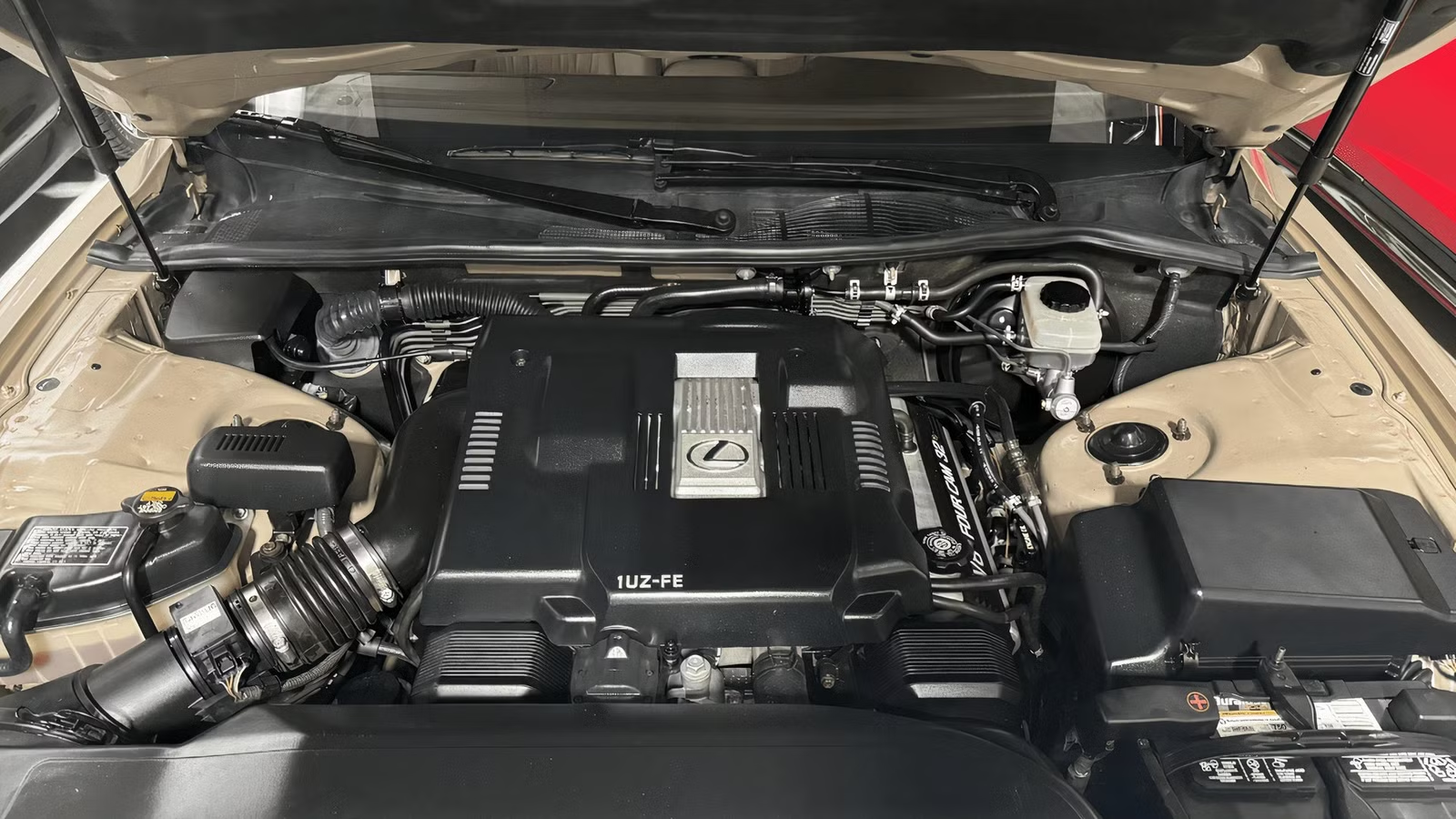
Big factory horsepower has a way of stealing every engine conversation. But the V8s that impress builders years later often started with something less flashy: extra metal where it matters, tight control of the crank, good oiling, and enough breathing room to take abuse the showroom tune never asked for. One Toyota 4.0-liter luxury V8 turned that hidden margin into a cult following.
The Toughest V8 Isn’t Always The One With The Biggest Factory Horsepower

Peak horsepower tells plenty about how fast a car might feel, but it says much less about how much punishment the engine itself can take. A factory can get more power from aggressive cam timing, higher compression, more rpm, freer-flowing heads, boost, or sharper calibration. None of those numbers reveal how much extra load the crank, rods, main bearings, block, and cooling system can absorb. In other words, an engine rated at 450 horsepower from new is not automatically tougher than one rated at 250. Sometimes the lower-output engine simply spends its life farther away from its mechanical limits.
Three things matter more for this particular durability contest. First is longevity: how far the engine can travel before it needs major internal work. Second is refinement: whether that durability comes from a crude, slow-turning lump or from an engine that stays smooth and sophisticated. Third is stock-internal headroom: how much extra cylinder pressure the original crank, rods, pistons, and block can tolerate once enthusiasts start ignoring the owner’s manual.
That puts some famous V8s on the comparison board. GM’s LS family is compact, simple, powerful, and supported by an aftermarket roughly the size of a small nation. Chevrolet itself credits the LS with reshaping modern hot-rodding and swap culture. Ford’s 5.0-liter Coyote takes another route, using four cams, 32 valves, variable cam timing, and excellent high-rpm breathing. BMW’s M62 is an especially useful comparison because it also came from the aluminum luxury-V8 school.

Toyota Engineered In Strength Owners Wouldn’t Need For Decades

Toyota did not develop its first Lexus flagship as a normal new-car program. Work began in 1984 under its Circle-F flagship project, with engineers studying American luxury buyers and chasing goals that often fought each other: quietness without laziness, performance without harshness, and quality without turning the car into a rolling bank vault. The program used roughly 450 vehicle prototypes and covered more than 3.5 million kilometers of testing. Even production methods changed for the car, including a new aluminum-block casting process intended to improve strength. That is a lot of effort for an engine whose main job was supposed to be quietly moving executives between nice restaurants.
The V8 developed for that mission had an unusual résumé for the late 1980s. It used an aluminum block and heads, four camshafts, 32 valves, and a forged-steel crankshaft. The main-bearing structure used six fasteners around each cap: four vertical bolts plus two cross bolts tying the cap into the sides of the block. The construction also included a forged crank with eight balance weights and induction-hardened journals, while early engines became known for substantial sinter-forged connecting rods.

Each piece served a purpose. Cross-bolted mains help keep the crank located when cylinder pressure tries to shove it around. A forged crank provides a strong core as torque rises. Four-valve heads let the engine breathe at higher rpm without giving up the smooth character expected in a luxury car. Most important for future tuners, early versions carried far more bottom-end strength than their original output required. There is another often-cited bonus: the earliest engines have a reputation as non-interference designs, reducing the chance that a broken timing belt immediately turns the valves and pistons into expensive acquaintances.
Toyota’s 1UZ-FE Has Been Pushed Toward 800 HP

The engine is Toyota’s 1UZ-FE, better known in the United States as the original heart of the Lexus LS 400. It arrived with the new luxury sedan in 1989 and displaced 3,968 cc, or roughly 4.0 liters. The all-aluminum V8 used dual overhead cams on each bank and four valves per cylinder for 32 valves total. U.S.-market 1990 LS 400s made 250 hp and 260 lb-ft of torque. Other markets used slightly different ratings. By 1998, VVT-i, revised heads, and other updates had lifted the U.S. LS 400 to 290 hp and 300 lb-ft. Toyota had gained 40 hp without changing the basic displacement.
For tuners, however, the oldest engine is often the more interesting one. Early 1UZ-FEs paired that forged crank with thicker, heavier rods than later versions. Toyota did not need those parts to support 250 hp, but they simply came with the original engineering package. Later development trimmed weight from some reciprocating parts as Toyota refined the design, which makes blanket statements about “stock 1UZ strength” risky. An early engine and a late VVT-i engine may share a badge on the valve cover, but a builder chasing boost should not treat their connecting rods as identical.

That brings up the number that turned the 1UZ into an internet legend: roughly 800 hp on stock or unopened bottom ends. Builds and tuning references have reported early 1UZ-FEs reaching that neighborhood without upgraded rods or pistons, including an SC 400 example cited at about 800 hp with the original bottom end. That is evidence of remarkable headroom, not an official safe limit. There is no magic line at 799 hp where everything smiles and 801 hp where a connecting rod applies for freedom. Fuel quality, boost, rpm, torque delivery, engine condition, injector capacity, charge temperature, and especially detonation control can change the outcome dramatically. Some builders consider much lower figures sensible for long-term street use, particularly with later, lighter rods.

The appeal gets easier to understand once the engine leaves the LS 400. It is relatively compact for a four-cam V8, it has an aluminum block, it breathes well, and for years donor engines came from aging luxury cars that few performance buyers wanted. Add a manual transmission adapter and forced induction, and the quiet sedan engine becomes something else entirely. Builders have put 1UZs into S-chassis drift cars, Lexus IS drift builds, Miatas, old Toyotas, and Volvo 240s. That last combination is wonderfully strange: Swedish brick, Japanese quad-cam V8, rear tires filing for early retirement.
High-power builds show how much extra cylinder pressure the design can tolerate. Matt Farah‘s famous 1996 Lexus LS 400 showed the other side of the same engineering margin. Farah bought the car in 2014 with about 897,000 miles already showing. It eventually crossed 1,000,000 miles in 2019. More impressive than the odometer was the condition of the engine itself. Farah reported that the original 1UZ had never been opened and that even the valve covers appeared never to have been removed when he acquired it. That means the engine had already traveled nearly 900,000 miles before the million-mile experiment really started.
Of course, Farah’s car became famous precisely because seven-digit mileage is extraordinary. The useful evidence comes from the broader pattern below that extreme. Long-running Lexus owner threads contain plenty of cars in the 200,000- to 300,000-mile range, along with reported 400,000- and 500,000-mile examples. One owner reported a 1996 LS 400 crossing 500,000 miles without serious mechanical trouble, while another long-running mileage thread includes multiple cars around or above 300,000. Those reports are anecdotal, but together they show why the million-mile car did not appear from nowhere.
The rival engines make the 1UZ’s position clearer rather than weaker. Ford’s Coyote produces far more power in factory form and brings modern variable cam timing, stronger airflow, and newer fuel-system technology. It also arrived for the 2011 model year, more than two decades after Toyota’s original V8, so it simply has not had the same amount of calendar time to build a history full of 30-year-old, ultra-high-mileage cars. GM’s LS is probably the strongest rival when durability, cheap power, packaging, and modification potential all matter. Its aftermarket is far larger, and its pushrod layout makes swaps easier in many engine bays. BMW‘s aluminum M62 may be the closest match in original mission, but aging M62s have become known for items such as timing-chain guide wear and associated repair work.
The 1UZ’s special trick is the combination. It can behave like a proper luxury engine, rev through four-cam cylinder heads, survive enormous mileage when maintained, and tolerate dramatic power increases in the right version and tune. An LS might be the easier route to 700 hp, and a Coyote might make the better starting point for naturally aspirated horsepower today. An M62, in turn, delivers its own polished European character. But the old Toyota earns attention because it blends qualities that usually belong to different engines. It was designed to disappear behind the refinement of a luxury sedan, yet enthusiasts later discovered a short block that could take the sort of abuse its original owners would have considered deeply impolite.
Toyota’s Aircraft Version Proves How Far The 1UZ’s Design Could Stretch
Toyota and Hamilton Standard developed an aviation engine called the FV2400-2TC around the architecture of Toyota’s Lexus V8. It remained a 4.0-liter V8 but gained twin turbochargers and full-authority digital engine control, or FADEC. Period aviation reports rated it at about 360 hp. The liquid-cooled V8 went through flight testing on aircraft including a Cessna 340 and Piper Malibu, including operation at high altitude.
FlightGlobal reported in January 1997 that Toyota had received FAA production certification for the FV2400-2TC. Aircraft duty asks different questions from a weekend dyno pull—an aero engine may need to hold substantial power for long periods, while failure carries consequences far beyond an embarrassing tow home. The aviation version was heavily adapted, of course, so its certification does not mean an LS 400 engine can be pulled from a junkyard and bolted to a propeller. It does show that engineers considered the basic Lexus V8 architecture worth developing into a serious, certified aircraft powerplant. That is a fairly strong résumé line for an engine born under the hood of a luxury sedan.

That may be the best way to understand the 1UZ-FE. The original LS 400 customer was never supposed to think about six-bolt mains, forged crank journals, rod thickness, turbo sizing, or FAA paperwork. The engine’s job was to start quietly, pull smoothly, and stay out of the conversation. Decades later, that silence became the punch line – tuners found huge stock-bottom-end headroom, and owners piled on hundreds of thousands of miles. Aviation engineers even took the basic V8 family into the sky. Toyota built strength into a 250-hp luxury engine that most first owners would never use.
Source: Toyota, Lexus, FlightGlobal

Related posts




Latest Post


No Comments