
Paul Newman’s Secret Sleeper: The Ford V8 Volvo Wagon Detroit Never Saw Coming
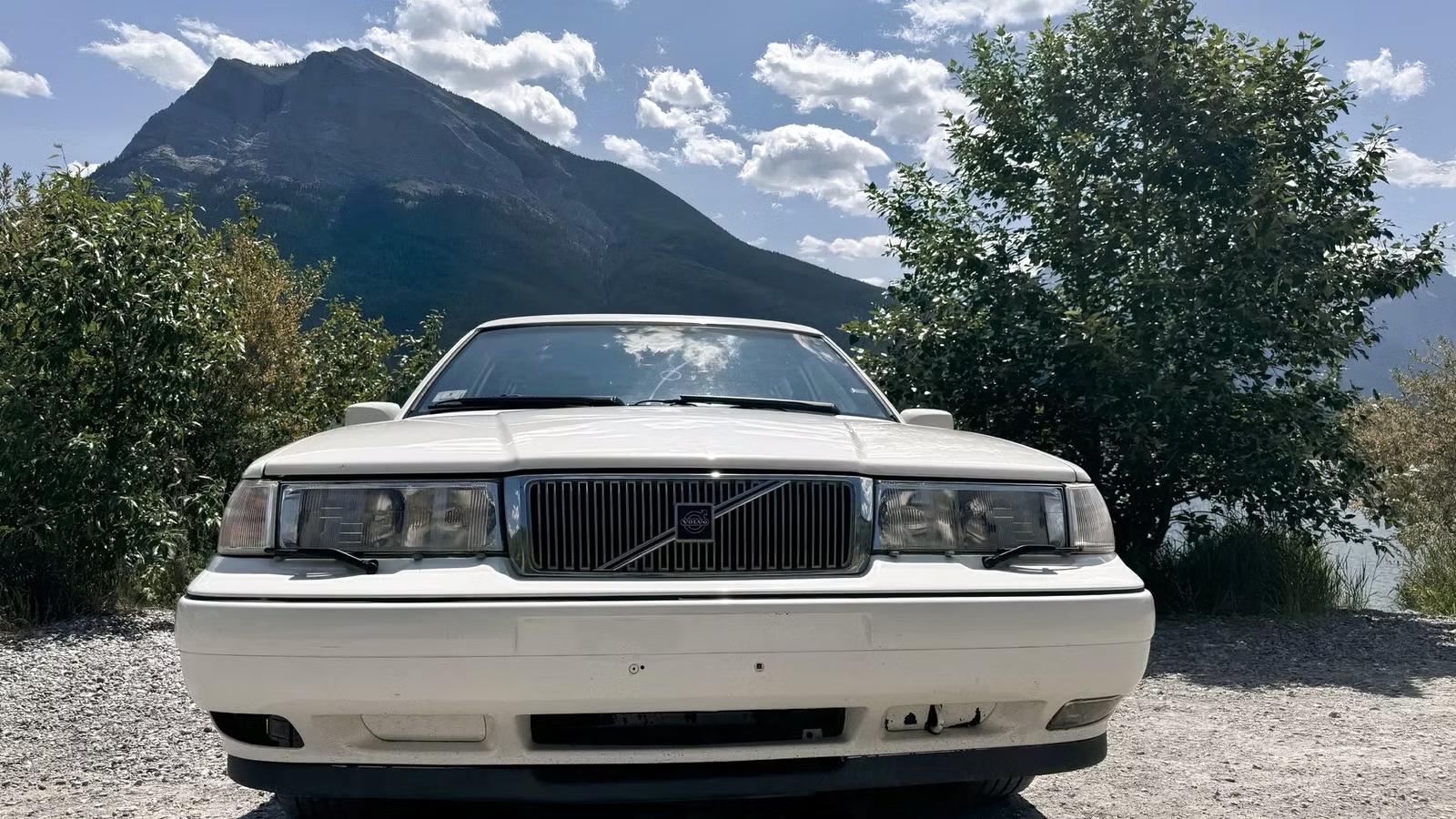
To many, Paul Newman is the badass who starred in Cool Hand Luke and The Hustler, but away from Hollywood, he had another passion: things that go fast. Newman had one of the most enviable sports car, motorbike, truck, wagon, and supercar collections around.

What started as a hobby became a real love, and alongside driving fast cars, he became very handy at getting exceptional custom jobs done on them as well. His Volvo/Ford-V8 custom wagon shows that the most.
Paul Newman Was Serious About Making Volvos Go Faster
Paul Newman’s obsession with quick Volvo wagons is one of the stranger but more entertaining parts of automotive history. It started with a 1988 Volvo 740, which he fitted with a turbocharged 3.8-liter V6 from a Buick Grand National, and it proves why boxy Volvo wagons are so cool. Then came the 1998 Volvo V90, better known as the “Volvette.”

Built by Newman’s racing team as a surprise gift in 2007, it came equipped with a 6.0-liter Chevrolet LS2 V8 with power routed through a four-speed automatic out of a C6 Corvette. Porsche 911 components were also fitted at the front, while the exterior stayed plain and box-like. It looked like a perfectly ordinary Volvo wagon until you put your foot down. It is a nice addition to his collection alongside his ’77 Nissan 200SX, ’74 Porsche 911rs, and Datsun 510.
His Racing Career Shaped The Way He Built Street Cars

A lot of us would like the free rein to turn any street car into a bona fide racer for the fun of it, and Newman’s approach makes a lot more sense when you consider what he was doing on the racetrack. His professional racing career wasn’t some celebrity side project; he competed seriously, winning multiple SCCA National Championships and a later IMSA class win (as part of a team) at Le Mans in 1979, before finishing third overall at the 24 Hours of Daytona in 1995 at the age of 70 . His racing background influenced the way some of his road cars were put together.
It is worth noting that many of the wild builds he had weren’t one-man projects. His racing team and the engineers around him did much of the development. However, Newman brought the enthusiasm, direction, and presumably, plenty of opinion. That is part of what separates some of his collection from a garage full of expensive toys: many of the machines came from race culture.
This Volvo 960 Wagon Got A Ford V8 Under The Hood

Then there is the mid-1990s Volvo 960 Wagon he and his team got a hold of. It started out as one of the more sensible-looking wagons of the 1990s, but ended up being anything but that. The 960 has space, comfort, understated looks, and a B6304F naturally aspirated inline-six under the hood. It also came equipped from the factory with an independent rear suspension, so it was an interesting place to start.
Working with Converse Engineering, which already had experience turning Volvos into performance cars, Newman’s project wasn’t limited to one-off tinkering. Three V8-powered 960s were built, including Newman’s car, one for David Letterman, and another for Newman’s friend Ian Warburg. From the outside, there is nothing that distinguishes it from the anonymous, standard Volvo wagon it was designed to be, but underneath, Converse turned it into a properly engineered sleeper wagon rather than a car with a massive engine wedged in.
The Engine Choice Made The Build Anything But Ordinary

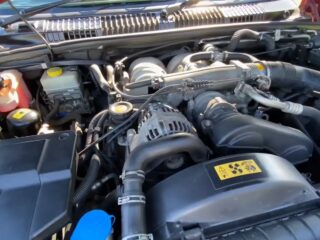
A 5.0-liter Windsor V8 was the starting point. Converse Engineering built the engine around a B303 camshaft and Edelbrock aluminum cylinder heads, and added a Kenne Bell supercharger, with the blower running at relatively modest boost to keep the power delivery usable. The mill was blueprinted and balanced before being put through a dyno, with the fuel and ignition calibration refined to make extra power the wagon base could actually use rather than just trying to get the biggest number down on the sheet. Real race-build thinking.
The 960’s original transmission was ditched for a Ford unit, while custom engine mounts and plenty of fabrication were needed to get the Windsor V8 sitting properly in the engine bay. Once it was all sorted, the custom supercharged V8 was good for around 380 horsepower and ~400 pound-feet of torque. Bear in mind, the original engine in the 960 was good for 201 horsepower and 197 pound-feet of torque.
They Went Further Than A Simple Engine Swap

The beefed-up drivetrain wasn’t just dropped in and left at that. Converse Engineering had to shorten and balance the Volvo driveshaft, then fit a new yoke so it could mate to the Ford transmission. They chose a Ford Mustang T5 five-speed manual, with a Camaro tail housing used to get the shifter to the right place on the 960’s floor. Eventually, they developed an extension to get it to work cleanly across all three of the custom wagons.
Newman reportedly also wanted the 960 Wagon to sit low and handle the extra performance properly, so the suspension also got a proper rethink. The front used IPD/TME lowering springs originally designed for the Volvo 740, along with a larger front sway bar. The rear was a lot more involved because the 960’s original suspension used a transverse leaf spring, so Converse had a custom fiberglass and steel spring made with a higher spring rate and lower ride height; that, plus a bespoke rear sway bar. It looked like a normal wagon, but underneath it had a chassis setup designed for a lot more enthusiasm.
Newman Had A Very Different Kind Of Fast Car

The appeal of sleeper cars is well established; you could be sitting at the lights next to something that looks purpose-built for the racetrack, and then just imagine the frustration of its driver as you pull away from the line.
That was pretty much the point of Newman’s custom 960 Wagon. From the outside, it was still a sensible shape with none of the visual nonsense that comes with 300+ horsepower cars.
It Could Surprise Much Faster Cars On Paper

Car and Driver tested one of these Converse custom jobs. It clocked a rest-to-60 time of 5.9 seconds, a 14.3-second quarter-mile at 100 mph, and a 145-mph top speed. Originally, a 3.0-liter-equipped 960 Wagon had a 0–60 mph time of somewhere near nine seconds. Those numbers aren’t just quick for a Volvo wagon either; the 2026 MX-5 Miata takes 6.1 seconds to reach 60 mph, while the new GR86 takes roughly the same time, the Civic Si needs 6.6 seconds, and the 2026 Mini Cooper JCW takes 5.9 seconds.
Newman’s V8-swapped 960 Wagon also only gained around 100 pounds despite the addition of the Ford small-block V8, so except for presumably worse fuel consumption, there wasn’t much of a penalty to pay for the extra ponies. Throttle response was described as sharp, and the car could spin its stock tires with ease. It wasn’t some wild, barely controllable conversion, but it was much faster than the 960 was designed to be and still holds its own against some of the cheapest fast cars today.
It’s Still A Wagon You Can Drive Every Day

The sleeper approach doesn’t work if the car you modify becomes miserable to live with. The appeal was that the basic Volvo wagon remained intact with a comfortable cabin, a maximum cargo capacity of up to 75 cubic feet, and unassuming manners that make it perfectly believable as everyday transport. Even with the lowered springs and stiffer suspension, it is the kind of build that could be used on the road rather than a stripped-out track special.
According to Classic.com, the average auction price of a 1990s 900 Series is just shy of $11,000. A donor Windsor V8 in near-stock form can cost anything from $2,000 to over $6,000 (depending on condition); for something that has been fitted with turbos and a lot of race spec, it can be tens of thousands. While it would take considerable expertise to get it to the standard of Paul Newman’s Volvo 960 Wagon, there is a lot you can do with these boxy wagons to make them far more interesting, and examples have been built with BMW M50 engine parts, turbos fitted, body kits bolted on, and suspensions reworked. All while keeping them relatively usable for everyday service.
The Modded Volvo 960 Became An Unusual Part Of His Car And Motorbike Collection

Paul Newman’s garage included plenty of serious machinery, from a Mercedes 300SL Gullwing and Porsche 935 to a selection of racing cars. He also had a real passion for motorbikes, and owned a ’67 CZ 250 dirt bike and a ’65 Triumph Bonneville. It was not a collection built around status, and the real connection was vehicles he actually drove, either on or off set, rather than a collection that just spent all its time in the garage.
That’s why the Volvo 960 Wagon with a Windsor V8 fits nicely. It is odd, but it is a legitimate vehicle that could be used for the boring stuff as well as the fun stuff. It wasn’t designed to be exotic, but was developed with the same kind of attention to detail he reportedly brought to his racing. Today, Paul Newman’s 960 Wagon is owned by a private collector, and like the Mustang that Steve McQueen couldn’t buy back, it acts as a meaningful link between the on-screen legend and the gearhead.
Sources: Bring A Trailer, Classic.com, Car and Driver

Related posts


Latest Post


No Comments