
The Nissan 4×4 Everyone Ignored While Toyota’s 4Runner Became Untouchable
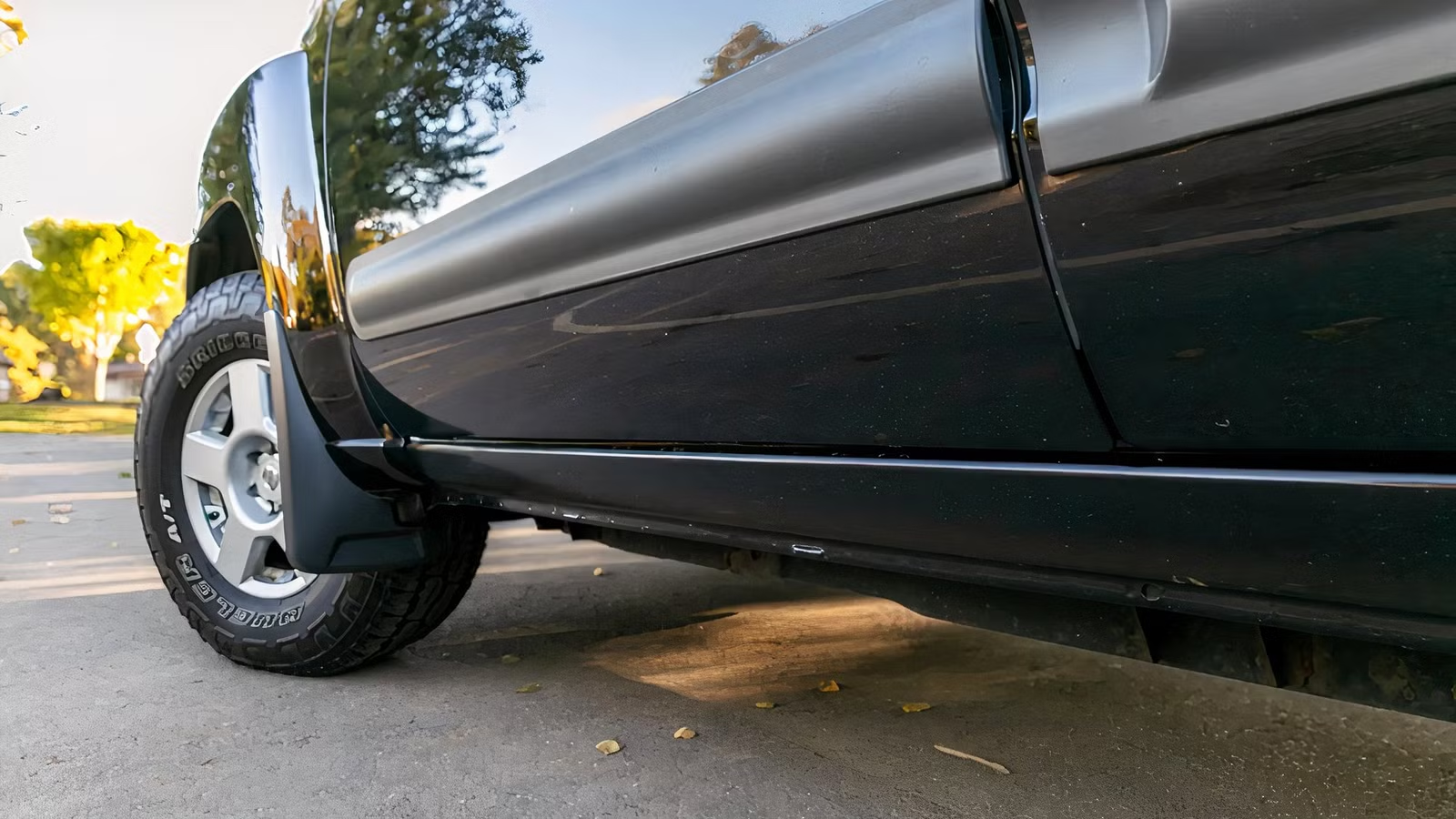
The Toyota 4Runner has spent years becoming the default used SUV for Americans who want body-on-frame toughness and proper four-wheel drive. Predictably, used prices have followed the reputation.

While the 4Runner has hogged all the limelight, though, another Japanese 4×4 spent much of that time hiding in plain sight. It offered similar old-school SUV hardware, a smaller footprint, and serious off-road ability, and weirdly enough, it never earned anything close to the same following.
The 4Runner Tax Changed The Used 4×4 Market
The Toyota 4Runner earned its reputation the old-fashioned way. While the North American SUV market embraced car-based crossovers, Toyota kept selling a body-on-frame 4×4 with low-range four-wheel drive and the sort of rugged construction that appeals to people planning to keep a vehicle for years. For American used SUV shoppers, the 4Runner eventually became the safe answer.

As you’d imagine, that reputation created a predictable side effect. Demand stayed strong, resale values followed, and affordable examples became harder to find. Anyone shopping for a cheap used off-road SUV in the USA now has to decide how much of the budget should go toward Toyota’s reputation before tires, maintenance, or actual off-road trips enter the equation.
In The Shadows

But if you look closer, it becomes evident that Toyota never had this segment completely to itself. Another Japanese body-on-frame SUV offered low range and the same 5,000-pound towing capacity while taking a simpler approach to trail driving. It just never developed the cult-like resale value that now surrounds the 4Runner.
Why is that being brought up now? Well, a used 4Runner remains one of America’s most desirable old-school SUVs, but the folks who just want genuine four-wheel-drive hardware have another option that spent years being overlooked.
Nissan Had A Tougher Rival Than Buyers Remember

On paper, Nissan’s forgotten Toyota 4Runner rival gives away surprisingly little. Its 4.0-liter V6 makes 261 horsepower and 281 lb-ft of torque, while the fifth-generation 4Runner in the direct comparison produces 270 hp and 278 lb-ft. Toyota gets the slight hp advantage, while Nissan offers marginally more torque.
The bigger difference is what those engines have to move. Nissan’s SUV rides on a 106.3-inch wheelbase and weighs roughly 4,438 pounds, while the comparable 4Runner stretches 109.8 inches between the axles and comes in around 4,750 pounds. The Nissan is also around three inches narrower, which becomes considerably more useful once the trail stops resembling an interstate.
Aging Well

That difference shows up in the way the two SUVs behave. A direct comparison found the Nissan quicker off the line and more agile, while the Toyota had a more comfortable and refined everyday experience. Off pavement, both were genuinely capable, but Nissan’s shorter dimensions helped make it easier to place on tight terrain.
The Toyota 4Runner was the better-known all-rounder, and that eventually mattered enormously to used values. Nissan’s alternative offered a more compact, more straightforward formula that suited people interested in off-road ability rather than prestige. That recipe’s aged remarkably well.
The Nissan Xterra Pro-4X Was Built For The Same Job

Needless to say, the SUV in question is the second-gen Nissan Xterra, sold in North America from 2005 through 2015. The trail-focused version started life as the Xterra Off-Road before becoming the Nissan Xterra Pro-4X for 2011, bringing one of Nissan’s most capable SUV packages to a nameplate that never received the recognition of the Toyota 4Runner.
Every second-generation Xterra used Nissan’s 4.0-liter VQ40DE V6, making 261 hp and 281 lb-ft of torque. In Pro-4X form, Nissan added a two-speed Hi/Lo transfer case and an electronically locking rear differential, giving the SUV exactly the sort of hardware used 4×4 buyers now hunt for.
Bilstein off-road shocks were part of the package, along with additional protection underneath. Ground clearance reached 9.5 inches, while the Xterra offered a 33.2-degree approach angle and a 29.4-degree departure angle. That departure figure bettered the comparable 4Runner’s 26 degrees and gave the shorter Nissan an advantage when trails became steep.
A major draw was the price. A 2013 Nissan Xterra Pro-4X started at $29,440 and could tow up to 5,000 pounds. Nissan even offered a six-speed manual transmission, although people choosing certain luxury equipment wound up with the five-speed automatic instead. Apparently there were limits to how much enthusiast indulgence one SUV configurator could tolerate.
Simple Hardware Made The Xterra Better Than It Looked

What makes the used Nissan Xterra Pro-4X well worth considering in 2026 is how straightforward it feels compared with many modern off-road SUVs. Even near the end of production, the cabin featured analog gauges and a fairly basic infotainment setup. The second gen received only one major facelift during its long production run, so a 2015 Xterra still feels closely related to the original 2005 model.
To add to that, its off-road philosophy was equally direct. The Toyota 4Runner could offer more sophisticated electronic traction aids, including Crawl Control in certain versions, while the Nissan relied heavily on low range and its locking rear differential. Hill-descent control was available, but the Xterra largely avoided turning off-roading into a menu-selection exercise.
Obvious Benefits

But don’t mistake that simplicity for being crude where it mattered. A stock 2015 Xterra Pro-4X stayed composed over serious off-road terrain and had useful suspension articulation when the trail got rough. Highway driving was perfectly manageable too, although the five-speed automatic sometimes hunted for fourth gear and wind noise made the SUV’s age pretty obvious.
The Xterra’s size remains one of its strongest advantages for North American buyers who actually leave pavement. A 2011 Pro-4X measures 178.7 inches long while offering up to 65.7 cubic feet of cargo space. It seats five and still fits comfortably on narrower trails, which is increasingly unusual as modern SUVs continue expanding toward small-apartment dimensions.
The Xterra Is Finally Getting Its Second Chance

Used Nissan Xterra prices are where the argument becomes difficult to ignore. A 2011 Xterra Pro-4X currently carries a private-party value of roughly $9,375-$11,050 depending on condition. That puts a genuine body-on-frame 4×4 SUV with low range and a locking rear differential within reach of buyers who may have been priced out of comparable Toyota 4Runners.
Actual Nissan Xterra Pro-4X listings show a wider spread. Higher-mileage examples can still fall below $10,000, while cleaner and later trucks can climb comfortably into the teens. The Xterra shouldn’t be treated as a guaranteed bargain at one specific price, especially as more buyers discover what it offers.
The Icon Or The Bargain?

There are things to watch out for, though, and fuel economy’s the obvious catch. A 2011 Xterra Pro-4X is rated at 15 mpg city and 20 mpg highway, with 17 mpg combined, while a 2013 Pro-4X returned 15.3 mpg in mixed real-world driving. Anyone looking for a fuel-efficient used SUV should probably keep scrolling. The Xterra’s 4.0-liter V6 has many talents, but making gas stations feel optional isn’t among them.
That said, the obvious takeaway is that for American buyers searching for an affordable Toyota 4Runner alternative, the second-gen Nissan Xterra Pro-4X makes far more sense today than its forgotten status suggests. It offers proper four-wheel-drive hardware in a smaller package, and used prices can still leave money for repairs, tires, and the places a 4×4 was built to reach. All in, would you rather the icon or the better bargain?
Sources: Nissan, Kelley Blue Book.

Related posts


Latest Post


No Comments